
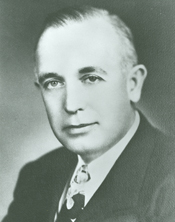
Historical · U.S. House · Oklahoma · District 8
George Wilson
Former U.S. Representative · Oklahoma District 8 · 1949–1951 · Democratic
George Wilson represented Oklahoma's District 8 in the United States House of Representatives (1949–1951) for the Democratic party. The page below collects sourced biographical facts, term history, committee roles, and provenance for Wilson.
Bioguide ID: W000582
Key facts
- Full name
- George Wilson
- State
- Oklahoma
- District
- District 8
- Party
- Democratic
- House service
- 1949–1951
- First House term
- 1949
- Status
- Left office
- Current term ends
- —
- Born
- 1905
- Bioguide ID
- W000582
- Committee assignments
- —
- Dataset version
- 1.20260605
Biographical narrative
882 words · sourced from the Wikipedia REST extract
George Wilson was an American attorney, military officer, and politician who served as a U.S. Representative for Oklahoma's 8th congressional district from 1949 to 1951. A member of the Democratic Party, Wilson's congressional career was preceded by a diverse professional background that included roles in law enforcement and the judiciary. After his term in Congress, he continued to contribute to the legal field as a judge in Oklahoma, where he held various judicial positions until his retirement.
Early life and career
George Howard Wilson was born on August 21, 1905, in Mattoon, Illinois. In 1910, when he was five years old, his family relocated to Enid, Oklahoma. Wilson attended the local public schools, where he completed his primary and secondary education. He pursued higher education at Phillips University, graduating in 1926. Following his undergraduate studies, he attended the University of Michigan Law School for a brief period in 1926 and 1927, before transferring to the University of Oklahoma, where he earned his law degree in 1929. He was admitted to the Oklahoma bar in 1928 and subsequently joined his father's law practice in Enid.
Wilson's early career included a role as a deputy district court clerk in Garfield County, Oklahoma, in 1928. He later became a special agent for the Federal Bureau of Investigation (FBI), serving from 1934 to 1938. After his tenure with the FBI, he returned to Enid, where he served as the city attorney from 1939 until 1942. His legal career laid a foundation for his later political aspirations.
During World War II, Wilson served in the United States Army, where he achieved the rank of Colonel within the Judge Advocate General's Department. His military service took him overseas to the South Atlantic Theater of Operations from 1942 to 1946, where he was involved in legal matters pertaining to military law.
House tenure
Wilson's political career began in earnest when he was elected as a Democrat to the 81st Congress, serving from January 3, 1949, to January 3, 1951. His election marked his first and only term in the U.S. House of Representatives. During his time in Congress, Wilson was a member of the Committee on Interstate and Foreign Commerce, where he participated in discussions and decisions regarding various legislative matters related to commerce and public health.
As part of his committee work, Wilson was involved in the Subcommittee on Public Health, Science, and Commerce. This subcommittee was tasked with considering legislation aimed at establishing a national health program, reflecting the growing concern for public health issues in post-war America. In 1950, he embarked on a tour of western Europe with his colleagues to investigate health systems and policies abroad, which informed their legislative efforts back home.
Despite his contributions during his term, Wilson faced challenges in securing re-election. In 1950, he ran for a seat in the 82nd Congress but was unsuccessful in his bid. Following his departure from Congress, Wilson transitioned back into the legal field, where he continued to make significant contributions to the judiciary in Oklahoma.
Legislative focus and committees
During his time in the House of Representatives, Wilson's legislative focus was primarily on issues related to health and commerce. His involvement in the Committee on Interstate and Foreign Commerce placed him at the center of discussions about the regulation of interstate commerce, which is a critical aspect of federal legislative authority. The subcommittee on which he served, the Subcommittee on Public Health, Science, and Commerce, was particularly relevant during a period when the United States was grappling with the implications of health care access and public health policy.
Wilson's efforts in Congress were characterized by a commitment to improving health services and addressing the needs of his constituents in Oklahoma. His participation in the tour of western Europe allowed him to gain insights into different health care systems, which he could then bring back to inform legislative proposals in the United States. This experience was part of a broader trend in which lawmakers sought to learn from international models to enhance domestic policy.
After his congressional tenure, Wilson's career continued to evolve as he took on various roles in the legal system. He directed the Oklahoma State Crime Bureau in 1951, further solidifying his commitment to public service and law enforcement. His legal expertise and experience eventually led him to the Oklahoma Supreme Court, where he served as a justice from 1952 until 1968. He also held the position of Chief Judge of State Administrative Zone No. 1 in 1967 and later served as a district judge and Chief Judge of Division No. 1 in Judicial District No. 4.
Throughout his career, Wilson's contributions to the legal and judicial systems in Oklahoma were recognized, and he served as President of the Oklahoma Judicial Conference in 1968. His extensive experience in both the legislative and judicial branches of government reflects a dedication to public service that spanned several decades.
Wilson's personal life included his marriage to Myrna Kathryn Reams in 1929, with whom he had four children. He spent much of his life in Enid, Oklahoma, where he remained active in the community until his death on July 16, 1985. He was interred in Memorial Park Cemetery, leaving behind a legacy of public service that encompassed law, military service, and legislative work.
Notable legislation
Sponsored and co-sponsored legislation for George Wilson is pending operator curation. The biographical narrative above carries the same provenance trail until per-bill rows are written.
Sources
- [1]https://en.wikipedia.org/wiki/George_H._WilsonWikipedia · retrieved 2026-06-05
Notable quotes
Sourced quotes for George Wilson are pending operator curation. Narrative-scope provenance remains attached below.
Sources
- [1]https://en.wikipedia.org/wiki/George_H._WilsonWikipedia · retrieved 2026-06-05
Key positions
Curated policy positions for George Wilson are pending operator review. The biographical narrative above carries the same provenance trail until per-topic positions are written.
Sources
- [1]https://en.wikipedia.org/wiki/George_H._WilsonWikipedia · retrieved 2026-06-05
Terms served
- 1949–1951U.S. House · Term 1 · Democratic
Sources & provenance
Every attributable claim above carries a per-section [N] marker that resolves to the corresponding URL below. Each entry records the upstream provider, the canonical URL, and the timestamp at which the source was retrieved by the ingest pipeline.
Key facts
- https://bioguide.congress.gov/search/bio/W000582bioguide · retrieved 2026-06-05
- https://www.govtrack.us/congress/members/411737govtrack · retrieved 2026-06-05
Biographical narrative
- https://en.wikipedia.org/wiki/George_H._Wilsonwikipedia · retrieved 2026-06-05
Find your representative
Every U.S. state elects representatives by district. Browse Oklahoma’s delegation, the full former-representative roster, or explore the role and term length.
Related on The Candidate
- Preceded by Ross RizleyEarlier holder of the Oklahoma District 8 House seat · Republican.Open
- Bird McGuireFormer U.S. Representative · Oklahoma District 1 · RepublicanOpen
- Charles O’ConnorFormer U.S. Representative · Oklahoma District 1 · RepublicanOpen
- Dixie GilmerFormer U.S. Representative · Oklahoma District 1 · DemocraticOpen
- Everette HowardFormer U.S. Representative · Oklahoma District 1 · DemocraticOpen
- Democratic PartyFederal candidates and office holders on the Democratic line.Open