
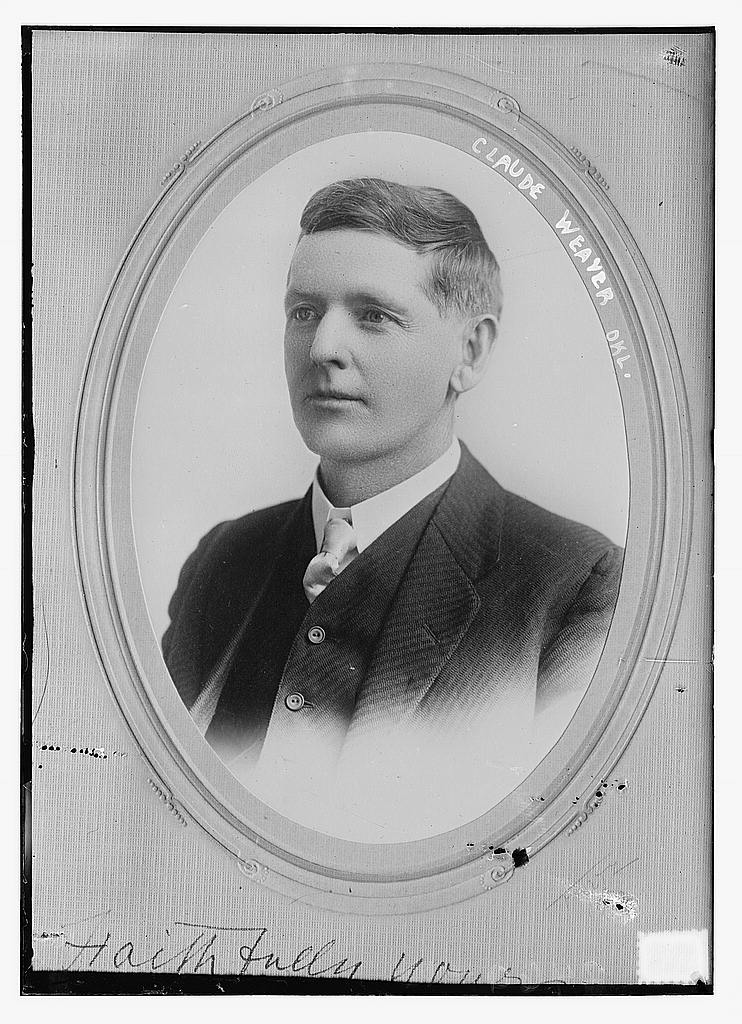
Historical · U.S. House · Oklahoma · At-Large
Claude Weaver
Former U.S. Representative · Oklahoma At-Large · 1913–1915 · Democratic
Claude Weaver represented Oklahoma's At-Large in the United States House of Representatives (1913–1915) for the Democratic party. The page below collects sourced biographical facts, term history, committee roles, and provenance for Weaver.
Bioguide ID: W000224
Key facts
- Full name
- Claude Weaver
- State
- Oklahoma
- District
- At-Large
- Party
- Democratic
- House service
- 1913–1915
- First House term
- 1913
- Status
- Left office
- Current term ends
- —
- Born
- 1867
- Bioguide ID
- W000224
- Committee assignments
- —
- Dataset version
- 1.20260606
Biographical narrative
986 words · sourced from the Wikipedia REST extract
Claude Weaver was an American politician and lawyer who served as a U.S. Representative for Oklahoma's at-large congressional district. A member of the Democratic Party, Weaver's congressional tenure spanned from 1913 to 1915. Born in Texas in 1867, he had a diverse career that included roles as a judge and a legal adviser to the governor of Oklahoma. His professional journey reflected the evolving landscape of American politics during the early 20th century, particularly in the context of the newly established state of Oklahoma.
Early life and career
Claude Weaver was born on March 19, 1867, in Gainesville, Texas, to W. T. G. Weaver and Nancy Wilkin Fletcher Weaver. Growing up in a family that valued education, he attended public schools in his hometown. His academic pursuits led him to the University of Texas at Austin, where he graduated from the law department in 1887. After completing his education, Weaver was admitted to the bar the same year, marking the beginning of his legal career.
Weaver began practicing law in Gainesville, Texas, where he established himself in the legal community. His early career included a notable position as the assistant prosecuting attorney for Cooke County, Texas, in 1892. This role provided him with valuable experience in the legal system and public service. In 1895, seeking new opportunities, he moved to Pauls Valley in the Indian Territory, where he continued his law practice. The Indian Territory, which would later become part of Oklahoma, was a region undergoing significant changes during this period, and Weaver's move reflected the westward expansion and development of the United States.
In 1910, Weaver relocated to Oklahoma City, Oklahoma, where he resumed his legal practice. His involvement in local governance began that same year when he served as a member of the Oklahoma City Board of Freeholders. This board was responsible for drafting a new city charter, an essential task in the context of Oklahoma's transition from territory to statehood. Weaver's engagement in local governance illustrated his commitment to public service and his interest in shaping the legal and political framework of his community.
House tenure
Claude Weaver's political career reached a significant milestone when he was elected as a Democrat to the Sixty-third Congress, which convened in March 1913. His term in the U.S. House of Representatives lasted until March 3, 1915. During this period, he represented Oklahoma's at-large congressional district, a position that required him to address the diverse needs and interests of constituents across the state.
Weaver's time in Congress occurred during a transformative era in American politics, characterized by progressive reforms and significant social change. As a member of the House, he participated in discussions and debates on various issues that were pertinent to his constituents and the nation as a whole. However, his congressional career was relatively brief, as he was not successful in his bid for renomination in 1914. Additionally, he sought election to fill a vacancy in the Sixty-sixth Congress in 1919 but was also unsuccessful in that endeavor. These electoral challenges marked the end of his formal legislative career, but they did not diminish his involvement in public service.
Following his congressional tenure, Weaver continued to contribute to his community and the state of Oklahoma. In 1915, he was appointed as the Postmaster of Oklahoma City, a position he held until 1923. This role allowed him to remain engaged with the public and to influence local affairs through the postal service, which was a vital institution in the early 20th century.
Legislative focus and committees
During his time in the U.S. House of Representatives, Claude Weaver's legislative focus aligned with the broader goals of the Democratic Party and the progressive movement of the time. While specific details about the bills he sponsored or the committees he served on are not provided, it can be inferred that his background as a lawyer and his experience in local governance informed his legislative priorities. Issues such as infrastructure development, education, and social welfare were likely of interest to him, given the context of Oklahoma's growth and the needs of its residents during the early 1900s.
Weaver's legal expertise would have been an asset in navigating the complexities of federal legislation and advocating for the interests of his constituents. The early 20th century was a time when many states were grappling with the implications of industrialization, urbanization, and the demands of a changing economy. As a representative from Oklahoma, Weaver would have been particularly attuned to the unique challenges faced by a state that was still establishing its identity and infrastructure.
After leaving Congress, Weaver's career continued to evolve. In 1926, he served as the acting county attorney for Oklahoma County, further solidifying his role in the legal and political landscape of the region. His legal acumen was recognized when he became the legal adviser and secretary to Governor William H. Murray from 1931 to 1934. This position allowed him to influence state policy and governance during a critical period in Oklahoma's history, particularly as the state navigated the challenges of the Great Depression.
In 1934 and 1935, Weaver served as a district judge for the thirteenth district of Oklahoma. This role marked a significant return to the judiciary, where he could apply his legal knowledge and experience to the judicial system. His tenure as a judge contributed to the administration of justice in Oklahoma and reflected his ongoing commitment to public service.
Claude Weaver passed away on May 19, 1954, in Oklahoma City, Oklahoma, at the age of 87. His contributions to the legal and political landscape of Oklahoma, as well as his service in the U.S. House of Representatives, left a lasting impact on the state. He is interred at Fairlawn Cemetery in Oklahoma City, where his legacy continues to be remembered. Through his various roles, Weaver exemplified the dedication to public service that characterized many of his contemporaries in the early 20th century.
Notable legislation
Sponsored and co-sponsored legislation for Claude Weaver is pending operator curation. The biographical narrative above carries the same provenance trail until per-bill rows are written.
Sources
- [1]https://en.wikipedia.org/wiki/Claude_WeaverWikipedia · retrieved 2026-06-06
Notable quotes
Sourced quotes for Claude Weaver are pending operator curation. Narrative-scope provenance remains attached below.
Sources
- [1]https://en.wikipedia.org/wiki/Claude_WeaverWikipedia · retrieved 2026-06-06
Key positions
Curated policy positions for Claude Weaver are pending operator review. The biographical narrative above carries the same provenance trail until per-topic positions are written.
Sources
- [1]https://en.wikipedia.org/wiki/Claude_WeaverWikipedia · retrieved 2026-06-06
Terms served
- 1913–1915U.S. House · Term 1 · Democratic
Sources & provenance
Every attributable claim above carries a per-section [N] marker that resolves to the corresponding URL below. Each entry records the upstream provider, the canonical URL, and the timestamp at which the source was retrieved by the ingest pipeline.
Key facts
- https://bioguide.congress.gov/search/bio/W000224bioguide · retrieved 2026-06-06
- https://www.govtrack.us/congress/members/411392govtrack · retrieved 2026-06-06
Biographical narrative
- https://en.wikipedia.org/wiki/Claude_Weaverwikipedia · retrieved 2026-06-06
Find your representative
Every U.S. state elects representatives by district. Browse Oklahoma’s delegation, the full former-representative roster, or explore the role and term length.
Related on The Candidate
- Preceded by Dennis FlynnEarlier holder of the Oklahoma At-Large House seat · Republican.Open
- Succeeded by Will RogersLater holder of the Oklahoma At-Large House seat · Democratic.Open
- Bird McGuireFormer U.S. Representative · Oklahoma District 1 · RepublicanOpen
- Charles O’ConnorFormer U.S. Representative · Oklahoma District 1 · RepublicanOpen
- Dixie GilmerFormer U.S. Representative · Oklahoma District 1 · DemocraticOpen
- Everette HowardFormer U.S. Representative · Oklahoma District 1 · DemocraticOpen