
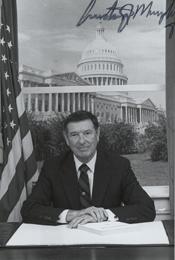
Historical · U.S. House · Pennsylvania · District 20
Austin Murphy
Former U.S. Representative · Pennsylvania District 20 · 1977–1995 · Democratic
Austin Murphy represented Pennsylvania's District 20 in the United States House of Representatives (1977–1995) for the Democratic party. The page below collects sourced biographical facts, term history, committee roles, and provenance for Murphy.
Bioguide ID: M001088
Key facts
- Full name
- Austin Murphy
- State
- Pennsylvania
- District
- District 20
- Party
- Democratic
- House service
- 1977–1995
- First House term
- 1977
- Status
- Left office
- Current term ends
- —
- Born
- 1927
- Bioguide ID
- M001088
- Committee assignments
- —
- Dataset version
- 1.20260605
Biographical narrative
839 words · sourced from the Wikipedia REST extract
Austin J. Murphy was an American politician who served as a U.S. Representative for Pennsylvania's 20th congressional district. A member of the Democratic Party, Murphy's political career spanned several decades, during which he held various elected positions at both the state and federal levels. He was known for his long tenure in the U.S. House of Representatives, where he served for nine terms from 1977 until 1995. His career was marked by significant legislative contributions, as well as controversies that ultimately influenced his decision not to seek reelection.
Early life and career
Austin J. Murphy was born on June 17, 1927, in North Charleroi, Pennsylvania. He was the son of Austin John Murphy Sr. and Evelyn F. Spence. His early years were spent in New London, Connecticut, before he returned to Pennsylvania. Following his high school education, Murphy served in the United States Marine Corps from 1944 to 1946, a period that coincided with the closing years of World War II. After his military service, he pursued higher education, earning a Bachelor of Arts degree from Duquesne University in 1949. He continued his studies at the University of Pittsburgh, where he obtained a Bachelor of Laws degree in 1952. Murphy was admitted to the Pennsylvania bar in 1953, subsequently practicing law in Washington, Pennsylvania.
Murphy's initial foray into politics began in the late 1950s when he was elected to the Pennsylvania House of Representatives. He served in this capacity from 1959 until 1968, representing Washington County. Following his tenure in the House, he returned to the Pennsylvania House of Representatives for District 48 from 1969 to 1970. His political career progressed as he was elected to the Pennsylvania Senate, where he represented District 46 from 1971 until 1977. Murphy's experience in state government laid the groundwork for his later election to the U.S. Congress.
In 1976, Murphy successfully ran for the U.S. House of Representatives, replacing longtime incumbent Thomas E. Morgan. His election marked the beginning of a significant period of service in the federal legislature, where he would go on to serve for nearly two decades.
House tenure
Austin Murphy's tenure in the U.S. House of Representatives began in 1977 and continued until 1995. Over the course of his nine terms, he became involved in various legislative initiatives and served on multiple committees. His long service in the House was characterized by his commitment to representing the interests of his constituents in Pennsylvania's 20th congressional district. During his time in office, Murphy participated in numerous debates and discussions on a wide range of issues, reflecting the priorities and concerns of his district.
Murphy was a delegate to the Democratic National Convention in both 1984 and 1988, further solidifying his role within the Democratic Party and contributing to national party strategies. His involvement in these conventions indicated his active participation in shaping party policies and platforms during a transformative period in American politics.
Despite his long-standing service, Murphy's career was not without controversy. In December 1987, he faced reprimand from the 100th United States Congress for engaging in ghost voting and misusing House funds. This incident involved the diversion of government resources to his former law firm and the presence of a ghost employee on his payroll. The repercussions of this scandal ultimately influenced his decision not to seek reelection in 1994, marking a significant turning point in his political career.
Legislative focus and committees
Throughout his time in the House, Austin Murphy focused on a variety of legislative issues that were pertinent to his constituents and aligned with the Democratic Party's broader goals. His legislative priorities included areas such as healthcare, education, and infrastructure, reflecting the needs of the communities he represented. Murphy's experience in state politics likely informed his approach to federal legislation, as he sought to address both local and national concerns.
In addition to his legislative work, Murphy served on various committees during his time in the House. These committees played a crucial role in shaping policy and overseeing government functions. His participation in committee work allowed him to engage more deeply with specific issues and contribute to the development of legislation that would impact his district and the nation.
Despite the challenges he faced, including the aforementioned reprimand and subsequent controversies, Murphy's long tenure in the House is indicative of his ability to navigate the complexities of political life. His experience in both state and federal government provided him with a unique perspective on the legislative process and the importance of constituent representation.
Austin J. Murphy's political career came to an end when he chose not to seek reelection in 1994. He continued to be involved in public life and civic activities following his departure from Congress. Murphy passed away on April 13, 2024, at the age of 96, leaving behind a legacy that reflects both his contributions to Pennsylvania politics and the challenges he faced during his time in office. He was interred at Howe Cemetery in Long Branch, Pennsylvania, marking the conclusion of a life dedicated to public service.
Notable legislation
Sponsored and co-sponsored legislation for Austin Murphy is pending operator curation. The biographical narrative above carries the same provenance trail until per-bill rows are written.
Sources
- [1]https://en.wikipedia.org/wiki/Austin_MurphyWikipedia · retrieved 2026-06-05
Notable quotes
Sourced quotes for Austin Murphy are pending operator curation. Narrative-scope provenance remains attached below.
Sources
- [1]https://en.wikipedia.org/wiki/Austin_MurphyWikipedia · retrieved 2026-06-05
Key positions
Curated policy positions for Austin Murphy are pending operator review. The biographical narrative above carries the same provenance trail until per-topic positions are written.
Sources
- [1]https://en.wikipedia.org/wiki/Austin_MurphyWikipedia · retrieved 2026-06-05
Terms served
- 1977–1979U.S. House · Term 1 · Democratic
- 1979–1981U.S. House · Term 2 · Democratic
- 1981–1983U.S. House · Term 3 · Democratic
- 1983–1985U.S. House · Term 4 · Democratic
- 1985–1987U.S. House · Term 5 · Democratic
- 1987–1989U.S. House · Term 6 · Democratic
- 1989–1991U.S. House · Term 7 · Democratic
- 1991–1993U.S. House · Term 8 · Democratic
- 1993–1995U.S. House · Term 9 · Democratic
Sources & provenance
Every attributable claim above carries a per-section [N] marker that resolves to the corresponding URL below. Each entry records the upstream provider, the canonical URL, and the timestamp at which the source was retrieved by the ingest pipeline.
Key facts
- https://bioguide.congress.gov/search/bio/M001088bioguide · retrieved 2026-06-05
- https://www.govtrack.us/congress/members/408052govtrack · retrieved 2026-06-05
Biographical narrative
- https://en.wikipedia.org/wiki/Austin_Murphywikipedia · retrieved 2026-06-05
Find your representative
Every U.S. state elects representatives by district. Browse Pennsylvania’s delegation, the full former-representative roster, or explore the role and term length.
Related on The Candidate
- Preceded by Elmer HollandEarlier holder of the Pennsylvania District 20 House seat · Democratic.Open
- Succeeded by Frank MascaraLater holder of the Pennsylvania District 20 House seat · Democratic.Open
- Adam SeybertFormer U.S. Representative · Pennsylvania District 1 · RepublicanOpen
- Benjamin SayFormer U.S. Representative · Pennsylvania District 1 · RepublicanOpen
- Chapman FreemanFormer U.S. Representative · Pennsylvania District 1 · RepublicanOpen
- Harry RansleyFormer U.S. Representative · Pennsylvania District 1 · RepublicanOpen