
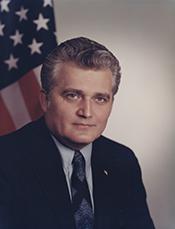
Historical · U.S. House · Pennsylvania · District 20
Joseph Gaydos
Former U.S. Representative · Pennsylvania District 20 · 1967–1993 · Democratic
Joseph Gaydos represented Pennsylvania's District 20 in the United States House of Representatives (1967–1993) for the Democratic party. The page below collects sourced biographical facts, term history, committee roles, and provenance for Gaydos.
Bioguide ID: G000105
Key facts
- Full name
- Joseph Gaydos
- State
- Pennsylvania
- District
- District 20
- Party
- Democratic
- House service
- 1967–1993
- First House term
- 1967
- Status
- Left office
- Current term ends
- —
- Born
- 1926
- Bioguide ID
- G000105
- Committee assignments
- —
- Dataset version
- 1.20260605
Biographical narrative
952 words · sourced from the Wikipedia REST extract
Joseph M. Gaydos was an American lawyer and politician who served as a Democratic member of the U.S. House of Representatives for Pennsylvania's 20th congressional district. His tenure in Congress spanned from 1968 until 1993, during which he became known for his advocacy of workers' rights and his commitment to the domestic steel industry. Gaydos was notable for being the first Slovak American to serve in the United States Congress, reflecting the diverse heritage of the American political landscape.
Early life and career
Joseph M. Gaydos was born on July 3, 1926, in Braddock, Pennsylvania, to parents John and Elona Magella Gaydos, who were immigrants from Slovakia. Growing up in a family with Slovak roots, Gaydos was influenced by the values of hard work and community service. He pursued higher education at Duquesne University before transferring to the University of Notre Dame Law School, where he earned his law degree in 1951. This educational background laid the foundation for his future career in law and politics.
Before entering the political arena, Gaydos served in the United States Navy Reserve during World War II, participating in the Pacific theater from 1944 to 1946. His military service not only shaped his character but also instilled in him a sense of duty to his country and community. After returning from the war, he began his legal career, which included roles such as Deputy Attorney General of Pennsylvania and Assistant Solicitor of Allegheny County. He also served as general counsel for the United Mine Workers of America, district five, where he gained valuable experience in labor relations and advocacy for workers' rights.
Gaydos's political career began in earnest when he was elected to the Pennsylvania State Senate, where he served from 1967 to 1968. His time in the state legislature provided him with insights into the legislative process and the needs of his constituents, preparing him for his subsequent election to the U.S. Congress.
House tenure
Joseph M. Gaydos was elected to the U.S. House of Representatives in 1968, filling a vacancy caused by the death of Representative Elmer Holland. He was elected simultaneously to both the 90th and 91st Congresses, marking the beginning of a significant political career that would last for 13 terms. Throughout his time in Congress, Gaydos was a steadfast member of the Democratic Party, aligning himself with the party's values and priorities.
During his congressional tenure, Gaydos focused on a variety of issues, but he was particularly known for his commitment to labor rights and the steel industry. His advocacy for workers' rights was a defining feature of his legislative career, as he sought to enhance protections for employees and improve working conditions. He championed initiatives aimed at strengthening labor laws, which included provisions for health and pension benefits as well as job safety protections.
Gaydos's dedication to the preservation of the domestic steel industry was also a significant aspect of his work in Congress. He recognized the importance of this industry to the economy of Pennsylvania and the nation as a whole. His efforts were aimed at ensuring that American steelworkers had the support they needed to compete in a changing economic landscape, particularly in the face of increasing foreign competition.
Throughout his time in the House, Gaydos was involved in various legislative initiatives and discussions that shaped the future of labor relations in the United States. His experience as a lawyer and his background in labor advocacy informed his approach to policymaking, allowing him to effectively represent the interests of his constituents and the working class.
Despite his long and impactful career, Gaydos chose not to seek renomination in 1992, concluding his service in Congress on January 3, 1993. His decision marked the end of an era for his constituents, who had come to rely on his leadership and advocacy.
Legislative focus and committees
During his time in the U.S. House of Representatives, Joseph M. Gaydos served on several committees that were instrumental in shaping legislation related to labor, industry, and economic policy. His committee assignments allowed him to influence a wide range of issues, particularly those that aligned with his focus on workers' rights and the steel industry.
Gaydos's legislative focus was characterized by a commitment to enhancing the welfare of American workers. He was a strong advocate for organized labor, recognizing the vital role that unions played in protecting workers' rights and negotiating fair wages and benefits. His efforts included supporting legislation that aimed to improve job safety standards and expand access to health care and retirement benefits for employees.
In addition to his work on labor issues, Gaydos was involved in discussions surrounding economic policies that affected the steel industry. He understood the challenges faced by steelworkers and the broader implications of a declining domestic steel market. His advocacy for the industry was rooted in a belief that a strong manufacturing base was essential for the economic health of Pennsylvania and the United States.
Throughout his congressional career, Gaydos maintained a focus on the needs of his constituents, particularly those in the working class. His legislative efforts were guided by a desire to create a fair and equitable environment for all workers, ensuring that their rights were protected and their voices heard in the halls of Congress.
After concluding his congressional tenure, Joseph M. Gaydos continued to be recognized for his contributions to public service and advocacy for labor rights. He passed away on February 7, 2015, at the age of 88, leaving behind a legacy of commitment to the working class and the values of the Democratic Party. His career serves as a testament to the impact that dedicated public servants can have on their communities and the nation as a whole.
Notable legislation
Sponsored and co-sponsored legislation for Joseph Gaydos is pending operator curation. The biographical narrative above carries the same provenance trail until per-bill rows are written.
Sources
- [1]https://en.wikipedia.org/wiki/Joseph_M._GaydosWikipedia · retrieved 2026-06-05
Notable quotes
Sourced quotes for Joseph Gaydos are pending operator curation. Narrative-scope provenance remains attached below.
Sources
- [1]https://en.wikipedia.org/wiki/Joseph_M._GaydosWikipedia · retrieved 2026-06-05
Key positions
Curated policy positions for Joseph Gaydos are pending operator review. The biographical narrative above carries the same provenance trail until per-topic positions are written.
Sources
- [1]https://en.wikipedia.org/wiki/Joseph_M._GaydosWikipedia · retrieved 2026-06-05
Terms served
- 1967–1969U.S. House · Term 1 · Democratic
- 1969–1971U.S. House · Term 2 · Democratic
- 1971–1973U.S. House · Term 3 · Democratic
- 1973–1975U.S. House · Term 4 · Democratic
- 1975–1977U.S. House · Term 5 · Democratic
- 1977–1979U.S. House · Term 6 · Democratic
- 1979–1981U.S. House · Term 7 · Democratic
- 1981–1983U.S. House · Term 8 · Democratic
- 1983–1985U.S. House · Term 9 · Democratic
- 1985–1987U.S. House · Term 10 · Democratic
- 1987–1989U.S. House · Term 11 · Democratic
- 1989–1991U.S. House · Term 12 · Democratic
- 1991–1993U.S. House · Term 13 · Democratic
Sources & provenance
Every attributable claim above carries a per-section [N] marker that resolves to the corresponding URL below. Each entry records the upstream provider, the canonical URL, and the timestamp at which the source was retrieved by the ingest pipeline.
Key facts
- https://bioguide.congress.gov/search/bio/G000105bioguide · retrieved 2026-06-05
- https://www.govtrack.us/congress/members/404477govtrack · retrieved 2026-06-05
Biographical narrative
- https://en.wikipedia.org/wiki/Joseph_M._Gaydoswikipedia · retrieved 2026-06-05
Find your representative
Every U.S. state elects representatives by district. Browse Pennsylvania’s delegation, the full former-representative roster, or explore the role and term length.
Related on The Candidate
- Preceded by James Van ZandtEarlier holder of the Pennsylvania District 20 House seat · Republican.Open
- Succeeded by Frank MascaraLater holder of the Pennsylvania District 20 House seat · Democratic.Open
- Adam SeybertFormer U.S. Representative · Pennsylvania District 1 · RepublicanOpen
- Benjamin SayFormer U.S. Representative · Pennsylvania District 1 · RepublicanOpen
- Chapman FreemanFormer U.S. Representative · Pennsylvania District 1 · RepublicanOpen
- Harry RansleyFormer U.S. Representative · Pennsylvania District 1 · RepublicanOpen