
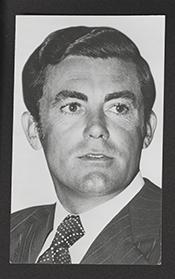
Historical · U.S. House · Pennsylvania · District 3
William Green
Former U.S. Representative · Pennsylvania District 3 · 1964–1977 · Democratic
William Green represented Pennsylvania's District 3 in the United States House of Representatives (1964–1977) for the Democratic party. The page below collects sourced biographical facts, term history, committee roles, and provenance for Green.
Bioguide ID: G000420
Key facts
- Full name
- William Green
- State
- Pennsylvania
- District
- District 3
- Party
- Democratic
- House service
- 1964–1977
- First House term
- 1964
- Status
- Left office
- Current term ends
- —
- Born
- 1938
- Bioguide ID
- G000420
- Committee assignments
- —
- Dataset version
- 1.20260605
Biographical narrative
896 words · sourced from the Wikipedia REST extract
William J. Green is a former American politician who served as a U.S. Representative for Pennsylvania's 3rd congressional district from 1964 to 1977. A member of the Democratic Party, Green was notable for being the youngest person ever elected to Congress from Pennsylvania, achieving this milestone at the age of 25. Following his congressional tenure, he served as the 94th mayor of Philadelphia from 1980 to 1984. Green's political career was marked by his involvement in significant legislative initiatives during the 1960s and 1970s, as well as his subsequent leadership in local government.
Early life and career
William Joseph Green III was born on June 24, 1938, in Philadelphia, Pennsylvania. He grew up in the Kensington neighborhood, specifically in the 33rd Ward, as one of six siblings, including Mary, Anne, Michael, Dennis, and Patrick. His father, William J. Green Jr., was a prominent Democratic congressman who served as a powerful figure in the U.S. House of Representatives until his death. This familial connection provided Green with unique access to influential leaders within the Democratic Party, shaping his early political awareness and aspirations. Notably, the Green family had interactions with significant historical figures, including President Harry Truman and President John F. Kennedy.
Green's educational background includes attending St. Joseph's Preparatory School, where he completed his secondary education. He then pursued higher education at Saint Joseph's University, earning a bachelor's degree in 1960. Following this, he attended Villanova Law School, where he completed his legal education, further preparing him for a career in public service and politics.
House tenure
Green's political career in the U.S. House of Representatives began with a special election on April 28, 1964, to fill the vacancy left by his father's passing. He was elected as a Democrat to the Eighty-eighth Congress and subsequently reelected for six additional terms, serving until January 3, 1977. His election at such a young age marked a significant moment in Pennsylvania's political history, establishing him as a prominent figure among his peers.
During his time in Congress, Green was an active participant in the legislative initiatives of President Lyndon B. Johnson's "Great Society." He focused on a variety of issues, including meat inspection, rat control, and tax reform. Green was particularly noted for his efforts to eliminate the oil depletion allowance, a significant tax benefit for oil companies. His voting record demonstrated a commitment to civil rights and social justice, as he supported landmark legislation such as the Voting Rights Act of 1965, the Fair Housing Act of 1968, and the Immigration Reform Act of 1965. Additionally, he was a cosponsor of the Equal Rights Amendment, reflecting his advocacy for gender equality.
Throughout his congressional career, Green maintained a strong alignment with labor and civil rights organizations, earning a perfect rating from the AFL-CIO, the NAACP, and the Americans for Democratic Action. His leadership extended beyond legislative matters, as he also served as the Democratic city chairman in Philadelphia from December 1967 to December 1969. However, he resigned from this position after his reform proposals were not adopted by the Democratic City Committee.
In 1971, Green sought the Democratic nomination for mayor of Philadelphia but was unsuccessful, losing to former Police Commissioner Frank Rizzo. The following year, he faced challenges due to congressional redistricting that placed him in a competitive district alongside Congressman James Byrne. Despite these obstacles, Green leveraged the grassroots organization he had built during his mayoral campaign to secure a decisive victory against Byrne. He was subsequently reelected in 1974 during a favorable Democratic election cycle.
Legislative focus and committees
Green's legislative focus during his time in the House encompassed a range of social and economic issues, reflecting the priorities of the Democratic Party during the 1960s and 1970s. His involvement in significant legislation underscored his commitment to addressing the pressing needs of his constituents and the nation at large. He played a role in advancing social welfare programs, civil rights protections, and economic reforms that aimed to improve the quality of life for many Americans.
In addition to his legislative achievements, Green's tenure in Congress was characterized by his active participation in various committees. His work on these committees allowed him to influence policy decisions and advocate for the interests of his district. Green's alignment with labor unions and civil rights organizations further solidified his reputation as a champion for the underrepresented.
After concluding his congressional career, Green sought to transition to the Senate, running for the seat vacated by U.S. Senator Hugh Scott in 1976. Although he secured the Democratic nomination, he ultimately lost the election to Republican candidate John Heinz, despite a competitive race that highlighted the challenges of fundraising and political messaging.
Following his Senate campaign, Green returned to Philadelphia, where he was admitted to the Pennsylvania bar and joined a law firm known for its lobbying and government relations practice. He later shifted his focus to local politics, successfully winning the Democratic nomination for mayor of Philadelphia in 1979. His tenure as mayor was marked by efforts to address the city's budgetary challenges and foster economic development.
William J. Green's political career reflects a commitment to public service and a dedication to addressing the needs of his constituents through legislative action and local governance. His legacy includes significant contributions to civil rights and social welfare, as well as a notable role in the political landscape of Pennsylvania.
Notable legislation
Sponsored and co-sponsored legislation for William Green is pending operator curation. The biographical narrative above carries the same provenance trail until per-bill rows are written.
Sources
- [1]https://en.wikipedia.org/wiki/William_J._Green_IIIWikipedia · retrieved 2026-06-05
Notable quotes
Sourced quotes for William Green are pending operator curation. Narrative-scope provenance remains attached below.
Sources
- [1]https://en.wikipedia.org/wiki/William_J._Green_IIIWikipedia · retrieved 2026-06-05
Key positions
Curated policy positions for William Green are pending operator review. The biographical narrative above carries the same provenance trail until per-topic positions are written.
Sources
- [1]https://en.wikipedia.org/wiki/William_J._Green_IIIWikipedia · retrieved 2026-06-05
Terms served
- 1964–1965U.S. House · Term 1 · Democratic
- 1965–1967U.S. House · Term 2 · Democratic
- 1967–1969U.S. House · Term 3 · Democratic
- 1969–1971U.S. House · Term 4 · Democratic
- 1971–1973U.S. House · Term 5 · Democratic
- 1973–1975U.S. House · Term 6 · Democratic
- 1975–1977U.S. House · Term 7 · Democratic
Sources & provenance
Every attributable claim above carries a per-section [N] marker that resolves to the corresponding URL below. Each entry records the upstream provider, the canonical URL, and the timestamp at which the source was retrieved by the ingest pipeline.
Key facts
- https://bioguide.congress.gov/search/bio/G000420bioguide · retrieved 2026-06-05
- https://www.govtrack.us/congress/members/404768govtrack · retrieved 2026-06-05
Biographical narrative
- https://en.wikipedia.org/wiki/William_J._Green_IIIwikipedia · retrieved 2026-06-05
Find your representative
Every U.S. state elects representatives by district. Browse Pennsylvania’s delegation, the full former-representative roster, or explore the role and term length.
Related on The Candidate
- Preceded by Hardie ScottEarlier holder of the Pennsylvania District 3 House seat · Republican.Open
- Succeeded by Raymond LedererLater holder of the Pennsylvania District 3 House seat · Democratic.Open
- Adam SeybertFormer U.S. Representative · Pennsylvania District 1 · RepublicanOpen
- Benjamin SayFormer U.S. Representative · Pennsylvania District 1 · RepublicanOpen
- Chapman FreemanFormer U.S. Representative · Pennsylvania District 1 · RepublicanOpen
- Harry RansleyFormer U.S. Representative · Pennsylvania District 1 · RepublicanOpen