
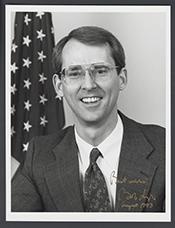
Historical · U.S. House · South Carolina · District 4
Bob Inglis
Former U.S. Representative · South Carolina District 4 · 1993–2011 · Republican
Bob Inglis represented South Carolina's District 4 in the United States House of Representatives (1993–2011) for the Republican party. The page below collects sourced biographical facts, term history, committee roles, and provenance for Inglis.
Bioguide ID: I000023
Key facts
- Full name
- Bob Inglis
- State
- South Carolina
- District
- District 4
- Party
- Republican
- House service
- 1993–2011
- First House term
- 1993
- Status
- Left office
- Current term ends
- —
- Born
- 1959
- Bioguide ID
- I000023
- Committee assignments
- —
- Dataset version
- 1.20260605
Biographical narrative
1,040 words · sourced from the Wikipedia REST extract
Robert Durden Inglis Sr. is a former American politician who served as the U.S. Representative for South Carolina's 4th congressional district. A member of the Republican Party, Inglis held office from 1993 to 1999 and again from 2005 until 2011. His political career is marked by his moderate stance within the Republican Party and his eventual criticism of the Tea Party movement. After leaving Congress, he became involved in initiatives focused on energy and climate change, advocating for market-based solutions to environmental challenges.
Early life and career
Bob Inglis was born on October 11, 1959, in Savannah, Georgia, to Helen Louise McCullough and Allick Wyllie Inglis Jr. His family has Scottish and English ancestry. He spent his formative years in Bluffton, South Carolina, a town located near Hilton Head Island. Inglis pursued higher education at Duke University in Durham, North Carolina, where he earned his undergraduate degree. Following his time at Duke, he attended the University of Virginia School of Law in Charlottesville, Virginia, where he obtained his Juris Doctor degree.
After completing his law degree, Inglis began his professional career in private legal practice, focusing on commercial real estate and corporate law. His involvement in politics began at the local level, where he served on the executive committee of the Greenville County Republican Party. This early engagement with the Republican Party laid the groundwork for his future political ambitions.
Inglis's entry into elected office came in 1992 when he won the Republican nomination for South Carolina's 4th congressional district. His victory in the general election marked the beginning of his congressional career. He defeated three-term incumbent Democrat Liz J. Patterson, who had previously held the seat since 1986. This election was significant not only for Inglis but also for the Republican Party, as it reflected a broader trend of Republican strength in South Carolina during the early 1990s.
House tenure
Inglis's first term in the U.S. House of Representatives began in 1993. He quickly established himself as a prominent figure in the Republican Party, winning re-election in 1994 and 1996 with substantial margins, often securing over 70 percent of the vote. His popularity during these years was indicative of the Republican dominance in the district, which had been trending Republican for several election cycles.
In 1998, Inglis chose to vacate his House seat to run for the U.S. Senate against incumbent Democrat Ernest Hollings, who had served in the Senate since 1966. Despite losing the election, Inglis performed competitively, garnering a significant portion of the vote against a long-standing political figure. Following this defeat, he returned to his legal practice, focusing on commercial real estate and corporate law.
Inglis made a political comeback in 2004 when he sought to reclaim his former House seat after Jim DeMint, the incumbent at the time, opted to run for Hollings's open Senate seat. Inglis won the Republican primary decisively, securing approximately 85 percent of the vote, which positioned him favorably for the general election. He faced Democratic candidate Brandon P. Brown, who was notable for being the first African American to run for the 4th District seat. Inglis won re-election in 2006 and 2008 with relative ease, reinforcing his status as a prominent Republican in the region.
However, Inglis faced a challenging primary in 2010, which marked a significant turning point in his political career. He encountered four challengers, including Trey Gowdy, who would ultimately defeat him in the Republican primary. This election was notable for the increased scrutiny Inglis faced regarding his voting record and political positions. Despite having a history of conservative voting, he was criticized by his opponents for certain decisions, including his support for the Emergency Economic Stabilization Act of 2008 and his opposition to the Iraq War troop surge in 2007. These factors contributed to his portrayal as being out of touch with the district's more conservative base.
Inglis finished second in the primary, which led to a runoff election against Gowdy. In this runoff, he was decisively defeated, receiving a significantly lower percentage of the vote compared to his opponent. Following his loss, Inglis expressed concerns about the direction of the Republican Party, particularly regarding the influence of the Tea Party movement, which had supported Gowdy's campaign.
Legislative focus and committees
During his time in the U.S. House of Representatives, Inglis served on various committees and was involved in a range of legislative issues. His tenure was characterized by a moderate approach to governance, which sometimes put him at odds with more conservative factions within his party. Inglis was known for his willingness to cross party lines on certain issues, particularly regarding climate change and environmental policy.
Inglis was one of a small number of House Republicans who voted for a Democratic resolution opposing the Iraq War troop surge in 2007, a decision that highlighted his moderate stance on foreign policy. He also spoke out against climate change denial and advocated for responsible environmental stewardship. His positions on these issues were often met with criticism from more conservative members of his party, who viewed his approach as too lenient.
Despite the challenges he faced from within his party, Inglis maintained a strong record of conservative voting, as evidenced by his lifetime rating of 93.5% from the American Conservative Union. He also received endorsements from various conservative organizations, including the National Rifle Association (NRA), which reflected his alignment with traditional Republican values on issues such as gun rights.
After leaving Congress, Inglis continued to engage in public policy discussions, particularly focusing on energy and climate issues. In 2012, he launched the Energy and Enterprise Initiative, a campaign aimed at promoting conservative solutions to energy and climate challenges. This initiative was based at George Mason University in Fairfax, Virginia, and sought to engage the public in discussions about market-based approaches to environmental issues. Inglis's advocacy included support for a revenue-neutral carbon tax, which he proposed as a means to address climate change while also reducing income and payroll taxes.
Inglis's post-congressional career has included his role as executive director of republicEN, a group dedicated to promoting free-market solutions to climate change. Through this work, he has continued to influence discussions on energy policy and environmental responsibility, reflecting his ongoing commitment to addressing these critical issues.
Notable legislation
Sponsored and co-sponsored legislation for Bob Inglis is pending operator curation. The biographical narrative above carries the same provenance trail until per-bill rows are written.
Sources
- [1]https://en.wikipedia.org/wiki/Bob_InglisWikipedia · retrieved 2026-06-05
Notable quotes
Sourced quotes for Bob Inglis are pending operator curation. Narrative-scope provenance remains attached below.
Sources
- [1]https://en.wikipedia.org/wiki/Bob_InglisWikipedia · retrieved 2026-06-05
Key positions
Curated policy positions for Bob Inglis are pending operator review. The biographical narrative above carries the same provenance trail until per-topic positions are written.
Sources
- [1]https://en.wikipedia.org/wiki/Bob_InglisWikipedia · retrieved 2026-06-05
Terms served
- 1993–1995U.S. House · Term 1 · Republican
- 1995–1997U.S. House · Term 2 · Republican
- 1997–1999U.S. House · Term 3 · Republican
- 2005–2007U.S. House · Term 4 · Republican
- 2007–2009U.S. House · Term 5 · Republican
- 2009–2011U.S. House · Term 6 · Republican
Sources & provenance
Every attributable claim above carries a per-section [N] marker that resolves to the corresponding URL below. Each entry records the upstream provider, the canonical URL, and the timestamp at which the source was retrieved by the ingest pipeline.
Key facts
- https://bioguide.congress.gov/search/bio/I000023bioguide · retrieved 2026-06-05
- http://inglis.house.govhouse.gov · retrieved 2026-06-05
Biographical narrative
- https://en.wikipedia.org/wiki/Bob_Ingliswikipedia · retrieved 2026-06-05
Find your representative
Every U.S. state elects representatives by district. Browse South Carolina’s delegation, the full former-representative roster, or explore the role and term length.
Related on The Candidate
- Preceded by Elizabeth PattersonEarlier holder of the South Carolina District 4 House seat · Democratic.Open
- Succeeded by Trey GowdyLater holder of the South Carolina District 4 House seat · Republican.Open
- Arthur Ravenel Jr.Former U.S. Representative · South Carolina District 1 · RepublicanOpen
- Benjamin WhittemoreFormer U.S. Representative · South Carolina District 1 · RepublicanOpen
- Clara McMillanFormer U.S. Representative · South Carolina District 1 · DemocraticOpen
- Daniel WallaceFormer U.S. Representative · South Carolina District 1 · DemocraticOpen