
Historical · U.S. House · South Carolina · District 4
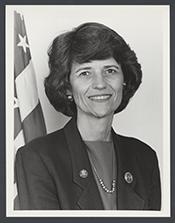
Elizabeth Patterson
Former U.S. Representative · South Carolina District 4 · 1987–1993 · Democratic
Elizabeth Patterson represented South Carolina's District 4 in the United States House of Representatives (1987–1993) for the Democratic party. The page below collects sourced biographical facts, term history, committee roles, and provenance for Patterson.
Bioguide ID: P000112
Key facts
- Full name
- Elizabeth Patterson
- State
- South Carolina
- District
- District 4
- Party
- Democratic
- House service
- 1987–1993
- First House term
- 1987
- Status
- Left office
- Current term ends
- —
- Born
- 1939
- Bioguide ID
- P000112
- Committee assignments
- —
- Dataset version
- 1.20260605
Biographical narrative
1,004 words · sourced from the Wikipedia REST extract
Gladys Elizabeth "Liz" Johnston Patterson was an American politician who served as a U.S. Representative for South Carolina's 4th congressional district from 1987 until 1993. A member of the Democratic Party, she was notable for being the first woman elected to Congress from South Carolina in her own right, following a lineage of political involvement that included her father, Olin D. Johnston, who served as both Governor and U.S. Senator from the state. Patterson's congressional career was marked by her focus on issues related to banking, veterans affairs, and hunger, as well as her role in local and state politics prior to her election to the House.
Early life and career
Liz Patterson was born on November 18, 1939, into a politically active family in South Carolina. Her father, Olin D. Johnston, was a prominent figure in state politics, serving as Governor of South Carolina and later as a U.S. Senator. Growing up in Kensington, Maryland, near Washington, D.C., Patterson was immersed in a political environment that would shape her future career. She pursued her education at Columbia College in South Carolina and later engaged in graduate studies at the University of South Carolina.
Patterson's early career included significant roles in federal programs during the administration of President Lyndon B. Johnson. She worked for the Peace Corps and the Office of Economic Opportunity, gaining experience in public service and community development. Following her time in Washington, D.C., she returned to South Carolina, where she took on the role of director for the Head Start Program, which aimed to provide early childhood education and support to low-income families. Additionally, she served as an assistant to Congressman James R. Mann, further solidifying her connection to political life.
In the mid-1970s, Patterson began her local political career by being elected to the Spartanburg County Council, where she served from 1975 to 1976. Her political journey continued as she was elected to the South Carolina State Senate in 1978, where she served until 1986. During her tenure, she became the second woman to serve in the South Carolina Senate, following Mary Gordon Ellis. Patterson's legislative experience and her family's political background positioned her well for a future in national politics.
House tenure
In 1986, Patterson successfully ran for the U.S. House of Representatives, representing South Carolina's 4th congressional district. She succeeded Carroll A. Campbell Jr., who vacated the seat to run for governor. Patterson's election was notable not only for her victory over Republican candidate Bill Workman, the mayor of Greenville, but also for her status as the first woman elected to Congress from South Carolina in her own right. This was a significant milestone, as previous women elected to Congress from the state had done so only through special elections following the deaths of their husbands.
Patterson's initial term in the House began in January 1987, and she was re-elected in 1988, narrowly defeating Knox H. White, a Republican attorney and city councilman. Despite the Republican Party's strong performance in the district during the 1988 elections, Patterson managed to retain her seat. She secured a third term in 1990 with a more comfortable margin against Terry Haskins, a state representative from Greenville.
Throughout her congressional tenure, Patterson served on several important committees, including the House Committees on Banking and Veterans Affairs, as well as the Select Committee on Hunger. Her work on these committees allowed her to address key issues affecting her constituents and the nation, particularly in areas related to economic policy and support for veterans.
Despite her accomplishments and the strong political lineage she represented, Patterson faced challenges in her re-election efforts. In 1992, she was narrowly defeated by Republican Bob Inglis, an attorney who was running for office for the first time. This election was marked by a significant Republican trend in the district, which had been shifting toward the GOP in the years leading up to her defeat. Following her departure from Congress in January 1993, Patterson's loss was notable as it would be nearly three decades before another woman would serve in Congress from South Carolina.
Legislative focus and committees
During her time in the U.S. House of Representatives, Patterson's legislative focus encompassed a variety of issues, particularly those affecting her constituents in South Carolina. Her work on the House Committee on Banking allowed her to engage with economic policies that impacted both local and national financial systems. This committee's jurisdiction included oversight of banking institutions, housing, and urban development, all of which were critical areas for her district.
Additionally, Patterson's role on the Committee on Veterans Affairs reflected her commitment to supporting those who had served in the military. This committee dealt with a range of issues, including veterans' benefits, healthcare, and services aimed at improving the quality of life for former service members. Patterson's advocacy for veterans was an important aspect of her legislative agenda, aligning with her broader Democratic values of supporting public service and community welfare.
Her involvement with the Select Committee on Hunger further highlighted her dedication to addressing food insecurity and poverty-related issues. This committee focused on the challenges of hunger in America and sought to develop policies aimed at alleviating food scarcity and improving nutrition for low-income families. Patterson's work in this area underscored her commitment to social justice and her desire to make a positive impact on the lives of her constituents.
After leaving Congress, Patterson continued to be active in public service and education. She ran unsuccessfully for the position of Lieutenant Governor of South Carolina in 1994 and later taught political science at Spartanburg Methodist College. She also served on the board of trustees for the college and held leadership roles within the Spartanburg County Democratic Party.
Patterson passed away on November 10, 2018, just days before her 79th birthday. Her contributions to South Carolina politics and her role as a pioneering woman in Congress left a lasting legacy in the state. Following her death, flags were lowered in her honor, recognizing her service and impact on the community.
Notable legislation
Sponsored and co-sponsored legislation for Elizabeth Patterson is pending operator curation. The biographical narrative above carries the same provenance trail until per-bill rows are written.
Sources
- [1]https://en.wikipedia.org/wiki/Liz_J._PattersonWikipedia · retrieved 2026-06-05
Notable quotes
Sourced quotes for Elizabeth Patterson are pending operator curation. Narrative-scope provenance remains attached below.
Sources
- [1]https://en.wikipedia.org/wiki/Liz_J._PattersonWikipedia · retrieved 2026-06-05
Key positions
Curated policy positions for Elizabeth Patterson are pending operator review. The biographical narrative above carries the same provenance trail until per-topic positions are written.
Sources
- [1]https://en.wikipedia.org/wiki/Liz_J._PattersonWikipedia · retrieved 2026-06-05
Terms served
- 1987–1989U.S. House · Term 1 · Democratic
- 1989–1991U.S. House · Term 2 · Democratic
- 1991–1993U.S. House · Term 3 · Democratic
Sources & provenance
Every attributable claim above carries a per-section [N] marker that resolves to the corresponding URL below. Each entry records the upstream provider, the canonical URL, and the timestamp at which the source was retrieved by the ingest pipeline.
Key facts
- https://bioguide.congress.gov/search/bio/P000112bioguide · retrieved 2026-06-05
- https://www.govtrack.us/congress/members/408520govtrack · retrieved 2026-06-05
Biographical narrative
- https://en.wikipedia.org/wiki/Liz_J._Pattersonwikipedia · retrieved 2026-06-05
Find your representative
Every U.S. state elects representatives by district. Browse South Carolina’s delegation, the full former-representative roster, or explore the role and term length.
Related on The Candidate
- Preceded by Carroll Campbell Jr.Earlier holder of the South Carolina District 4 House seat · Republican.Open
- Succeeded by Bob InglisLater holder of the South Carolina District 4 House seat · Republican.Open
- Arthur Ravenel Jr.Former U.S. Representative · South Carolina District 1 · RepublicanOpen
- Benjamin WhittemoreFormer U.S. Representative · South Carolina District 1 · RepublicanOpen
- Clara McMillanFormer U.S. Representative · South Carolina District 1 · DemocraticOpen
- Daniel WallaceFormer U.S. Representative · South Carolina District 1 · DemocraticOpen