
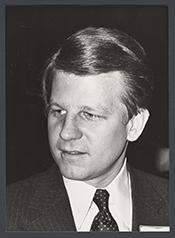
Historical · U.S. House · South Carolina · District 6
John Napier
Former U.S. Representative · South Carolina District 6 · 1981–1983 · Republican
John Napier represented South Carolina's District 6 in the United States House of Representatives (1981–1983) for the Republican party. The page below collects sourced biographical facts, term history, committee roles, and provenance for Napier.
Bioguide ID: N000005
Key facts
- Full name
- John Napier
- State
- South Carolina
- District
- District 6
- Party
- Republican
- House service
- 1981–1983
- First House term
- 1981
- Status
- Left office
- Current term ends
- —
- Born
- 1947
- Bioguide ID
- N000005
- Committee assignments
- —
- Dataset version
- 1.20260605
Biographical narrative
803 words · sourced from the Wikipedia REST extract
John L. Napier is a former American politician, lawyer, and jurist who served as a U.S. Representative for South Carolina's 6th congressional district from 1981 to 1983. A member of the Republican Party, Napier's congressional career was marked by his involvement in agricultural and veterans' affairs, as well as his efforts in bipartisan coalition building. Following his time in the House of Representatives, he served as a judge on the United States Court of Federal Claims from 1986 to 1989. His career has spanned various roles in both public service and private practice, reflecting a commitment to law and governance.
Early life and career
John L. Napier was born on May 16, 1947, in South Carolina. He attended public schools in Marlboro County, where he completed his primary and secondary education. Napier pursued higher education at Davidson College, graduating in 1969. Following his undergraduate studies, he attended the University of South Carolina School of Law, earning his Juris Doctor in 1972. During this time, he also served as a first lieutenant in the United States Army Reserve, a commitment he maintained until 1977.
After being admitted to the bar in 1972, Napier began his professional career as a legislative assistant to U.S. Senator Strom Thurmond. In this role, he worked on various legislative matters, including serving as minority counsel on the Subcommittee on Administrative Practices and Procedures and the Committee on Veterans Affairs. His expertise and dedication led to his appointment as Senator Thurmond's chief legal assistant and legal counsel in 1976. The following year, he was named Chief Republican Counsel to the Senate Special Committee on Official Conduct, where he played a significant role in drafting the initial Code of Ethics and Financial Disclosure for the U.S. Senate.
In 1978, Napier transitioned back to private legal practice in Bennettsville, South Carolina, where he remained until 1980. His early career laid a strong foundation for his later political endeavors, providing him with valuable experience in both legislative processes and legal matters.
House tenure
In 1980, Napier was elected to the 97th United States Congress, representing South Carolina's 6th congressional district. His term in the House of Representatives began in January 1981 and concluded in January 1983. During his time in office, he was recognized for his leadership as a Deputy Whip and was an active member of the Agriculture and Veterans Affairs Committees. His work on these committees allowed him to focus on issues pertinent to his constituents, particularly those related to agriculture, which is a significant sector in South Carolina.
Napier's tenure was characterized by his ability to build coalitions across party lines. He collaborated closely with Congressman Charlie Rose, a Democrat from North Carolina, to develop bipartisan legislation that established a tobacco stabilization program. This initiative was crucial for the agricultural community in the southeastern United States, highlighting Napier's commitment to addressing the needs of his district and the broader region.
Despite his efforts and contributions, Napier faced challenges in his re-election bid in 1982, ultimately losing to Democrat Robin Tallon. His single term in the House was marked by significant legislative activity, and he left office with a reputation for bipartisanship and effective advocacy for his constituents.
Legislative focus and committees
During his time in the House of Representatives, Napier's legislative focus primarily revolved around agriculture and veterans' affairs, reflecting the interests and needs of his district. As a member of the Agriculture Committee, he engaged in discussions and initiatives aimed at supporting farmers and agricultural workers, particularly in relation to tobacco, which is a key crop in South Carolina. His work on the Veterans Affairs Committee also underscored his commitment to addressing the needs of veterans, ensuring they received the support and resources necessary for their well-being.
Napier's role as Deputy Whip further enhanced his influence within the House, allowing him to play a pivotal part in party strategy and legislative coordination. His ability to foster relationships with colleagues across the aisle was instrumental in his success in coalition building, particularly in crafting bipartisan legislation that addressed pressing issues in his district.
After leaving Congress, Napier continued his public service when he was nominated by President Ronald Reagan to the United States Court of Federal Claims in 1986. His confirmation by the Senate marked a transition from legislative to judicial responsibilities, where he contributed to the restructuring of the court's administrative functions. He served in this capacity until 1989, after which he returned to private legal practice.
In summary, John L. Napier's career reflects a blend of legal expertise, public service, and a commitment to addressing the needs of his constituents. His time in the U.S. House of Representatives was marked by significant legislative efforts in agriculture and veterans' affairs, and his subsequent judicial service further exemplified his dedication to the principles of law and governance.
Notable legislation
Sponsored and co-sponsored legislation for John Napier is pending operator curation. The biographical narrative above carries the same provenance trail until per-bill rows are written.
Sources
- [1]https://en.wikipedia.org/wiki/John_Light_NapierWikipedia · retrieved 2026-06-05
Notable quotes
Sourced quotes for John Napier are pending operator curation. Narrative-scope provenance remains attached below.
Sources
- [1]https://en.wikipedia.org/wiki/John_Light_NapierWikipedia · retrieved 2026-06-05
Key positions
Curated policy positions for John Napier are pending operator review. The biographical narrative above carries the same provenance trail until per-topic positions are written.
Sources
- [1]https://en.wikipedia.org/wiki/John_Light_NapierWikipedia · retrieved 2026-06-05
Terms served
- 1981–1983U.S. House · Term 1 · Republican
Sources & provenance
Every attributable claim above carries a per-section [N] marker that resolves to the corresponding URL below. Each entry records the upstream provider, the canonical URL, and the timestamp at which the source was retrieved by the ingest pipeline.
Key facts
- https://bioguide.congress.gov/search/bio/N000005bioguide · retrieved 2026-06-05
- https://www.govtrack.us/congress/members/408099govtrack · retrieved 2026-06-05
Biographical narrative
- https://en.wikipedia.org/wiki/John_Light_Napierwikipedia · retrieved 2026-06-05
Find your representative
Every U.S. state elects representatives by district. Browse South Carolina’s delegation, the full former-representative roster, or explore the role and term length.
Related on The Candidate
- Preceded by John Jenrette Jr.Earlier holder of the South Carolina District 6 House seat · Democratic.Open
- Succeeded by Robin Tallon Jr.Later holder of the South Carolina District 6 House seat · Democratic.Open
- Arthur Ravenel Jr.Former U.S. Representative · South Carolina District 1 · RepublicanOpen
- Benjamin WhittemoreFormer U.S. Representative · South Carolina District 1 · RepublicanOpen
- Clara McMillanFormer U.S. Representative · South Carolina District 1 · DemocraticOpen
- Daniel WallaceFormer U.S. Representative · South Carolina District 1 · DemocraticOpen