
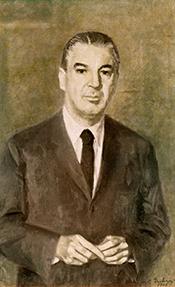
Historical · U.S. House · Tennessee · District 4
Joseph Evins
Former U.S. Representative · Tennessee District 4 · 1947–1977 · Democratic
Joseph Evins represented Tennessee's District 4 in the United States House of Representatives (1947–1977) for the Democratic party. The page below collects sourced biographical facts, term history, committee roles, and provenance for Evins.
Bioguide ID: E000273
Key facts
- Full name
- Joseph Evins
- State
- Tennessee
- District
- District 4
- Party
- Democratic
- House service
- 1947–1977
- First House term
- 1947
- Status
- Left office
- Current term ends
- —
- Born
- 1910
- Bioguide ID
- E000273
- Committee assignments
- —
- Dataset version
- 1.20260605
Biographical narrative
999 words · sourced from the Wikipedia REST extract
Joseph Landon Evins was an American lawyer and politician who served as a Democratic U.S. Representative for Tennessee's 4th congressional district from 1947 until 1977. Over his three-decade career in the House of Representatives, he was elected to 15 consecutive terms, making him one of the longest-serving members of Congress from Tennessee. Evins was known for his influential roles in various congressional committees, particularly those focused on appropriations and small business, and he played a significant part in securing federal funding for projects in his district.
Early life and career
Joe L. Evins was born on October 24, 1910, in the Blend Community of DeKalb County, Tennessee. He was the son of James Edgar Evins, a prominent local businessman and a Tennessee state senator, and Myrtie Goodson Evins. His family had deep roots in the region, with his father being honored as the namesake of Edgar Evins State Park, located near Smithville. Evins was part of a family that remained active in local business and politics; one of his brother's children managed a local bank, while another nephew, Dan Evins, founded the Cracker Barrel Old Country Store restaurant chain.
Evins pursued higher education at Vanderbilt University in Nashville, where he graduated in 1933. He continued his studies at the Cumberland School of Law in Lebanon, Tennessee, earning his law degree in 1934. Additionally, he attended The George Washington University. After being admitted to the bar in 1934, Evins began his legal practice in Smithville, the county seat of DeKalb County.
In 1935, Evins began his career in public service as a staff attorney for the Federal Trade Commission (FTC), where he worked until 1938. He then advanced to the role of assistant secretary of the FTC, a position he held until 1940. With the onset of World War II, Evins was commissioned in the United States Army Judge Advocate General Corps, serving on active duty until 1946. After his military service, he returned to his law practice in Smithville and took on a leadership role as the chairman of the DeKalb County Democratic Party.
House tenure
In 1947, Evins entered the political arena by winning the Democratic nomination for the 5th congressional district of Tennessee, defeating the incumbent Harold Earthman. He was elected to the House of Representatives in a district that was solidly Democratic, and he continued to win re-election for 15 terms, generally facing little opposition. Throughout his tenure, he encountered a regular Republican opponent in only three elections. Following the 1950 Census, Tennessee lost a congressional district, and Evins's district was renumbered to the 4th.
During his time in Congress, Evins emerged as a significant figure, holding various leadership roles. He served as the chair of the House Select Committee on Small Business for six terms and later chaired the permanent Small Business Committee. Additionally, he was the chair of the Speaker's patronage committee for five terms. Notably, Evins was a long-serving member of the House Appropriations Committee, where he served for eleven terms. He chaired the Subcommittee on Independent Offices and the Department of Housing and Urban Development for three terms and the Subcommittee on Public Works for another three terms.
Evins utilized his congressional influence to benefit his district, which was primarily rural and located east and south of Nashville. He played a pivotal role in securing federal funding for local projects, including a $5 million grant that facilitated the establishment of the Tennessee Technological University Appalachian Center for Craft near Smithville. His efforts also led to the designation of Smithville as the smallest city to participate in the Model Cities Program, and he was instrumental in renaming the city's major thoroughfare to "Congressional Boulevard."
While Evins was a powerful advocate for his district, his record on civil rights was complex. He was initially slow to embrace racial desegregation, signing the 1956 Southern Manifesto and voting against several key civil rights legislation, including the Civil Rights Acts of 1957, 1960, 1964, and 1968. However, he did vote present on the 24th Amendment to the U.S. Constitution and supported the Voting Rights Act of 1965. Overall, his voting record in Congress was generally considered liberal.
In 1976, after serving 15 terms in the House, Evins chose not to seek re-election. At the time of his retirement on January 3, 1977, he held the distinction of being the longest-serving House member from Tennessee. His departure from Congress opened the door for Al Gore, who won a competitive primary to succeed him and subsequently began his own political career.
Legislative focus and committees
Throughout his congressional career, Joe L. Evins was deeply involved in various legislative matters, particularly those related to appropriations and small business. His leadership roles in the House Select Committee on Small Business and the House Appropriations Committee allowed him to shape policies that impacted not only his district but also the broader national landscape.
As chair of the House Select Committee on Small Business, Evins focused on issues affecting small enterprises, advocating for policies that would support their growth and sustainability. His tenure on the Appropriations Committee was marked by significant contributions to federal funding allocations, ensuring that his district received necessary resources for development and infrastructure projects.
Evins's work on the Subcommittee on Public Works was particularly influential, as he oversaw funding for various public infrastructure initiatives. His commitment to improving the quality of life in his district was evident through his efforts to secure federal grants and support for local projects. The establishment of the Appalachian Center for Craft is a prime example of how his legislative actions translated into tangible benefits for his constituents.
Despite his mixed record on civil rights, Evins's overall legislative focus reflected a commitment to addressing the needs of his constituents and advocating for policies that aligned with the Democratic Party's platform during his time in office. His long tenure and leadership roles in key committees positioned him as a significant player in shaping legislation that impacted both his district and the nation.
Notable legislation
Sponsored and co-sponsored legislation for Joseph Evins is pending operator curation. The biographical narrative above carries the same provenance trail until per-bill rows are written.
Sources
- [1]https://en.wikipedia.org/wiki/Joe_L._EvinsWikipedia · retrieved 2026-06-05
Notable quotes
Sourced quotes for Joseph Evins are pending operator curation. Narrative-scope provenance remains attached below.
Sources
- [1]https://en.wikipedia.org/wiki/Joe_L._EvinsWikipedia · retrieved 2026-06-05
Key positions
Curated policy positions for Joseph Evins are pending operator review. The biographical narrative above carries the same provenance trail until per-topic positions are written.
Sources
- [1]https://en.wikipedia.org/wiki/Joe_L._EvinsWikipedia · retrieved 2026-06-05
Terms served
- 1947–1949U.S. House · Term 1 · Democratic
- 1949–1951U.S. House · Term 2 · Democratic
- 1951–1953U.S. House · Term 3 · Democratic
- 1953–1955U.S. House · Term 4 · Democratic
- 1955–1957U.S. House · Term 5 · Democratic
- 1957–1959U.S. House · Term 6 · Democratic
- 1959–1961U.S. House · Term 7 · Democratic
- 1961–1963U.S. House · Term 8 · Democratic
- 1963–1965U.S. House · Term 9 · Democratic
- 1965–1967U.S. House · Term 10 · Democratic
- 1967–1969U.S. House · Term 11 · Democratic
- 1969–1971U.S. House · Term 12 · Democratic
- 1971–1973U.S. House · Term 13 · Democratic
- 1973–1975U.S. House · Term 14 · Democratic
- 1975–1977U.S. House · Term 15 · Democratic
Sources & provenance
Every attributable claim above carries a per-section [N] marker that resolves to the corresponding URL below. Each entry records the upstream provider, the canonical URL, and the timestamp at which the source was retrieved by the ingest pipeline.
Key facts
- https://bioguide.congress.gov/search/bio/E000273bioguide · retrieved 2026-06-05
- https://www.govtrack.us/congress/members/403952govtrack · retrieved 2026-06-05
Biographical narrative
- https://en.wikipedia.org/wiki/Joe_L._Evinswikipedia · retrieved 2026-06-05
Find your representative
Every U.S. state elects representatives by district. Browse Tennessee’s delegation, the full former-representative roster, or explore the role and term length.
Related on The Candidate
- Preceded by John MitchellEarlier holder of the Tennessee District 4 House seat · Democratic.Open
- Succeeded by Van HillearyLater holder of the Tennessee District 4 House seat · Republican.Open
- Albert WatkinsFormer U.S. Representative · Tennessee District 1 · DemocraticOpen
- Alfred TaylorFormer U.S. Representative · Tennessee District 1 · RepublicanOpen
- Augustus PettiboneFormer U.S. Representative · Tennessee District 1 · RepublicanOpen
- Bill JenkinsFormer U.S. Representative · Tennessee District 1 · RepublicanOpen