
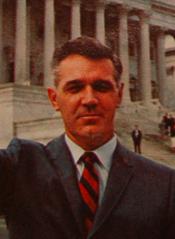
Historical · U.S. House · Tennessee · District 5
Richard Fulton
Former U.S. Representative · Tennessee District 5 · 1963–1977 · Democratic
Richard Fulton represented Tennessee's District 5 in the United States House of Representatives (1963–1977) for the Democratic party. The page below collects sourced biographical facts, term history, committee roles, and provenance for Fulton.
Bioguide ID: F000424
Key facts
- Full name
- Richard Fulton
- State
- Tennessee
- District
- District 5
- Party
- Democratic
- House service
- 1963–1977
- First House term
- 1963
- Status
- Left office
- Current term ends
- —
- Born
- 1927
- Bioguide ID
- F000424
- Committee assignments
- —
- Dataset version
- 1.20260605
Biographical narrative
973 words · sourced from the Wikipedia REST extract
Richard Fulton was an American politician affiliated with the Democratic Party, who served as a U.S. Representative for Tennessee's 5th congressional district from 1963 until 1977. He is also known for his role as the second mayor of the Metropolitan Government of Nashville and Davidson County, a position he held from 1975 to 1987. Throughout his political career, Fulton was recognized for his liberal voting record and his commitment to civil rights legislation. His contributions to both state and local governance reflect a significant engagement with the political landscape of Tennessee during a transformative period in American history.
Early life and career
Richard Harmon Fulton was born on January 27, 1927, in Nashville, Tennessee. His early education took place at East Nashville High School, where he laid the groundwork for his future endeavors. Following his high school education, Fulton served in the United States Navy during World War II, an experience that shaped his early adulthood and instilled in him a sense of duty and public service. After completing his military service, he pursued higher education at the University of Tennessee, where he also played on the university's football team, the Volunteers. This athletic involvement not only contributed to his personal development but also helped him build connections within the community.
Fulton's entry into politics began in 1954 when he was elected to the Tennessee State Senate. This election came about under tragic circumstances, as he succeeded his brother Lyle Fulton, who had recently passed away from cancer shortly after receiving the Democratic nomination for the position. However, Richard's initial tenure in the State Senate was short-lived. Due to his age of 27, he was deemed ineligible to serve according to the Tennessee State Constitution, leading to a unanimous vote by the Senate to unseat him. It was not until 1956, when he turned 31, that he was successfully elected to the Senate, where he served until 1960. Fulton was reelected in 1958, demonstrating his growing influence and popularity in the political arena. However, he eventually left the Senate to pursue a career in real estate, marking a brief hiatus from public office.
House tenure
Fulton's congressional career began in 1962 when he entered the Democratic primary for the 5th Congressional District of Tennessee, which was based in Nashville. At that time, he faced off against the incumbent Congressman Joseph Carlton Loser. The initial election results declared Loser the winner; however, allegations of corruption within the election commission prompted a friend of Fulton to file a lawsuit to contest the results. This legal challenge led to a rerun of the primary, in which Fulton emerged victorious. He subsequently won the general election in November, marking the beginning of his seven-term tenure in the U.S. House of Representatives, which commenced in 1963.
During his time in Congress, Fulton was known for his liberal voting record, aligning himself with progressive policies and initiatives. He was a strong supporter of civil rights and voted in favor of significant legislation, including the Civil Rights Acts of 1964 and 1968, as well as the Voting Rights Act of 1965. These legislative measures were pivotal in advancing civil rights and addressing racial discrimination in the United States. Fulton's commitment to these issues reflected the broader social movements of the 1960s and underscored his dedication to promoting equality and justice.
Fulton's congressional career was characterized by his active participation in various legislative matters, and he was known for his willingness to engage with constituents and address their concerns. His tenure in the House lasted until January 3, 1977, when he resigned following his election as mayor of Nashville. His departure from Congress marked the end of a significant chapter in his political career, but it also paved the way for his subsequent leadership role at the municipal level.
Legislative focus and committees
Throughout his time in the U.S. House of Representatives, Richard Fulton focused on a range of legislative issues that were particularly relevant to his constituents in Tennessee. His alignment with the Democratic Party and his liberal stance on various matters positioned him as a proponent of social justice and civil rights. Fulton's support for the Civil Rights Acts and the Voting Rights Act demonstrated his commitment to addressing systemic inequalities and advocating for the rights of marginalized communities.
In addition to civil rights, Fulton was involved in discussions and initiatives related to urban development and infrastructure, reflecting the needs of Nashville as it experienced growth and change during the 1960s and 1970s. His background in real estate likely informed his perspectives on urban planning and development, allowing him to contribute meaningfully to legislative efforts aimed at improving the quality of life for residents in his district.
Fulton's involvement in various committees during his congressional tenure further enhanced his ability to influence policy and advocate for his constituents. While specific committee assignments are not detailed in the available information, it is common for members of Congress to serve on committees that align with their legislative interests and the needs of their districts. These committees play a crucial role in shaping legislation and overseeing government functions, and Fulton's participation would have allowed him to engage directly with key issues affecting his constituents.
After leaving Congress, Fulton continued to serve the public as the mayor of Nashville, where he held office from 1975 to 1987. His experience in the House of Representatives likely informed his approach to local governance, as he worked on initiatives that shaped the city's development and addressed the needs of its residents. Fulton's legacy in both the House and as mayor reflects a career dedicated to public service and a commitment to improving the lives of those he represented. He passed away on November 28, 2018, at the age of 91, leaving behind a significant impact on the political landscape of Nashville and Tennessee.
Notable legislation
Sponsored and co-sponsored legislation for Richard Fulton is pending operator curation. The biographical narrative above carries the same provenance trail until per-bill rows are written.
Sources
- [1]https://en.wikipedia.org/wiki/Richard_FultonWikipedia · retrieved 2026-06-05
Notable quotes
Sourced quotes for Richard Fulton are pending operator curation. Narrative-scope provenance remains attached below.
Sources
- [1]https://en.wikipedia.org/wiki/Richard_FultonWikipedia · retrieved 2026-06-05
Key positions
Curated policy positions for Richard Fulton are pending operator review. The biographical narrative above carries the same provenance trail until per-topic positions are written.
Sources
- [1]https://en.wikipedia.org/wiki/Richard_FultonWikipedia · retrieved 2026-06-05
Terms served
- 1963–1965U.S. House · Term 1 · Democratic
- 1965–1967U.S. House · Term 2 · Democratic
- 1967–1969U.S. House · Term 3 · Democratic
- 1969–1971U.S. House · Term 4 · Democratic
- 1971–1973U.S. House · Term 5 · Democratic
- 1973–1975U.S. House · Term 6 · Democratic
- 1975–1977U.S. House · Term 7 · Democratic
Sources & provenance
Every attributable claim above carries a per-section [N] marker that resolves to the corresponding URL below. Each entry records the upstream provider, the canonical URL, and the timestamp at which the source was retrieved by the ingest pipeline.
Key facts
- https://bioguide.congress.gov/search/bio/F000424bioguide · retrieved 2026-06-05
- https://www.govtrack.us/congress/members/404365govtrack · retrieved 2026-06-05
Biographical narrative
- https://en.wikipedia.org/wiki/Richard_Fultonwikipedia · retrieved 2026-06-05
Find your representative
Every U.S. state elects representatives by district. Browse Tennessee’s delegation, the full former-representative roster, or explore the role and term length.
Related on The Candidate
- Preceded by Joseph LoserEarlier holder of the Tennessee District 5 House seat · Democratic.Open
- Succeeded by William BonerLater holder of the Tennessee District 5 House seat · Democratic.Open
- Albert WatkinsFormer U.S. Representative · Tennessee District 1 · DemocraticOpen
- Alfred TaylorFormer U.S. Representative · Tennessee District 1 · RepublicanOpen
- Augustus PettiboneFormer U.S. Representative · Tennessee District 1 · RepublicanOpen
- Bill JenkinsFormer U.S. Representative · Tennessee District 1 · RepublicanOpen