
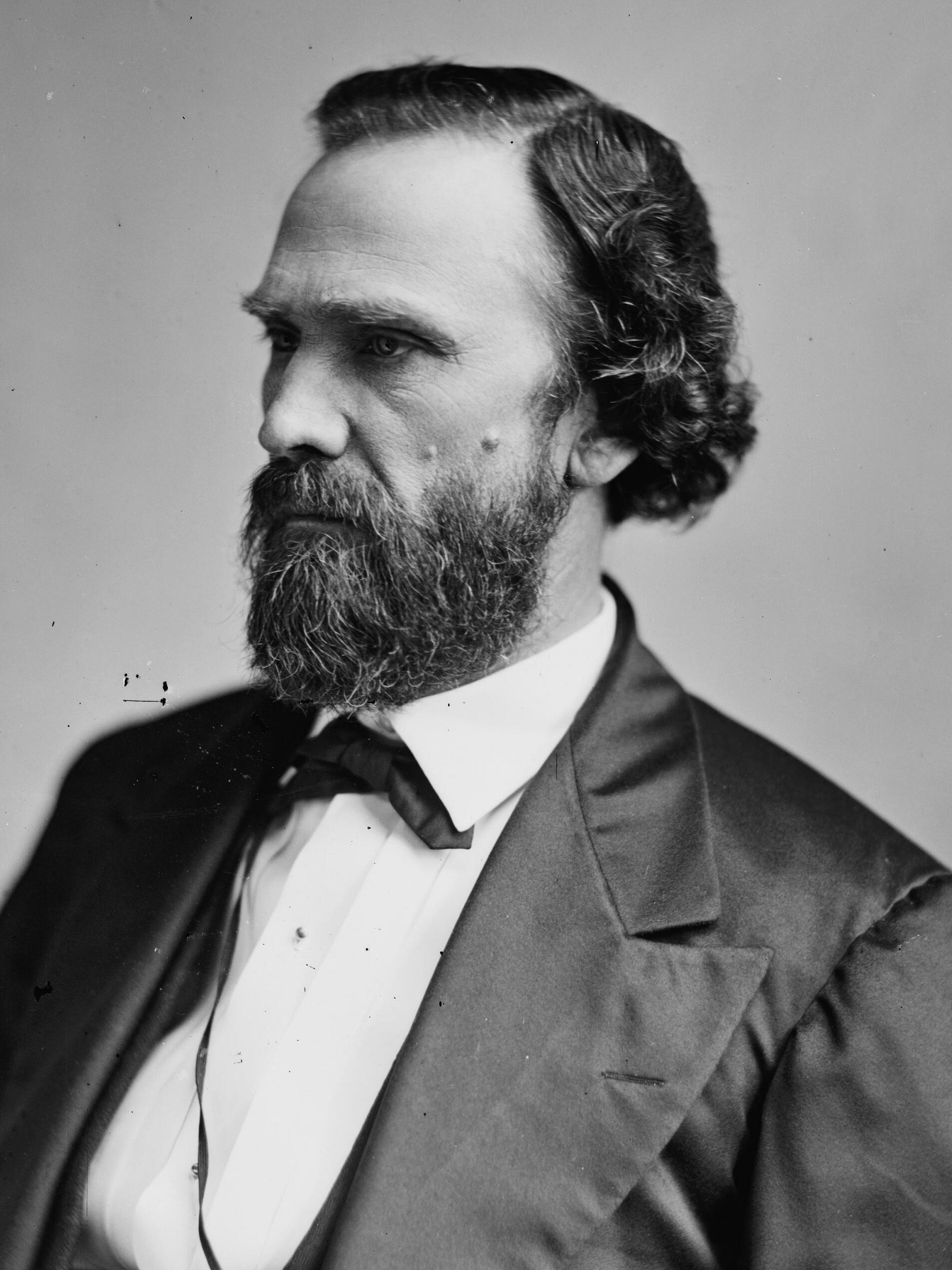
Historical · U.S. House · Tennessee · District 8
John Atkins
Former U.S. Representative · Tennessee District 8 · 1857–1883 · Democratic
John Atkins represented Tennessee's District 8 in the United States House of Representatives (1857–1883) for the Democratic party. The page below collects sourced biographical facts, term history, committee roles, and provenance for Atkins.
Bioguide ID: A000327
Key facts
- Full name
- John Atkins
- State
- Tennessee
- District
- District 8
- Party
- Democratic
- House service
- 1857–1883
- First House term
- 1857
- Status
- Left office
- Current term ends
- —
- Born
- 1825
- Bioguide ID
- A000327
- Committee assignments
- —
- Dataset version
- 1.20260606
Biographical narrative
834 words · sourced from the Wikipedia REST extract
John Atkins was a prominent American politician and lawyer who served as a U.S. Representative from Tennessee's 8th congressional district. A member of the Democratic Party, Atkins had a significant political career that spanned multiple terms in the U.S. House of Representatives and included service in the Confederate Congress during the Civil War. His tenure in Congress was marked by his involvement in key legislative issues of the time, particularly those related to Reconstruction and appropriations.
Early life and career
John Atkins was born on June 4, 1825, in Manly's Chapel, located in Henry County, Tennessee. He was the son of Johnathan Atkins and Sarah Manley Atkins. His early education took place at a private school in Paris, Tennessee, after which he attended East Tennessee University in Knoxville, graduating in 1846. Following his graduation, Atkins studied law and was admitted to the bar; however, he chose not to practice law and instead engaged in agricultural pursuits.
Atkins's personal life included his marriage to Elizabeth Bacon Porter on November 23, 1847. After her passing in 1887, he remarried to Flora Crawford on June 24, 1890. Throughout his life, Atkins was known to have owned slaves, a factor that reflects the complex social and economic dynamics of the time in which he lived.
Atkins began his political career in the Tennessee House of Representatives, where he served from 1849 to 1851. He then moved to the Tennessee Senate, holding office from 1855 to 1857. His early political involvement laid the groundwork for his later election to the U.S. Congress.
House tenure
Atkins was elected as a Democrat to the Thirty-fifth Congress, representing Tennessee's 9th congressional district. His first term in the U.S. House of Representatives began on March 4, 1857, and concluded on March 3, 1859. However, he did not succeed in his bid for re-election to the Thirty-sixth Congress.
With the onset of the Civil War, Atkins served as a lieutenant colonel in the Fifth Tennessee Regiment of the Confederate Army, beginning in 1861. His military service included a role as a delegate to the Confederate Provisional Congress in November 1861. Subsequently, he was elected to the First Confederate Congress and was re-elected in 1863 to the Second Confederate Congress. During the war, he advocated for the Confederate government to procure a significant number of enslaved individuals to bolster the military ranks, reflecting the desperate measures taken by the Confederacy as the conflict progressed.
After the Civil War, Atkins returned to political life and was elected as a Democrat to the Forty-third Congress, serving from March 4, 1873, to March 3, 1883. Following a reapportionment, he represented Tennessee's 8th congressional district. During his time in Congress, he played a crucial role in legislative efforts to counteract Reconstruction policies, which aimed to integrate formerly enslaved individuals into American society. The Tennessee Historical Commission has noted his instrumental role in the removal of Federal troops from the South, a significant event in the post-war period.
Atkins held several leadership positions during his congressional tenure, including serving as chairman of the House Committee on Appropriations during the Forty-fifth and Forty-sixth Congresses. His influence in this role allowed him to shape funding priorities and fiscal policy during a tumultuous period in American history. After completing his final term in 1883, he chose not to seek renomination in 1882.
Legislative focus and committees
Throughout his congressional career, Atkins's legislative focus was largely shaped by the political climate of the time, particularly the aftermath of the Civil War and the challenges of Reconstruction. His actions in Congress were characterized by a commitment to the Democratic Party's agenda, which often included opposition to the policies aimed at integrating formerly enslaved individuals into society and restoring Southern states to their pre-war status.
As chairman of the House Committee on Appropriations, Atkins was responsible for overseeing the allocation of federal funds, a role that required negotiation and collaboration with other members of Congress. His leadership in this committee was significant, as appropriations decisions directly impacted various federal programs and initiatives.
After his congressional service, Atkins continued to engage in public service. He was appointed by President Cleveland as the United States Commissioner of Indian Affairs on March 21, 1885, a position he held until June 13, 1888. During his tenure, he implemented policies that restricted the use of Native languages in reservation schools, reflecting the prevailing attitudes of the time regarding assimilation and education.
In 1888, Atkins sought the Democratic nomination for the U.S. Senate but was unsuccessful. Following this political endeavor, he returned to his agricultural roots, retiring from active political life in 1898 and settling back in Paris, Tennessee.
Atkins lived in retirement until his death on June 2, 1908, just two days shy of his 83rd birthday. He was interred at City Cemetery in Paris, Tennessee. His legacy includes his contributions to the political landscape of Tennessee during a pivotal era in American history, as well as his involvement in both the U.S. Congress and the Confederate Congress.
Notable legislation
Sponsored and co-sponsored legislation for John Atkins is pending operator curation. The biographical narrative above carries the same provenance trail until per-bill rows are written.
Sources
- [1]https://en.wikipedia.org/wiki/John_D._C._AtkinsWikipedia · retrieved 2026-06-06
Notable quotes
Sourced quotes for John Atkins are pending operator curation. Narrative-scope provenance remains attached below.
Sources
- [1]https://en.wikipedia.org/wiki/John_D._C._AtkinsWikipedia · retrieved 2026-06-06
Key positions
Curated policy positions for John Atkins are pending operator review. The biographical narrative above carries the same provenance trail until per-topic positions are written.
Sources
- [1]https://en.wikipedia.org/wiki/John_D._C._AtkinsWikipedia · retrieved 2026-06-06
Terms served
- 1857–1859U.S. House · Term 1 · Democratic
- 1873–1875U.S. House · Term 2 · Democratic
- 1875–1877U.S. House · Term 3 · Democratic
- 1877–1879U.S. House · Term 4 · Democratic
- 1879–1881U.S. House · Term 5 · Democratic
- 1881–1883U.S. House · Term 6 · Democratic
Sources & provenance
Every attributable claim above carries a per-section [N] marker that resolves to the corresponding URL below. Each entry records the upstream provider, the canonical URL, and the timestamp at which the source was retrieved by the ingest pipeline.
Key facts
- https://bioguide.congress.gov/search/bio/A000327bioguide · retrieved 2026-06-06
- https://www.govtrack.us/congress/members/400976govtrack · retrieved 2026-06-06
Biographical narrative
- https://en.wikipedia.org/wiki/John_D._C._Atkinswikipedia · retrieved 2026-06-06
Find your representative
Every U.S. state elects representatives by district. Browse Tennessee’s delegation, the full former-representative roster, or explore the role and term length.
Related on The Candidate
- Preceded by Andrew EwingEarlier holder of the Tennessee District 8 House seat · Democratic.Open
- Succeeded by John TaylorLater holder of the Tennessee District 8 House seat · Democratic.Open
- Albert WatkinsFormer U.S. Representative · Tennessee District 1 · DemocraticOpen
- Alfred TaylorFormer U.S. Representative · Tennessee District 1 · RepublicanOpen
- Augustus PettiboneFormer U.S. Representative · Tennessee District 1 · RepublicanOpen
- Bill JenkinsFormer U.S. Representative · Tennessee District 1 · RepublicanOpen