
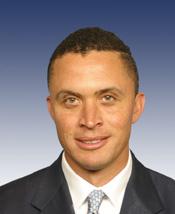
Historical · U.S. House · Tennessee · District 9
Harold Ford Jr.
Former U.S. Representative · Tennessee District 9 · 1997–2007 · Democratic
Harold Ford Jr. represented Tennessee's District 9 in the United States House of Representatives (1997–2007) for the Democratic party. The page below collects sourced biographical facts, term history, committee roles, and provenance for Jr..
Bioguide ID: F000262
Key facts
- Full name
- Harold Ford Jr.
- State
- Tennessee
- District
- District 9
- Party
- Democratic
- House service
- 1997–2007
- First House term
- 1997
- Status
- Left office
- Current term ends
- —
- Born
- 1970
- Bioguide ID
- F000262
- Committee assignments
- —
- Dataset version
- 1.20260605
Biographical narrative
1,035 words · sourced from the Wikipedia REST extract
Harold E. Ford Jr. is a former U.S. Representative who served Tennessee's 9th congressional district from 1997 to 2007. A member of the Democratic Party, Ford is part of a prominent political family in Memphis, Tennessee, where his father, Harold Ford Sr., previously held the same congressional seat for over two decades. After leaving Congress, Ford transitioned into the financial sector and media, taking on roles as a managing director and political commentator. He has also authored a book and continues to engage in political discourse through various platforms.
Early life and career
Harold Eugene Ford Jr. was born on May 11, 1970, in Memphis, Tennessee. He is the eldest son of Harold Ford Sr. and Dorothy Bowles Ford, and he has two brothers, Jake and Isaac, as well as two half-siblings, Andrew and Ava, from his father's subsequent marriage. The Ford family has a long-standing presence in Memphis's Black community, with his grandfather, N. J. Ford, establishing a funeral home that became a significant business and community hub. This family legacy provided Ford with a broad network and deep roots in the local community.
Ford's early life was spent in the Riverside neighborhood of Memphis, where he lived in the family-owned funeral home. His upbringing was influenced by the family's strong ties to the community and their involvement in local politics. He was baptized at Mt. Moriah-East Baptist Church, which further connected him to his cultural and community heritage. Ford attended Double Tree Elementary School, a public Montessori institution, before transferring to St. Albans School, a prestigious private university-preparatory school in Washington, D.C. This transition occurred after his father was elected to Congress, allowing Ford to benefit from a more rigorous academic environment.
In 1992, Ford graduated from the University of Pennsylvania with a Bachelor of Arts degree in American history. Following his undergraduate studies, he began his career in government, initially serving as a staff aide for the Senate Budget Committee. In 1993, he took on the role of special assistant at the United States Department of Commerce, where he gained valuable experience in federal operations and policy.
Ford pursued further education by enrolling at the University of Michigan Law School, where he earned his Juris Doctor degree in 1996. During this time, he also began his campaign for the House of Representatives. Despite his efforts, he did not pass the Tennessee bar exam on his first attempt, although he expressed intentions to retake it in the future.
House tenure
Harold Ford Jr. entered the political arena when his father decided not to seek reelection in 1996. Ford quickly emerged as the frontrunner in the Democratic primary for Tennessee's 9th congressional district, a seat that had been held by his father for 22 years. Recognizing the significance of the primary in a heavily Democratic and predominantly Black district, Ford strategically organized his law school schedule to allow him to campaign effectively. He won the Democratic primary and subsequently secured election to the House of Representatives in November 1996.
At the age of 26, Ford became one of the youngest members of Congress in U.S. history and the youngest serving in the 105th and 106th Congresses. His election marked a generational shift, as he was among the first members of Generation X to serve in Congress. Over the course of his five terms, Ford was reelected four times, consistently receiving significant support from his constituents, often winning by large margins.
During his tenure, Ford gained national recognition when he served as the keynote speaker at the 2000 Democratic National Convention, where he endorsed then-Vice President Al Gore for the presidential nomination. His visibility and influence within the party grew, and he was considered a potential candidate for higher office, including speculation about a vice presidential nomination in 2004. However, he was ineligible for the position due to his age at the time.
Ford's legislative record includes notable votes on significant pieces of legislation. He voted in favor of the Gramm–Leach–Bliley Act in 1999, which repealed parts of the Glass–Steagall Act, allowing for greater financial integration among banks and insurance companies. This decision has been scrutinized in the context of the financial crisis that occurred nearly a decade later. Additionally, he was one of the House Democrats who voted to authorize the invasion of Iraq in 2002, a decision that would later become a contentious issue within the party and among the public.
In 2002, after the Democrats faced losses in the midterm elections, Ford announced his candidacy for House Democratic Leader, challenging Nancy Pelosi for the position. Although he did not win, he garnered more support than anticipated, indicating his growing influence within the party.
Legislative focus and committees
Throughout his congressional career, Ford was involved in various legislative initiatives and served on multiple committees. His focus included issues pertinent to his constituents in Memphis and the broader Democratic agenda. He was particularly active in discussions around economic policy, civil rights, and healthcare, reflecting the priorities of his district.
Ford's committee assignments provided him with platforms to advocate for his constituents and engage in national policy discussions. His involvement in the House allowed him to address issues affecting urban communities, including education, housing, and economic development. He sought to leverage his position to benefit the residents of his district, emphasizing the importance of federal support for local initiatives.
In addition to his legislative work, Ford's tenure was marked by his engagement in the Democratic Leadership Council (DLC), where he served as the last chairman. This organization aimed to promote centrist policies within the Democratic Party and sought to appeal to a broader electorate.
After leaving Congress in 2007, Ford transitioned to a career in finance and media. He worked as a managing director at Morgan Stanley and became a familiar face on political commentary programs across various networks. His expertise and insights have made him a sought-after commentator on contemporary political issues.
Ford's legacy in Congress is characterized by his youth, his connection to a prominent political family, and his engagement in significant legislative debates during a transformative period in American politics. His career reflects the complexities of navigating party politics, generational change, and the challenges of representing a diverse constituency.
Notable legislation
Sponsored and co-sponsored legislation for Harold Ford Jr. is pending operator curation. The biographical narrative above carries the same provenance trail until per-bill rows are written.
Sources
- [1]https://en.wikipedia.org/wiki/Harold_Ford_Jr.Wikipedia · retrieved 2026-06-05
Notable quotes
Sourced quotes for Harold Ford Jr. are pending operator curation. Narrative-scope provenance remains attached below.
Sources
- [1]https://en.wikipedia.org/wiki/Harold_Ford_Jr.Wikipedia · retrieved 2026-06-05
Key positions
Curated policy positions for Harold Ford Jr. are pending operator review. The biographical narrative above carries the same provenance trail until per-topic positions are written.
Sources
- [1]https://en.wikipedia.org/wiki/Harold_Ford_Jr.Wikipedia · retrieved 2026-06-05
Terms served
- 1997–1999U.S. House · Term 1 · Democratic
- 1999–2001U.S. House · Term 2 · Democratic
- 2001–2003U.S. House · Term 3 · Democratic
- 2003–2005U.S. House · Term 4 · Democratic
- 2005–2007U.S. House · Term 5 · Democratic
Sources & provenance
Every attributable claim above carries a per-section [N] marker that resolves to the corresponding URL below. Each entry records the upstream provider, the canonical URL, and the timestamp at which the source was retrieved by the ingest pipeline.
Key facts
- https://bioguide.congress.gov/search/bio/F000262bioguide · retrieved 2026-06-05
- http://www.house.gov/fordhouse.gov · retrieved 2026-06-05
Biographical narrative
- https://en.wikipedia.org/wiki/Harold_Ford_Jr.wikipedia · retrieved 2026-06-05
Find your representative
Every U.S. state elects representatives by district. Browse Tennessee’s delegation, the full former-representative roster, or explore the role and term length.
Related on The Candidate
- Preceded by Harold FordEarlier holder of the Tennessee District 9 House seat · Democratic.Open
- Albert WatkinsFormer U.S. Representative · Tennessee District 1 · DemocraticOpen
- Alfred TaylorFormer U.S. Representative · Tennessee District 1 · RepublicanOpen
- Augustus PettiboneFormer U.S. Representative · Tennessee District 1 · RepublicanOpen
- Bill JenkinsFormer U.S. Representative · Tennessee District 1 · RepublicanOpen
- Democratic PartyFederal candidates and office holders on the Democratic line.Open