
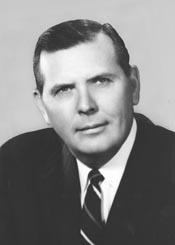
Historical · U.S. House · Virginia · District 10
Joel Broyhill
Former U.S. Representative · Virginia District 10 · 1953–1975 · Republican
Joel Broyhill represented Virginia's District 10 in the United States House of Representatives (1953–1975) for the Republican party. The page below collects sourced biographical facts, term history, committee roles, and provenance for Broyhill.
Bioguide ID: B000967
Key facts
- Full name
- Joel Broyhill
- State
- Virginia
- District
- District 10
- Party
- Republican
- House service
- 1953–1975
- First House term
- 1953
- Status
- Left office
- Current term ends
- —
- Born
- 1919
- Bioguide ID
- B000967
- Committee assignments
- —
- Dataset version
- 1.20260605
Biographical narrative
1,053 words · sourced from the Wikipedia REST extract
Joel T. Broyhill was an American politician who served as a U.S. Representative for Virginia's 10th congressional district from 1953 until 1975. A member of the Republican Party, Broyhill was known for his advocacy on behalf of federal workers and his significant involvement in local infrastructure projects. His tenure in Congress spanned over two decades, during which he became a prominent figure in Virginia politics, particularly in the suburbs of Arlington, Falls Church, and parts of Fairfax County and Alexandria.
Early life and career
Joel Thomas Broyhill was born on November 4, 1919, into a family with deep roots in Virginia. His grandfather, Thomas Jefferson Broyhill, was a notable figure in his community, having established various businesses, including sawmills, in North Carolina before the family moved to Virginia. Joel's father, Marvin Talmadge Broyhill Sr., relocated the family to Hopewell, Virginia, where he worked for the DuPont Powder Company and later founded a successful real estate business. This early exposure to business and community service likely influenced Broyhill's later political career.
Broyhill's formative years were spent in Arlington, Virginia, where he moved at the age of eighteen. He attended George Washington University from 1939 to 1941, where he began to develop his interests in business and public service. His education was interrupted by World War II, during which he enlisted in the United States Army in February 1942. Serving as a captain in the 106th Infantry Division, Broyhill participated in significant military engagements, including the Battle of the Bulge, where he was captured by German forces. After enduring six months as a prisoner of war, he escaped and rejoined U.S. forces, ultimately being released from active duty on November 1, 1945. His military service earned him several commendations, including a Bronze Star Medal.
Following the war, Broyhill returned to his family's real estate business, M.T. Broyhill & Sons Corporation, where he became a partner and general manager. Under his leadership, the firm thrived, constructing thousands of homes annually and becoming a major customer for General Electric appliances. His involvement in local business and community affairs laid the groundwork for his entry into politics.
House tenure
Broyhill's political career began in earnest when he was elected president of the Arlington County Chamber of Commerce and later became chairman of the Arlington County Planning Commission. In 1950, he was elected president of the Arlington Republican Club, further solidifying his political connections and influence within the local Republican Party.
In 1952, Broyhill ran for Congress to represent Virginia's newly established 10th congressional district, which included the inner suburbs of Washington, D.C. He won the election by a narrow margin, defeating Democrat Edmund D. Campbell by 322 votes. Broyhill's victory coincided with a significant Republican wave led by Dwight D. Eisenhower, which contributed to his electoral success. He served a total of 11 terms in the House of Representatives, with his first term beginning in 1953 and concluding in 1975.
Throughout his congressional career, Broyhill was known for his strong focus on constituent services. His office was characterized by a rapid response system, sending out Western Union telegrams to government agencies on behalf of constituents every 30 minutes. This dedication to serving his constituents earned him a reputation for being accessible and responsive to the needs of the people he represented.
Broyhill's legislative efforts were primarily centered on local infrastructure and support for federal employees. He sponsored significant projects, including the construction of the Roosevelt and Woodrow Wilson bridges across the Potomac River and the expansion of the 14th Street Bridge. Additionally, he advocated for improvements to Shirley Highway and fought for better pay and working conditions for federal employees. His commitment to local issues resonated with his constituents, contributing to his electoral success over the years.
Despite his popularity in Virginia, Broyhill faced challenges during his political career. He was a vocal opponent of home rule for the District of Columbia, arguing that the U.S. Constitution placed ultimate responsibility for the nation's capital with Congress. This stance drew criticism from D.C. leaders, who accused him of harboring racial motives in his opposition to self-governance for a predominantly Black city. However, many in Northern Virginia viewed his position as a defense against potential taxation by the city on suburban residents.
Broyhill's congressional career came to an end in 1974 when he lost his seat during a Democratic landslide in the wake of the Watergate scandal and the resignation of President Richard Nixon. His defeat marked the end of an era for the 10th congressional district, which had been represented by Broyhill for over two decades.
Legislative focus and committees
During his time in Congress, Broyhill served on several influential committees, most notably the House Ways and Means Committee. This committee is responsible for overseeing taxation and revenue generation, making it one of the most powerful bodies in the House. His involvement in this committee allowed him to influence significant legislation related to taxation and economic policy.
Broyhill's legislative focus included a range of issues that were important to his constituents and the broader community. He was a proponent of federal aid to local school systems and supported measures aimed at improving the quality of education. Additionally, he advocated for financial support for the Washington Metropolitan Area Transit Authority, recognizing the importance of public transportation for the growing suburban population.
Broyhill also supported constitutional amendments that expanded voting rights, including the 23rd Amendment, which granted D.C. residents the right to vote for president and vice president, and the 26th Amendment, which lowered the voting age to 18. His advocacy for these amendments reflected his commitment to expanding democratic participation.
Throughout his tenure, Broyhill maintained a focus on the needs of federal employees, championing legislation that aimed to improve their working conditions and compensation. His efforts in this area were well-received by the federal workforce, contributing to his reputation as a representative who prioritized the interests of his constituents.
In summary, Joel T. Broyhill's career as a U.S. Representative was marked by a strong commitment to local issues, particularly those affecting federal employees and infrastructure development. His legislative achievements and dedication to constituent services left a lasting impact on the communities he represented in Virginia's 10th congressional district. After serving 11 terms in Congress, Broyhill's legacy continues to be remembered in the context of Virginia's political history.
Notable legislation
Sponsored and co-sponsored legislation for Joel Broyhill is pending operator curation. The biographical narrative above carries the same provenance trail until per-bill rows are written.
Sources
- [1]https://en.wikipedia.org/wiki/Joel_BroyhillWikipedia · retrieved 2026-06-05
Notable quotes
Sourced quotes for Joel Broyhill are pending operator curation. Narrative-scope provenance remains attached below.
Sources
- [1]https://en.wikipedia.org/wiki/Joel_BroyhillWikipedia · retrieved 2026-06-05
Key positions
Curated policy positions for Joel Broyhill are pending operator review. The biographical narrative above carries the same provenance trail until per-topic positions are written.
Sources
- [1]https://en.wikipedia.org/wiki/Joel_BroyhillWikipedia · retrieved 2026-06-05
Terms served
- 1953–1955U.S. House · Term 1 · Republican
- 1955–1957U.S. House · Term 2 · Republican
- 1957–1959U.S. House · Term 3 · Republican
- 1959–1961U.S. House · Term 4 · Republican
- 1961–1963U.S. House · Term 5 · Republican
- 1963–1965U.S. House · Term 6 · Republican
- 1965–1967U.S. House · Term 7 · Republican
- 1967–1969U.S. House · Term 8 · Republican
- 1969–1971U.S. House · Term 9 · Republican
- 1971–1973U.S. House · Term 10 · Republican
- 1973–1975U.S. House · Term 11 · Republican
Sources & provenance
Every attributable claim above carries a per-section [N] marker that resolves to the corresponding URL below. Each entry records the upstream provider, the canonical URL, and the timestamp at which the source was retrieved by the ingest pipeline.
Key facts
- https://bioguide.congress.gov/search/bio/B000967bioguide · retrieved 2026-06-05
- https://www.govtrack.us/congress/members/401919govtrack · retrieved 2026-06-05
Biographical narrative
- https://en.wikipedia.org/wiki/Joel_Broyhillwikipedia · retrieved 2026-06-05
Find your representative
Every U.S. state elects representatives by district. Browse Virginia’s delegation, the full former-representative roster, or explore the role and term length.
Related on The Candidate
- Preceded by Henry TuckerEarlier holder of the Virginia District 10 House seat · Democratic.Open
- Succeeded by Joseph FisherLater holder of the Virginia District 10 House seat · Democratic.Open
- Alexander WhiteFormer U.S. Representative · Virginia District 1Open
- Archibald AtkinsonFormer U.S. Representative · Virginia District 1 · DemocraticOpen
- Beverly DouglasFormer U.S. Representative · Virginia District 1 · DemocraticOpen
- Daniel MorganFormer U.S. Representative · Virginia District 1 · FederalistOpen