
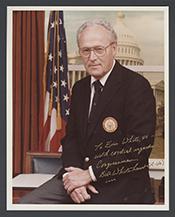
Historical · U.S. House · Virginia · District 2
George Whitehurst
Former U.S. Representative · Virginia District 2 · 1969–1987 · Republican
George Whitehurst represented Virginia's District 2 in the United States House of Representatives (1969–1987) for the Republican party. The page below collects sourced biographical facts, term history, committee roles, and provenance for Whitehurst.
Bioguide ID: W000406
Key facts
- Full name
- George Whitehurst
- State
- Virginia
- District
- District 2
- Party
- Republican
- House service
- 1969–1987
- First House term
- 1969
- Status
- Left office
- Current term ends
- —
- Born
- 1925
- Bioguide ID
- W000406
- Committee assignments
- —
- Dataset version
- 1.20260605
Biographical narrative
893 words · sourced from the Wikipedia REST extract
G. William Whitehurst is a retired American politician, journalist, and academic who served as a U.S. Representative for Virginia's 2nd congressional district from 1969 until 1987. A member of the Republican Party, Whitehurst was notable for being the first Republican to represent his district since the Great Depression and for his moderate conservative stance on various issues. Following his congressional career, he returned to academia, where he continued to influence public affairs until his retirement.
Early life and career
G. William Whitehurst was born on March 12, 1925, in Norfolk, Virginia. He was the son of Calvert Stanhope Whitehurst and Laura Virginia Tomlinson. Whitehurst completed his secondary education at Matthew Fontaine Maury High School, graduating in 1942. Shortly thereafter, he enlisted in the United States Navy, where he served as an aviation radioman in the Pacific Theater during World War II from 1943 to 1946. After his military service, he married Jennette Seymour Franks on August 24, 1946, in Plymouth, Massachusetts. The couple had two children, a son and a daughter. Jennette Whitehurst passed away on March 6, 2009.
Whitehurst pursued higher education after the war, earning a bachelor's degree in history from Washington and Lee University in 1950. He continued his studies at the University of Virginia, where he received a master's degree in history in 1951. His academic journey culminated in 1962 when he obtained a Doctor of Philosophy in American Diplomatic History from West Virginia University. During his time at Washington and Lee University, he became a member of the Delta Upsilon fraternity and later served on its board of directors.
In 1950, Whitehurst began his professional career as a faculty member at the Norfolk Division of William & Mary, which later became Old Dominion University in 1962. He played a significant role in the institution's transition to a four-year university and served as the dean of students from 1963 until 1968. His academic career laid a strong foundation for his subsequent entry into politics.
House tenure
Whitehurst entered politics in 1968 when he ran for a seat in the U.S. House of Representatives. He was elected as a Republican representative for Virginia's 2nd congressional district, which is primarily located in the Hampton Roads area. His election was historically significant, as he became the first Republican to represent this district since the Great Depression and only the second Republican to win a full term in the 20th century.
Throughout his time in Congress, Whitehurst was re-elected on multiple occasions, demonstrating a strong electoral presence in his district. His initial victory in 1968 saw him defeating Democrat Frederick T. Stant with a substantial majority. Over the years, he continued to secure re-election, often with significant margins. For instance, in 1972, he won against Democrat L. Charles Burlage with over 73% of the vote. Even during challenging political climates, such as the aftermath of the Watergate scandal in 1974, Whitehurst maintained a comfortable victory, garnering nearly 60% of the vote.
From 1978 to 1984, Whitehurst faced minimal opposition, with the Democratic Party not fielding candidates against him in several elections. In 1986, he expressed support for the naturalization of Filipino individuals serving in the U.S. Navy, reflecting his engagement with issues affecting military personnel and their families. After serving nine terms in Congress, Whitehurst chose not to seek re-election for a tenth term, concluding his congressional career on January 3, 1987.
Legislative focus and committees
During his tenure in the House of Representatives, Whitehurst was a member of several key committees that shaped his legislative focus. He served on the United States House Committee on Armed Services, where he was involved in matters related to national defense and military operations. His role on this committee was particularly relevant given the strategic importance of the Hampton Roads area, which is home to several military installations.
In addition to Armed Services, Whitehurst was a member of the United States House Permanent Select Committee on Intelligence, where he contributed to discussions and decisions regarding national security and intelligence operations. His involvement in these committees underscored his commitment to issues of defense and security, which were central to the interests of his constituents.
Whitehurst also served on the United States House Committee on Ethics, where he participated in overseeing ethical standards and practices within the House. His moderate conservative stance was evident in his voting record, which included support for the Equal Employment Opportunity Act of 1972 and the Equal Rights Amendment, while he maintained opposition to abortion.
After retiring from Congress, Whitehurst returned to Old Dominion University, where he continued to engage in academia as a faculty member. He held the position of Kaufman Lecturer in Public Affairs until his retirement in May 2020. His long-standing connection to the university and his contributions to public affairs reflected his ongoing commitment to education and civic engagement.
In addition to his academic pursuits, Whitehurst worked as an analyst for WTKR, a television station in Norfolk, where he provided insights on political matters and public policy. His extensive career in both politics and academia has left a lasting impact on the community he served and the institutions with which he was associated.
Throughout his life, G. William Whitehurst has exemplified a dedication to public service, education, and civic involvement, contributing to both the political landscape of Virginia and the academic community at Old Dominion University.
Notable legislation
Sponsored and co-sponsored legislation for George Whitehurst is pending operator curation. The biographical narrative above carries the same provenance trail until per-bill rows are written.
Sources
- [1]https://en.wikipedia.org/wiki/G._William_WhitehurstWikipedia · retrieved 2026-06-05
Notable quotes
Sourced quotes for George Whitehurst are pending operator curation. Narrative-scope provenance remains attached below.
Sources
- [1]https://en.wikipedia.org/wiki/G._William_WhitehurstWikipedia · retrieved 2026-06-05
Key positions
Curated policy positions for George Whitehurst are pending operator review. The biographical narrative above carries the same provenance trail until per-topic positions are written.
Sources
- [1]https://en.wikipedia.org/wiki/G._William_WhitehurstWikipedia · retrieved 2026-06-05
Terms served
- 1969–1971U.S. House · Term 1 · Republican
- 1971–1973U.S. House · Term 2 · Republican
- 1973–1975U.S. House · Term 3 · Republican
- 1975–1977U.S. House · Term 4 · Republican
- 1977–1979U.S. House · Term 5 · Republican
- 1979–1981U.S. House · Term 6 · Republican
- 1981–1983U.S. House · Term 7 · Republican
- 1983–1985U.S. House · Term 8 · Republican
- 1985–1987U.S. House · Term 9 · Republican
Sources & provenance
Every attributable claim above carries a per-section [N] marker that resolves to the corresponding URL below. Each entry records the upstream provider, the canonical URL, and the timestamp at which the source was retrieved by the ingest pipeline.
Key facts
- https://bioguide.congress.gov/search/bio/W000406bioguide · retrieved 2026-06-05
- https://www.govtrack.us/congress/members/411566govtrack · retrieved 2026-06-05
Biographical narrative
- https://en.wikipedia.org/wiki/G._William_Whitehurstwikipedia · retrieved 2026-06-05
Find your representative
Every U.S. state elects representatives by district. Browse Virginia’s delegation, the full former-representative roster, or explore the role and term length.
Related on The Candidate
- Preceded by Porter Hardy Jr.Earlier holder of the Virginia District 2 House seat · Democratic.Open
- Succeeded by Owen PickettLater holder of the Virginia District 2 House seat · Democratic.Open
- Alexander WhiteFormer U.S. Representative · Virginia District 1Open
- Archibald AtkinsonFormer U.S. Representative · Virginia District 1 · DemocraticOpen
- Beverly DouglasFormer U.S. Representative · Virginia District 1 · DemocraticOpen
- Daniel MorganFormer U.S. Representative · Virginia District 1 · FederalistOpen