
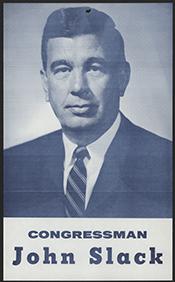
Historical · U.S. House · West Virginia · District 3
John Slack Jr.
Former U.S. Representative · West Virginia District 3 · 1959–1981 · Democratic
John Slack Jr. represented West Virginia's District 3 in the United States House of Representatives (1959–1981) for the Democratic party. The page below collects sourced biographical facts, term history, committee roles, and provenance for Jr..
Bioguide ID: S000473
Key facts
- Full name
- John Slack Jr.
- State
- West Virginia
- District
- District 3
- Party
- Democratic
- House service
- 1959–1981
- First House term
- 1959
- Status
- Left office
- Current term ends
- —
- Born
- 1915
- Bioguide ID
- S000473
- Committee assignments
- —
- Dataset version
- 1.20260605
Biographical narrative
963 words · sourced from the Wikipedia REST extract
John Slack was a prominent American politician who served as a U.S. Representative from West Virginia for over two decades. A member of the Democratic Party, Slack's political career was marked by his long tenure in the House of Representatives, where he was known for his liberal voting record and support for significant civil rights legislation. His service spanned from 1959 until his death in 1980, during which he represented the state's 3rd congressional district. Slack's contributions to American politics were shaped by his early life experiences and his commitment to public service.
Early life and career
John Slack was born on March 18, 1915, in Charleston, West Virginia. He grew up in a region that would later become central to his political career. Slack attended public schools in Charleston, where he received a foundational education that would prepare him for his future endeavors. Following his early education, he furthered his studies at the Virginia Military Institute, located in Lexington, Virginia. This institution is known for its rigorous academic and military training, which likely influenced Slack's discipline and leadership skills.
Slack's public service career began in 1948 when he was elected to the Kanawha County Court. This role marked the beginning of his long-standing commitment to serving the public and addressing local issues. He held this position until 1952, gaining valuable experience in governance and public administration. Following his tenure on the county court, Slack served as the Kanawha County Assessor from 1952 to 1958. In this capacity, he was responsible for assessing property values, which played a crucial role in local taxation and revenue generation. His work in these local government roles helped him build a reputation as a dedicated public servant and laid the groundwork for his future political career.
In 1958, Slack's political trajectory took a significant turn when he sought the Democratic nomination for the U.S. House of Representatives. He entered the race after the incumbent representative, Robert Byrd, decided not to seek re-election in order to pursue a seat in the U.S. Senate. Slack successfully secured the Democratic nomination and subsequently won the election that November, marking the beginning of his lengthy congressional career.
House tenure
John Slack's first term in the U.S. House of Representatives began in 1959, and he would go on to serve a total of 11 terms in office. His tenure in Congress was characterized by a consistent pattern of re-election, as he never faced serious opposition during his time in office. This lack of significant electoral challenges reflects both his popularity within his district and the effectiveness of his political strategies.
In 1963, following the 1960 Census, West Virginia underwent a redistricting process that resulted in the renumbering of congressional districts. Slack's district was renumbered from the 6th to the 3rd District, but this change did not impact his electoral success. Throughout his time in Congress, Slack was known for his ability to connect with constituents and address their concerns, which contributed to his sustained electoral victories.
Slack's legislative career was marked by his involvement in key national issues and his support for various pieces of significant legislation. He was a member of Congress during a transformative period in American history, which included the civil rights movement and the push for social justice. His voting record indicates a commitment to progressive values, as he supported landmark civil rights legislation, including the Civil Rights Acts of 1960, 1964, and 1968, as well as the Voting Rights Act of 1965. These votes demonstrated his alignment with the broader Democratic Party agenda of the time, which sought to address racial discrimination and promote equality.
Slack's long tenure in the House allowed him to build relationships with fellow lawmakers and gain influence within the Democratic Party. His experience and seniority positioned him as a respected figure in Congress, and he was able to contribute to discussions on a wide range of issues. His liberal voting record reflected his belief in the government's role in promoting social welfare and protecting civil rights.
Legislative focus and committees
During his time in the House of Representatives, John Slack was involved in various legislative initiatives and served on several committees that shaped his policy focus. His commitment to civil rights and social justice was a defining aspect of his legislative agenda. Slack's support for civil rights legislation was consistent with the Democratic Party's platform during the 1960s and 1970s, as the party sought to address systemic inequalities in American society.
In addition to civil rights, Slack's legislative interests likely extended to issues affecting his constituents in West Virginia. As a representative from a state with significant economic challenges, he may have focused on policies related to economic development, job creation, and infrastructure improvements. While specific details about his committee assignments are not provided, it is common for members of Congress to serve on committees that align with their interests and the needs of their districts.
Slack's ability to navigate the complexities of legislative processes and his dedication to public service contributed to his reputation as an effective lawmaker. His long tenure in Congress allowed him to witness and participate in significant political changes, including the evolution of the Democratic Party's stance on various social issues.
John Slack's life came to an end on March 17, 1980, when he passed away from a heart attack in Alexandria, Virginia. His death marked the conclusion of a notable political career that spanned over two decades. Following his passing, a special election was held to fill his seat, resulting in the election of John G. Hutchinson, who was then the mayor of Charleston. Slack was interred at Cunningham Memorial Park in St. Albans, West Virginia, leaving behind a legacy of public service and commitment to the principles of democracy and civil rights.
Notable legislation
Sponsored and co-sponsored legislation for John Slack Jr. is pending operator curation. The biographical narrative above carries the same provenance trail until per-bill rows are written.
Sources
- [1]https://en.wikipedia.org/wiki/John_M._Slack_Jr.Wikipedia · retrieved 2026-06-05
Notable quotes
Sourced quotes for John Slack Jr. are pending operator curation. Narrative-scope provenance remains attached below.
Sources
- [1]https://en.wikipedia.org/wiki/John_M._Slack_Jr.Wikipedia · retrieved 2026-06-05
Key positions
Curated policy positions for John Slack Jr. are pending operator review. The biographical narrative above carries the same provenance trail until per-topic positions are written.
Sources
- [1]https://en.wikipedia.org/wiki/John_M._Slack_Jr.Wikipedia · retrieved 2026-06-05
Terms served
- 1959–1961U.S. House · Term 1 · Democratic
- 1961–1963U.S. House · Term 2 · Democratic
- 1963–1965U.S. House · Term 3 · Democratic
- 1965–1967U.S. House · Term 4 · Democratic
- 1967–1969U.S. House · Term 5 · Democratic
- 1969–1971U.S. House · Term 6 · Democratic
- 1971–1973U.S. House · Term 7 · Democratic
- 1973–1975U.S. House · Term 8 · Democratic
- 1975–1977U.S. House · Term 9 · Democratic
- 1977–1979U.S. House · Term 10 · Democratic
- 1979–1981U.S. House · Term 11 · Democratic
Sources & provenance
Every attributable claim above carries a per-section [N] marker that resolves to the corresponding URL below. Each entry records the upstream provider, the canonical URL, and the timestamp at which the source was retrieved by the ingest pipeline.
Key facts
- https://bioguide.congress.gov/search/bio/S000473bioguide · retrieved 2026-06-05
- https://www.govtrack.us/congress/members/409963govtrack · retrieved 2026-06-05
Biographical narrative
- https://en.wikipedia.org/wiki/John_M._Slack_Jr.wikipedia · retrieved 2026-06-05
Find your representative
Every U.S. state elects representatives by district. Browse West Virginia’s delegation, the full former-representative roster, or explore the role and term length.
Related on The Candidate
- Preceded by Edward RohrboughEarlier holder of the West Virginia District 3 House seat · Republican.Open
- Succeeded by David StatonLater holder of the West Virginia District 3 House seat · Republican.Open
- Alan MollohanFormer U.S. Representative · West Virginia District 1 · DemocraticOpen
- Andrew SchifflerFormer U.S. Representative · West Virginia District 1 · RepublicanOpen
- Arch Moore Jr.Former U.S. Representative · West Virginia District 1 · RepublicanOpen
- Benjamin RosenbloomFormer U.S. Representative · West Virginia District 1 · RepublicanOpen