
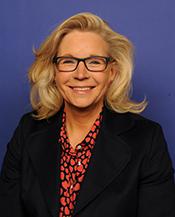
Historical · U.S. House · Wyoming · At-Large
Liz Cheney
Former U.S. Representative · Wyoming At-Large · 2017–2023 · Republican
Liz Cheney represented Wyoming's At-Large in the United States House of Representatives (2017–2023) for the Republican party. The page below collects sourced biographical facts, term history, committee roles, and provenance for Cheney.
Bioguide ID: C001109
Key facts
- Full name
- Liz Cheney
- State
- Wyoming
- District
- At-Large
- Party
- Republican
- House service
- 2017–2023
- First House term
- 2017
- Status
- Left office
- Current term ends
- —
- Born
- 1966
- Bioguide ID
- C001109
- Committee assignments
- —
- Dataset version
- 1.20260604
Biographical narrative
896 words · sourced from the Wikipedia REST extract
Elizabeth Lynne Cheney is an American attorney and former politician who served as the U.S. Representative for Wyoming's at-large congressional district from 2017 until 2023. A member of the Republican Party, Cheney is recognized for her significant role in the House of Representatives, including her tenure as chair of the House Republican Conference from 2019 to 2021. She is particularly noted for her vocal opposition to former President Donald Trump, which ultimately influenced her political trajectory and party affiliations.
Early life and career
Liz Cheney was born on July 28, 1966, in Madison, Wisconsin, to Dick Cheney and Lynne Cheney, both of whom were engaged in their studies at the University of Wisconsin–Madison at the time of her birth. She has a younger sister, Mary Cheney. During her childhood, the family frequently moved between Casper, Wyoming, and Washington, D.C., particularly after her father was elected to Congress. This upbringing in a politically active family likely influenced her future career in politics.
Cheney attended McLean High School in Virginia, where she graduated in 1984. During her high school years, she was involved in various extracurricular activities, including cheerleading. After high school, she pursued higher education at Colorado College, earning a Bachelor of Arts degree in political science in 1988. Her senior thesis focused on "The Evolution of Presidential War Powers," reflecting her early interest in political and legal issues.
Following her undergraduate education, Cheney worked for the U.S. State Department and the United States Agency for International Development (USAID) from 1989 until 1993. She then joined Armitage Associates LLP, a consulting firm founded by Richard Armitage, a former Defense Department official. Cheney's career in public service continued as she practiced law at the law firm White & Case and served as an international law attorney and consultant at the International Finance Corporation, which is part of the World Bank Group.
In 2002, Cheney was appointed as the deputy assistant secretary of state for Near Eastern affairs. This role involved promoting economic investment in the Middle East and overseeing the Middle East Partnership Initiative, which aimed to foster democracy and economic progress in the region. Her appointment was notable, as it came amid discussions about the U.S. government's commitment to reform in the Middle East. Cheney's work in this position included managing significant funding for initiatives aimed at supporting democratic movements and economic development in the region.
House tenure
Cheney's political career took a significant turn when she entered the race for the U.S. House of Representatives in 2016. She was elected to represent Wyoming's at-large congressional district in the November 2016 elections, succeeding Cynthia Lummis. Cheney's first term in the House began in January 2017, and she was re-elected for two additional terms, serving until January 3, 2023.
During her time in Congress, Cheney quickly established herself as a prominent figure within the Republican Party. She was elected chair of the House Republican Conference in 2019, making her the third-ranking Republican in the House. In this leadership role, she was responsible for communicating the party's message and strategy to its members and the public.
Cheney's tenure in the House was marked by her complex relationship with the party, particularly regarding her stance on former President Donald Trump. While she generally supported many of Trump's policies, she became increasingly critical of his actions, particularly following the events of January 6, 2021, when a mob stormed the U.S. Capitol. Cheney's decision to support the second impeachment of Trump after the Capitol riot was a pivotal moment in her political career, leading to significant backlash from party members and ultimately resulting in her removal from Republican leadership in May 2021.
Legislative focus and committees
Throughout her congressional career, Cheney focused on various issues, including national security, foreign policy, and economic matters. She was regarded as a leading voice for neoconservative principles within the Republican Party, advocating for a strong U.S. presence on the global stage and supporting policies that aligned with the traditional Republican establishment's views.
In addition to her leadership role, Cheney was appointed to the House Select Committee on the January 6 Attack, where she served as vice chair. This committee was tasked with investigating the circumstances surrounding the Capitol riot and the broader implications for American democracy. Cheney's participation in this committee further solidified her position as a prominent critic of Trump and his influence on the Republican Party.
Her outspoken criticism of Trump and her support for the impeachment process led to significant consequences for her political career. In November 2021, the Wyoming Republican Party revoked her membership, and she faced censure from the Republican National Committee in February 2022. In the 2022 primary election, Cheney lost her bid for renomination to Harriet Hageman, a candidate endorsed by Trump, receiving a notable minority of the vote.
Following her departure from Congress, Cheney has expressed her intention to remain active in political discourse, particularly regarding the future of the Republican Party. She has indicated a desire to lead efforts aimed at restoring the party's traditional values and principles. In 2024, she was awarded the Presidential Citizens Medal and later took on a role as a professor of practice at the University of Virginia Center for Politics.
Cheney's career reflects a complex interplay of traditional Republican values, national security interests, and a commitment to democratic principles, making her a significant figure in contemporary American politics.
Notable legislation
Sponsored and co-sponsored legislation for Liz Cheney is pending operator curation. The biographical narrative above carries the same provenance trail until per-bill rows are written.
Sources
- [1]https://en.wikipedia.org/wiki/Liz_CheneyWikipedia · retrieved 2026-06-04
Notable quotes
Sourced quotes for Liz Cheney are pending operator curation. Narrative-scope provenance remains attached below.
Sources
- [1]https://en.wikipedia.org/wiki/Liz_CheneyWikipedia · retrieved 2026-06-04
Key positions
Curated policy positions for Liz Cheney are pending operator review. The biographical narrative above carries the same provenance trail until per-topic positions are written.
Sources
- [1]https://en.wikipedia.org/wiki/Liz_CheneyWikipedia · retrieved 2026-06-04
Terms served
- 2017–2019U.S. House · Term 1 · Republican
- 2019–2021U.S. House · Term 2 · Republican
- 2021–2023U.S. House · Term 3 · Republican
Sources & provenance
Every attributable claim above carries a per-section [N] marker that resolves to the corresponding URL below. Each entry records the upstream provider, the canonical URL, and the timestamp at which the source was retrieved by the ingest pipeline.
Key facts
- https://bioguide.congress.gov/search/bio/C001109bioguide · retrieved 2026-06-04
- https://cheney.house.govhouse.gov · retrieved 2026-06-04
Biographical narrative
- https://en.wikipedia.org/wiki/Liz_Cheneywikipedia · retrieved 2026-06-04
Find your representative
Every U.S. state elects representatives by district. Browse Wyoming’s delegation, the full former-representative roster, or explore the role and term length.
Related on The Candidate
- Preceded by Barbara CubinEarlier holder of the Wyoming At-Large House seat · Republican.Open
- Charles WinterFormer U.S. Representative · Wyoming At-Large · RepublicanOpen
- Edwin ThomsonFormer U.S. Representative · Wyoming At-Large · RepublicanOpen
- Frank HortonFormer U.S. Representative · Wyoming At-Large · RepublicanOpen
- Republican PartyFederal candidates and office holders on the Republican line.Open
- Representatives from WyomingEvery former U.S. Representative who has represented Wyoming.Open