
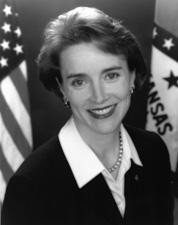
Historical · U.S. Senate · Arkansas
Blanche Lincoln
Former U.S. Senator from Arkansas · 1999–2011 · Democratic · Class 3
Blanche Lincoln represented Arkansas in the United States Senate (1999–2011) for the Democratic party. The page below collects sourced biographical facts, term history, committee roles, and provenance for Lincoln.
Bioguide ID: L000035
Key facts
- Full name
- Blanche Lincoln
- State
- Arkansas
- Party
- Democratic
- Senate class
- Class III
- Senate service
- 1999–2011
- First Senate term
- 1999
- Status
- Left office
- Current term ends
- —
- Born
- 1960
- Bioguide ID
- L000035
- Committee assignments
- —
- Dataset version
- 1.20260601-3
Biographical narrative
856 words · sourced from the Wikipedia REST extract
Blanche L. Lincoln is a former United States senator from Arkansas, serving from 1999 to 2011. A member of the Democratic Party, she was the first woman elected to the Senate from Arkansas and the youngest woman ever to hold a Senate seat at the age of 38. Prior to her Senate tenure, Lincoln represented Arkansas's 1st congressional district in the U.S. House of Representatives from 1993 to 1997. Throughout her political career, she focused on issues pertinent to agriculture, rural development, and health care, and held significant leadership roles, including chairing the Senate Committee on Agriculture, Nutrition, and Forestry.
Early life and career
Blanche Lambert Lincoln was born on September 30, 1960, in Helena, Arkansas, as the daughter of Martha and Jordan Bennett Lambert. She comes from a long line of Arkansas residents, being a seventh-generation Arkansan. Her father worked as a rice and cotton farmer, which likely influenced her later focus on agricultural issues. Lincoln has an older sister, Mary Lambert, who is a film director.
Lincoln's early education took place in the public schools of Helena, where she demonstrated leadership skills by serving as the student council president at Central High School during her senior year. Following high school, she attended the University of Arkansas in Fayetteville, where she was involved in the Chi Omega sorority. She later graduated from Randolph-Macon Woman's College in Virginia in 1982 with a Bachelor of Science degree in biology, initially intending to pursue a career in nursing.
After completing her education, Lincoln began her political career as a staff assistant for U.S. Representative Bill Alexander, a Democrat representing Arkansas's 1st congressional district. She worked in Alexander's office until 1984, gaining valuable experience in the legislative process. In 1994, she married Steve Lincoln, who is distantly related to former President Abraham Lincoln. She is an Episcopalian.
Senate tenure
Blanche Lincoln's political career advanced significantly when she ran for the U.S. Senate in 1998, seeking to fill the seat vacated by retiring Senator Dale Bumpers. She won the Democratic primary and subsequently defeated her Republican opponent, Fay Boozman, in the general election. Lincoln's victory marked a historic moment as she became the first woman elected to the Senate from Arkansas since Hattie Caraway in 1932.
During her first term in the Senate, which lasted from 1999 to 2005, Lincoln focused on issues affecting farmers and rural communities. She was a prominent advocate for the Delta Regional Authority, an initiative aimed at fostering economic development in the lower Mississippi Delta region. Her commitment to agricultural issues continued throughout her Senate career.
In 2004, Lincoln successfully ran for re-election, defeating Republican state Senator Jim Holt. Despite the fact that President George W. Bush won Arkansas in the same election, Lincoln secured her seat with a significant margin.
In her second term, from 2005 to 2011, Lincoln remained active in various legislative matters. In March 2007, she called for the resignation of U.S. Attorney General Alberto Gonzales, expressing concerns over the firing of federal prosecutors and the implications for the relationship between the Justice Department and Congress. Gonzales ultimately resigned later that year.
Lincoln played a crucial role in the passage of the Food, Conservation, and Energy Act of 2008, commonly referred to as the "farm bill." This legislation addressed a range of issues, including nutrition, conservation, rural development, and renewable energy. She was particularly vocal against an amendment that sought to cap government agricultural subsidy payments, arguing that it would adversely affect farmers in her state, particularly cotton growers. Although the amendment passed, Lincoln's threat of a filibuster led to its withdrawal.
In September 2009, Lincoln took a firm stance on health care reform, pledging to filibuster any legislation that included a public health insurance option. This position highlighted her centrist approach and her willingness to negotiate on key issues.
Legislative focus and committees
Throughout her Senate career, Lincoln's legislative focus was primarily on agriculture, rural development, and health care. As the first woman and the first Arkansan to chair the Senate Committee on Agriculture, Nutrition, and Forestry, she was instrumental in shaping policies that affected farmers and rural communities. Her leadership in this committee allowed her to advocate for the interests of her constituents effectively.
In addition to her work on agricultural issues, Lincoln was involved in various other legislative efforts. She was known for her centrist approach, often crossing party lines to support measures that she believed would benefit her constituents. This included her support for the Central America Free Trade Agreement (CAFTA) and her votes in favor of certain tax cuts during the Bush administration.
Lincoln's tenure in the Senate came to an end after she lost her bid for a third term in 2010 to Republican John Boozman. Her defeat marked the conclusion of a significant chapter in her political career, during which she made history as a trailblazer for women in Arkansas politics.
After leaving the Senate, Lincoln became a founding principal of the Lincoln Policy Group, a consulting firm. Her experience in public service and her extensive knowledge of agricultural and rural issues continue to inform her work in the private sector.
Notable legislation
Sponsored and co-sponsored legislation for Blanche Lincoln is pending operator curation. The biographical narrative above carries the same provenance trail until per-bill rows are written.
Sources
- [1]https://en.wikipedia.org/wiki/Blanche_LincolnWikipedia · retrieved 2026-06-01
Notable quotes
Sourced quotes for Blanche Lincoln are pending operator curation. Narrative-scope provenance remains attached below.
Sources
- [1]https://en.wikipedia.org/wiki/Blanche_LincolnWikipedia · retrieved 2026-06-01
Key positions
Curated policy positions for Blanche Lincoln are pending operator review. The biographical narrative above carries the same provenance trail until per-topic positions are written.
Sources
- [1]https://en.wikipedia.org/wiki/Blanche_LincolnWikipedia · retrieved 2026-06-01
Terms served
- 1993–1995U.S. House · District 1 · Term 1 · Democratic
- 1995–1997U.S. House · District 1 · Term 2 · Democratic
- 1999–2005U.S. Senate · Term 3 · Democratic · Class III
- 2005–2011U.S. Senate · Term 4 · Democratic · Class III
Sources & provenance
Every attributable claim above carries a per-section [N] marker that resolves to the corresponding URL below. Each entry records the upstream provider, the canonical URL, and the timestamp at which the source was retrieved by the ingest pipeline.
Key facts
- https://bioguide.congress.gov/search/bio/L000035bioguide · retrieved 2026-06-01
- http://lincoln.senate.gov/senate.gov · retrieved 2026-06-01
Biographical narrative
- https://en.wikipedia.org/wiki/Blanche_Lincolnwikipedia · retrieved 2026-06-01
Find your senator
Every U.S. state elects two senators. Browse Arkansas’s delegation, the full former-senator roster, or explore the role and term length.
Related on The Candidate
- Preceded by Dale BumpersEarlier holder of the Arkansas Class III Senate seat · Democratic.Open
- Alexander McDonaldFormer U.S. Senator from Arkansas · RepublicanOpen
- Ambrose SevierFormer U.S. Senator from Arkansas · DemocraticOpen
- Augustus GarlandFormer U.S. Senator from Arkansas · DemocraticOpen
- Benjamin RiceFormer U.S. Senator from Arkansas · RepublicanOpen
- Democratic PartyFederal candidates and office holders on the Democratic line.Open