
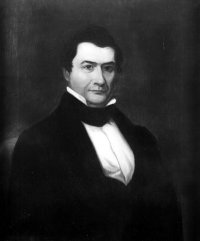
Historical · U.S. Senate · Arkansas
Ambrose Sevier
Former U.S. Senator from Arkansas · 1836–1848 · Democratic · Class 3
Ambrose Sevier represented Arkansas in the United States Senate (1836–1848) for the Democratic party. The page below collects sourced biographical facts, term history, committee roles, and provenance for Sevier.
Bioguide ID: S000256
Key facts
- Full name
- Ambrose Sevier
- State
- Arkansas
- Party
- Democratic
- Senate class
- Class III
- Senate service
- 1836–1848
- First Senate term
- 1836
- Status
- Left office
- Current term ends
- —
- Born
- 1801
- Bioguide ID
- S000256
- Committee assignments
- —
- Dataset version
- 1.20260602
Biographical narrative
963 words · sourced from the Wikipedia REST extract
Ambrose Hundley Sevier was a prominent attorney, politician, and planter from Arkansas, who served as a Democratic U.S. Senator during the antebellum period. Known for his significant contributions to the political landscape of Arkansas, he played a crucial role in the state's journey to statehood and was a key figure in the early governance of the region. His tenure in the U.S. Senate, which began in 1836, marked him as one of the first representatives of Arkansas at the national level. Sevier's political legacy is intertwined with his family's influence in Arkansas politics, as he was part of a notable political dynasty.
Early life and career
Ambrose Hundley Sevier was born on November 4, 1801, near Greeneville in Greene County, Tennessee. His early life was marked by a series of relocations that would ultimately lead him to Arkansas. In 1820, Sevier moved to Missouri before settling in Little Rock, Arkansas, in 1821. His initial foray into public service began when he became the clerk of the Territorial House of Representatives, a position that provided him with valuable experience in governance.
Sevier pursued a legal education and was admitted to the bar in 1823, marking the beginning of his career as an attorney. His legal expertise would later serve as a foundation for his political ambitions. In 1823, he was elected to the Territorial House of Representatives, where he served until 1827. During this time, he was elected as Speaker of the House, further establishing his reputation as a capable leader within the emerging political framework of Arkansas.
In his personal life, Sevier married Juliette Johnson, whose family was also deeply involved in Arkansas politics. Juliette was the sister of Robert Ward Johnson, another influential political figure in the state. Their father, Benjamin Johnson, had a significant role in Arkansas's early judicial system, serving as the first territorial judge and later as the first federal district judge when Arkansas achieved statehood. The couple had several children, contributing to the continuation of their family's political legacy.
Senate tenure
Sevier's political career took a significant turn when he was elected as a Jacksonian Delegate to the 20th U.S. Congress to fill the vacancy left by the death of Henry Wharton Conway, who was killed in a duel. Sevier's election to Congress marked the beginning of his long-standing involvement in national politics. He was reelected and served as a delegate in three successive congresses from 1828 until 1836, when Arkansas was admitted to the Union. His efforts during this period earned him the title of "Father of Arkansas Statehood," reflecting his pivotal role in the state's transition from a territory to a state.
In 1836, Sevier was elected as the first U.S. Senator from Arkansas, representing the state in the Senate as a member of the Democratic Party. His initial election was a significant milestone, as he became one of the first individuals to hold this position following Arkansas's admission to the Union. Sevier was reelected in 1837 and again in 1843, serving a total of three terms in the Senate. During his time in office, he held various leadership roles, including a brief appointment as President pro tempore of the Senate, although he was not formally elected to that position.
Sevier's Senate tenure was marked by his involvement in key committees, including the Committee on Indian Affairs, where he addressed issues related to Native American policy, and the Committee on Foreign Relations, which dealt with matters of international significance. His legislative work during this period contributed to shaping policies that affected both Arkansas and the broader United States.
In addition to his Senate duties, Sevier was appointed in 1848 as a Commissioner to assist in negotiating the Treaty of Guadalupe Hidalgo, which concluded the Mexican-American War. This role underscored his influence in national affairs, as he was involved in discussions that would have lasting implications for U.S. territorial expansion. Shortly after this appointment, he was designated by President James K. Polk to lead what would later evolve into the International Boundary and Water Commission. However, Sevier passed away on December 31, 1848, before he could be confirmed for this position.
Legislative focus and committees
Throughout his Senate career, Ambrose Sevier's legislative focus was primarily on issues pertinent to the growing state of Arkansas and its relationship with the federal government. His work on the Committee on Indian Affairs was particularly significant, as it involved addressing the complex dynamics between the U.S. government and Native American tribes during a time of westward expansion. This committee played a crucial role in shaping policies that would impact the lives of indigenous peoples and the distribution of land in the region.
Sevier's participation in the Committee on Foreign Relations also highlighted his engagement with international matters, particularly in the context of the Mexican-American War. His involvement in negotiating the Treaty of Guadalupe Hidalgo demonstrated his commitment to addressing the challenges and opportunities that arose from territorial changes during this period.
As a member of the Senate, Sevier was part of a broader network of Democratic politicians in Arkansas, many of whom were related to him by blood or marriage. This familial connection to other influential figures, such as his cousins and brother-in-law, reinforced his position within the political landscape of the state. The Conway-Johnson family, to which Sevier belonged, was known for its significant impact on Arkansas politics during the antebellum era.
Ambrose Hundley Sevier's contributions to the political framework of Arkansas and his role in the U.S. Senate reflect the complexities of governance during a transformative period in American history. His legacy is commemorated in various ways, including the naming of Sevier County, Arkansas, in his honor, and his burial in Mount Holly Cemetery, where a monument has been erected to recognize his service and influence.
Notable legislation
Sponsored and co-sponsored legislation for Ambrose Sevier is pending operator curation. The biographical narrative above carries the same provenance trail until per-bill rows are written.
Sources
- [1]https://en.wikipedia.org/wiki/Ambrose_H._SevierWikipedia · retrieved 2026-06-02
Notable quotes
Sourced quotes for Ambrose Sevier are pending operator curation. Narrative-scope provenance remains attached below.
Sources
- [1]https://en.wikipedia.org/wiki/Ambrose_H._SevierWikipedia · retrieved 2026-06-02
Key positions
Curated policy positions for Ambrose Sevier are pending operator review. The biographical narrative above carries the same provenance trail until per-topic positions are written.
Sources
- [1]https://en.wikipedia.org/wiki/Ambrose_H._SevierWikipedia · retrieved 2026-06-02
Terms served
- 1828–1829U.S. House · District -1 · Term 1 · Jacksonian
- 1829–1831U.S. House · District -1 · Term 2 · Jacksonian
- 1831–1833U.S. House · District -1 · Term 3 · Jacksonian
- 1833–1835U.S. House · District -1 · Term 4 · Jacksonian
- 1835–1836U.S. House · District -1 · Term 5 · Jacksonian
- 1836–1837U.S. Senate · Term 6 · Democratic · Class III
- 1837–1843U.S. Senate · Term 7 · Democratic · Class III
- 1843–1848U.S. Senate · Term 8 · Democratic · Class III
Sources & provenance
Every attributable claim above carries a per-section [N] marker that resolves to the corresponding URL below. Each entry records the upstream provider, the canonical URL, and the timestamp at which the source was retrieved by the ingest pipeline.
Key facts
- https://bioguide.congress.gov/search/bio/S000256bioguide · retrieved 2026-06-02
- https://www.govtrack.us/congress/members/409757govtrack · retrieved 2026-06-02
Biographical narrative
- https://en.wikipedia.org/wiki/Ambrose_H._Sevierwikipedia · retrieved 2026-06-02
Find your senator
Every U.S. state elects two senators. Browse Arkansas’s delegation, the full former-senator roster, or explore the role and term length.
Related on The Candidate
- Succeeded by Solon BorlandLater holder of the Arkansas Class III Senate seat · Democratic.Open
- Alexander McDonaldFormer U.S. Senator from Arkansas · RepublicanOpen
- Augustus GarlandFormer U.S. Senator from Arkansas · DemocraticOpen
- Benjamin RiceFormer U.S. Senator from Arkansas · RepublicanOpen
- Blanche LincolnFormer U.S. Senator from Arkansas · DemocraticOpen
- Democratic PartyFederal candidates and office holders on the Democratic line.Open