
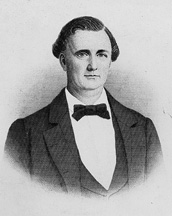
Historical · U.S. Senate · Arkansas
Charles Mitchel
Former U.S. Senator from Arkansas · 1861–1861 · Democratic · Class 3
Charles Mitchel represented Arkansas in the United States Senate (1861–1861) for the Democratic party. The page below collects sourced biographical facts, term history, committee roles, and provenance for Mitchel.
Bioguide ID: M000801
Key facts
- Full name
- Charles Mitchel
- State
- Arkansas
- Party
- Democratic
- Senate class
- Class III
- Senate service
- 1861–1861
- First Senate term
- 1861
- Status
- Left office
- Current term ends
- —
- Born
- 1815
- Bioguide ID
- M000801
- Committee assignments
- —
- Dataset version
- 1.20260602
Biographical narrative
858 words · sourced from the Wikipedia REST extract
Charles Mitchel was an American politician who served as a United States Senator from Arkansas during a tumultuous period in American history. A member of the Democratic Party, he began his Senate career in March 1861 but was expelled later that year due to his support for the Confederacy. Following his expulsion, he was elected to the Confederate States Senate, where he served until his death in 1864. Mitchel's political career was marked by his alignment with the Confederate cause during the American Civil War, reflecting the deep divisions within the United States at that time.
Early life and career
Charles Mitchel was born on September 19, 1815, in Gallatin, Tennessee. He pursued higher education at the University of Nashville, graduating in 1833. Following his undergraduate studies, he attended Jefferson Medical College, where he earned his medical degree in 1836. After completing his education, Mitchel relocated to Washington, Arkansas, where he established a medical practice that he maintained for approximately 25 years. During this time, he became a prominent figure in the local community.
In addition to his medical career, Mitchel engaged in politics. He was elected to the Arkansas House of Representatives in 1848, marking the beginning of his political involvement. His political aspirations continued when he served as the receiver of public monies from 1853 to 1856, a role that involved managing federal funds within the state. Despite his political efforts, he faced challenges in securing a congressional seat, as he was an unsuccessful candidate in the 1860 election for the 37th United States Congress.
Mitchel's life and career were also shaped by the social and economic context of his time. He was a slave owner, which was a common practice among many Southern politicians and landowners in the antebellum period. This aspect of his life reflects the broader societal norms and values that characterized the Southern states prior to the Civil War.
Senate tenure
Mitchel's tenure in the United States Senate began on March 4, 1861, when he was elected as a Democrat to represent Arkansas. His time in the Senate was short-lived, as he served only until July 11, 1861. His expulsion from the Senate was a significant event, occurring in the context of the growing tensions between the Union and the Confederacy. Mitchel's support for the Confederate cause led to his removal, as the Senate was increasingly aligned with the Union's interests during the Civil War.
Following his expulsion from the U.S. Senate, Mitchel's political career took a different direction. He was elected to the Confederate States Senate during the first session of the Arkansas General Assembly. This transition marked his alignment with the Confederacy, as he continued to serve in this capacity until his death in 1864. His role in the Confederate Senate was part of the broader political landscape of the South during the Civil War, as many Southern politicians sought to support their states' secession from the Union and the establishment of the Confederacy.
Mitchel's time in the Confederate Senate was characterized by the challenges faced by the Confederate government, including issues related to military strategy, resource allocation, and the management of the war effort. His involvement in this legislative body reflected his commitment to the Confederate cause and the political dynamics of the time.
Legislative focus and committees
During his brief tenure in the United States Senate, Mitchel's legislative focus and committee assignments are not extensively documented. However, it is known that his political activities were influenced by the prevailing issues of the time, particularly the secession of Southern states and the onset of the Civil War. His alignment with the Democratic Party and subsequent support for the Confederacy suggest that his legislative priorities may have included issues related to states' rights, military support for the Confederate cause, and the defense of Southern interests.
After his expulsion from the U.S. Senate, Mitchel's role in the Confederate Senate would have involved engagement with the legislative challenges facing the Confederacy. This included addressing the needs of the Confederate military, managing the economic difficulties arising from the war, and navigating the political landscape of a government that was struggling to maintain cohesion in the face of external pressures.
Mitchel's contributions to the Confederate Senate would have been shaped by the urgent needs of the Confederacy during the Civil War, as the government sought to mobilize resources and support for its military efforts. His legislative focus likely reflected the priorities of Southern leaders who were committed to the secessionist cause and sought to establish a functioning government in the face of significant challenges.
Charles Mitchel's life and career were ultimately cut short when he passed away on September 20, 1864, just one day after his forty-ninth birthday. He was interred in the Presbyterian Cemetery in Washington, Arkansas. His political legacy is intertwined with the complex history of the Civil War era, reflecting the divisions and conflicts that shaped the United States during this period. As a former U.S. Senator and a member of the Confederate Senate, Mitchel's career serves as a historical example of the political dynamics of the time and the impact of the Civil War on American governance.
Notable legislation
Sponsored and co-sponsored legislation for Charles Mitchel is pending operator curation. The biographical narrative above carries the same provenance trail until per-bill rows are written.
Sources
- [1]https://en.wikipedia.org/wiki/Charles_B._MitchelWikipedia · retrieved 2026-06-02
Notable quotes
Sourced quotes for Charles Mitchel are pending operator curation. Narrative-scope provenance remains attached below.
Sources
- [1]https://en.wikipedia.org/wiki/Charles_B._MitchelWikipedia · retrieved 2026-06-02
Key positions
Curated policy positions for Charles Mitchel are pending operator review. The biographical narrative above carries the same provenance trail until per-topic positions are written.
Sources
- [1]https://en.wikipedia.org/wiki/Charles_B._MitchelWikipedia · retrieved 2026-06-02
Terms served
- 1861–1861U.S. Senate · Term 1 · Democratic · Class III
Sources & provenance
Every attributable claim above carries a per-section [N] marker that resolves to the corresponding URL below. Each entry records the upstream provider, the canonical URL, and the timestamp at which the source was retrieved by the ingest pipeline.
Key facts
- https://bioguide.congress.gov/search/bio/M000801bioguide · retrieved 2026-06-02
- https://www.govtrack.us/congress/members/407777govtrack · retrieved 2026-06-02
Biographical narrative
- https://en.wikipedia.org/wiki/Charles_B._Mitchelwikipedia · retrieved 2026-06-02
Find your senator
Every U.S. state elects two senators. Browse Arkansas’s delegation, the full former-senator roster, or explore the role and term length.
Related on The Candidate
- Preceded by Robert JohnsonEarlier holder of the Arkansas Class III Senate seat · Democratic.Open
- Succeeded by Benjamin RiceLater holder of the Arkansas Class III Senate seat · Republican.Open
- Alexander McDonaldFormer U.S. Senator from Arkansas · RepublicanOpen
- Ambrose SevierFormer U.S. Senator from Arkansas · DemocraticOpen
- Augustus GarlandFormer U.S. Senator from Arkansas · DemocraticOpen
- Democratic PartyFederal candidates and office holders on the Democratic line.Open