
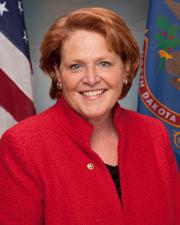
Historical · U.S. Senate · North Dakota
Heidi Heitkamp
Former U.S. Senator from North Dakota · 2013–2019 · Democratic · Class 1
Heidi Heitkamp represented North Dakota in the United States Senate (2013–2019) for the Democratic party. The page below collects sourced biographical facts, term history, committee roles, and provenance for Heitkamp.
Bioguide ID: H001069
Key facts
- Full name
- Heidi Heitkamp
- State
- North Dakota
- Party
- Democratic
- Senate class
- Class I
- Senate service
- 2013–2019
- First Senate term
- 2013
- Status
- Left office
- Current term ends
- —
- Born
- 1955
- Bioguide ID
- H001069
- Committee assignments
- —
- Dataset version
- 1.20260601-7
Biographical narrative
888 words · sourced from the Wikipedia REST extract
Mary Kathryn "Heidi" Heitkamp is an American politician and lawyer who served as a United States Senator from North Dakota from 2013 until 2019. A member of the Democratic Party, Heitkamp made history in 2012 by becoming the first woman elected to Congress from North Dakota. Her political career includes significant roles in state government, including serving as North Dakota's tax commissioner and attorney general. After her tenure in the Senate, Heitkamp has continued to engage in public service and political discourse through various roles, including as a contributor to media outlets and as a director at the University of Chicago Institute of Politics.
Early life and career
Heidi Heitkamp was born on October 30, 1955, in Breckenridge, Minnesota, as the fourth of seven children in her family. Her parents, Doreen LaVonne and Raymond Bernard Heitkamp, had diverse backgrounds; her mother worked as a school cook and had Norwegian and German ancestry, while her father was a janitor and construction worker of German descent. The family was raised in Mantador, North Dakota, where Heitkamp attended local public schools. To differentiate herself from two classmates named Mary and Kathy, she adopted the nickname "Heidi" during her first grade.
Heitkamp pursued higher education at the University of North Dakota, where she earned a Bachelor of Arts degree in 1977. She later attended Lewis & Clark Law School, obtaining her Juris Doctor in 1980. Early in her career, Heitkamp gained experience in government and law by interning for the United States Congress in 1976 and the North Dakota Legislative Assembly in 1977. Following her graduation from law school, she worked as an attorney for the Environmental Protection Agency in 1980 and 1981.
Transitioning into state politics, Heitkamp served as an attorney for North Dakota State Tax Commissioner Kent Conrad. Her political involvement deepened as she joined the North Dakota Democratic–Nonpartisan League Party. In 1984, she made her first bid for public office, running for state auditor but losing to the incumbent Republican. However, her political fortunes changed in 1986 when she was appointed tax commissioner by Governor George A. Sinner after Conrad's election to the U.S. Senate. Heitkamp successfully ran for the position and was elected with a significant majority, serving until 1992.
Senate tenure
Heitkamp's political career continued to evolve when she ran for North Dakota attorney general in 1992, winning the election with a substantial margin. She was reelected in 1996, serving a total of eight years in that role. During her time as attorney general, Heitkamp gained recognition for her leadership in legal efforts against tobacco companies, which contributed to the Tobacco Master Settlement Agreement.
In 2000, Heitkamp sought the governorship of North Dakota after the incumbent Republican governor chose not to run for a third term. She won the Democratic primary unopposed but was ultimately defeated by Republican John Hoeven in the general election. Following this setback, Heitkamp continued her professional journey in the business sector, serving on the board of directors for the Dakota Gasification Company's Great Plains synfuels plant from 2001 to 2012.
Heitkamp's return to politics came in 2011 when she announced her candidacy for the U.S. Senate seat being vacated by retiring Senator Kent Conrad. Her campaign focused on being an independent voice for North Dakota, and on November 6, 2012, she narrowly won the election against Republican Congressman Rick Berg, marking a significant achievement as the first woman elected to Congress from the state. Heitkamp served in the Senate from January 3, 2013, until January 3, 2019, representing North Dakota alongside Republican Senator John Hoeven.
During her time in the Senate, Heitkamp was involved in various legislative initiatives and discussions pertinent to her constituents and the nation. Her tenure was marked by a focus on issues affecting rural communities and a commitment to bipartisan collaboration. In 2018, she sought reelection but was defeated by Republican Kevin Cramer, concluding her time in the Senate.
Legislative focus and committees
Throughout her Senate career, Heitkamp was known for her pragmatic approach to governance, often emphasizing the importance of working across party lines. Her legislative focus included issues relevant to agriculture, energy, and rural development, reflecting the interests of her North Dakota constituents. Heitkamp's background as a former attorney general and tax commissioner informed her perspectives on various legal and fiscal matters.
In the Senate, Heitkamp served on several committees, where she contributed to discussions and decisions on a range of topics. Her experience in state government and law provided her with a unique insight into the challenges faced by rural states, and she advocated for policies that would benefit North Dakota's economy and communities.
After leaving the Senate, Heitkamp continued to engage in political discourse and public service. She became a contributor for CNBC and took on a role as a visiting fellow at the Harvard Kennedy School's Institute of Politics. In April 2019, she co-founded the One Country Project with former Senator Joe Donnelly, aiming to help Democrats reconnect with rural voters. In January 2023, Heitkamp was appointed as the director of the University of Chicago Institute of Politics, a position she held until November 2025.
Heidi Heitkamp's career reflects a commitment to public service and a focus on the needs of her constituents, and she remains an influential figure in discussions surrounding rural politics and governance in the United States.
Notable legislation
Sponsored and co-sponsored legislation for Heidi Heitkamp is pending operator curation. The biographical narrative above carries the same provenance trail until per-bill rows are written.
Sources
- [1]https://en.wikipedia.org/wiki/Heidi_HeitkampWikipedia · retrieved 2026-06-01
Notable quotes
Sourced quotes for Heidi Heitkamp are pending operator curation. Narrative-scope provenance remains attached below.
Sources
- [1]https://en.wikipedia.org/wiki/Heidi_HeitkampWikipedia · retrieved 2026-06-01
Key positions
Curated policy positions for Heidi Heitkamp are pending operator review. The biographical narrative above carries the same provenance trail until per-topic positions are written.
Sources
- [1]https://en.wikipedia.org/wiki/Heidi_HeitkampWikipedia · retrieved 2026-06-01
Terms served
- 2013–2019U.S. Senate · Term 1 · Democratic · Class I
Sources & provenance
Every attributable claim above carries a per-section [N] marker that resolves to the corresponding URL below. Each entry records the upstream provider, the canonical URL, and the timestamp at which the source was retrieved by the ingest pipeline.
Key facts
- https://bioguide.congress.gov/search/bio/H001069bioguide · retrieved 2026-06-01
- https://www.heitkamp.senate.gov/publicsenate.gov · retrieved 2026-06-01
Biographical narrative
- https://en.wikipedia.org/wiki/Heidi_Heitkampwikipedia · retrieved 2026-06-01
Find your senator
Every U.S. state elects two senators. Browse North Dakota’s delegation, the full former-senator roster, or explore the role and term length.
Related on The Candidate
- Preceded by Kent ConradEarlier holder of the North Dakota Class I Senate seat · Democratic.Open
- Asle GronnaFormer U.S. Senator from North Dakota · RepublicanOpen
- Byron DorganFormer U.S. Senator from North Dakota · DemocraticOpen
- Clarence BrunsdaleFormer U.S. Senator from North Dakota · RepublicanOpen
- Edwin LaddFormer U.S. Senator from North Dakota · RepublicanOpen
- Democratic PartyFederal candidates and office holders on the Democratic line.Open