
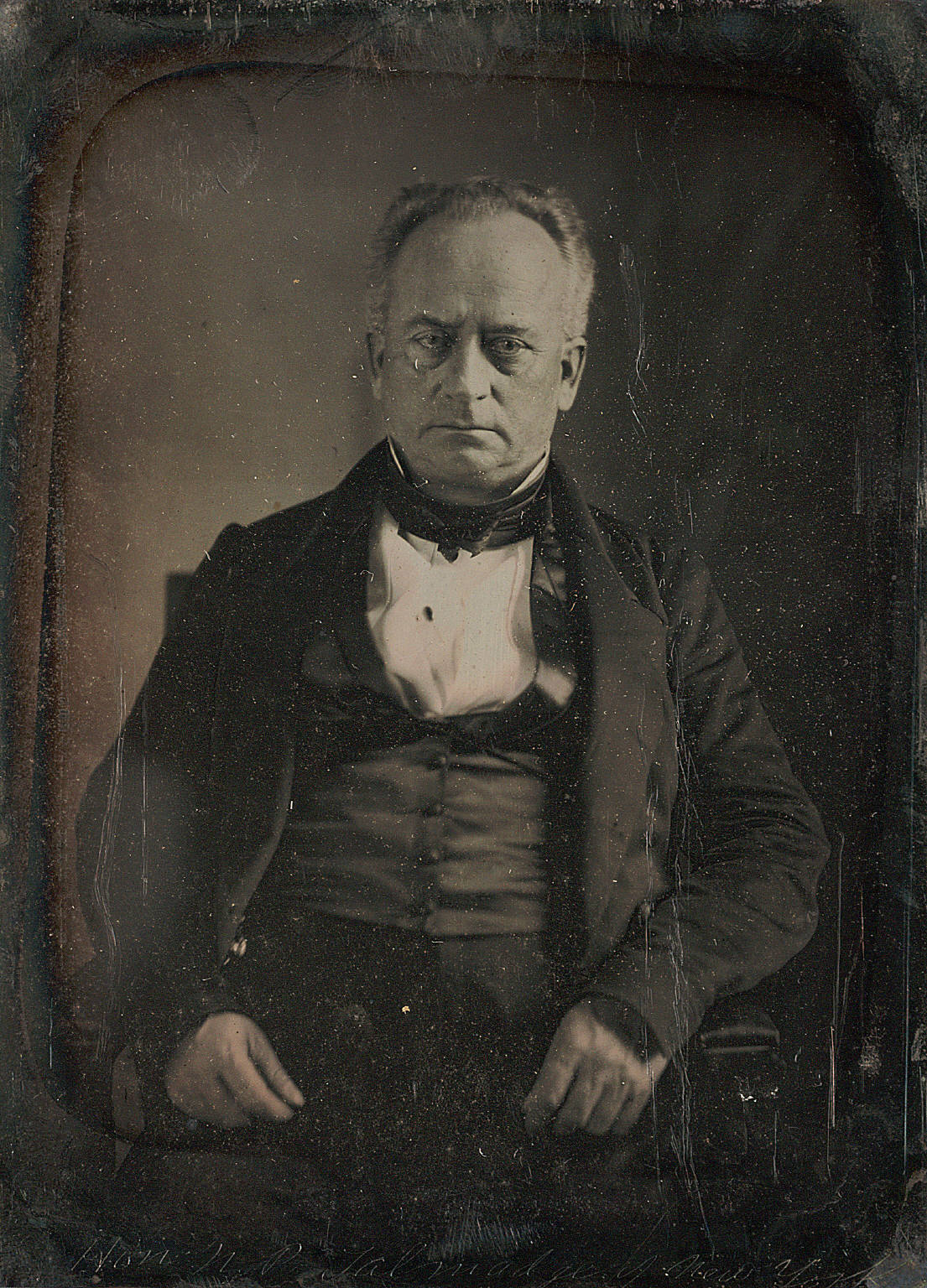
Historical · U.S. Senate · New York
Nathaniel Tallmadge
Former U.S. Senator from New York · 1833–1845 · Whig · Class 1
Nathaniel Tallmadge represented New York in the United States Senate (1833–1845) for the Whig party. The page below collects sourced biographical facts, term history, committee roles, and provenance for Tallmadge.
Bioguide ID: T000032
Key facts
- Full name
- Nathaniel Tallmadge
- State
- New York
- Party
- Whig
- Senate class
- Class I
- Senate service
- 1833–1845
- First Senate term
- 1833
- Status
- Left office
- Current term ends
- —
- Born
- 1795
- Bioguide ID
- T000032
- Committee assignments
- —
- Dataset version
- 1.20260602
Biographical narrative
888 words · sourced from the Wikipedia REST extract
Nathaniel Tallmadge was an American lawyer and politician who served as a United States Senator from New York and later became the third governor of the Wisconsin Territory. A member of the Whig Party, Tallmadge's political career spanned significant periods of American history, reflecting the shifting political landscape of the early 19th century. His tenure in the Senate and his governorship were marked by his advocacy for infrastructure development and a conciliatory approach to governance.
Early life and career
Nathaniel Tallmadge was born on February 8, 1795, in Chatham, New York. He pursued higher education at Williams College before transferring to Union College, where he graduated in 1815. Following his graduation, Tallmadge moved to Poughkeepsie, New York, to study law under the guidance of his first cousin, James Tallmadge Jr. He was admitted to the bar in 1818 and subsequently entered into a legal practice with his cousin, forming a partnership that lasted until James Tallmadge's election as Lieutenant Governor of New York in 1825. After this, Nathaniel Tallmadge continued his legal career independently.
Tallmadge's political involvement began as a member of the Jacksonian Democrats. He was elected to the New York State Assembly representing Dutchess County in 1828 and subsequently served in the New York State Senate from 1830 to 1833. During his time in the State Senate, he participated in the 53rd, 54th, 55th, and 56th New York State Legislatures, where he engaged in various legislative activities that laid the groundwork for his future political endeavors.
Senate tenure
Tallmadge's ascent to the United States Senate began in 1833 when he was elected as a Jacksonian Democrat, taking office on March 4 of that year. His political alignment shifted during his Senate career, particularly as he became disillusioned with the policies of President Martin Van Buren and the Albany Regency, a powerful political faction in New York. In 1838, Tallmadge was part of a faction known as the "Conservatives," which consisted of former Democrats who opposed Van Buren's leadership. This group supported the Whig candidates for governor and lieutenant governor, leading to their narrow election over the incumbents.
By the time of the 1839 election for U.S. Senator, Tallmadge had fully aligned himself with the Whig Party, which nominated him for reelection. However, the Democratic-controlled State Senate opposed him due to his defection from Van Buren's camp. Consequently, the Democrats' refusal to vote resulted in a vacancy for Tallmadge's seat on March 4, 1839. The political landscape shifted in 1840 when the Whigs regained control of both houses of the legislature, leading to Tallmadge's reelection on January 13, 1840. He officially took his seat again on January 27, 1840, and served until June 17, 1844, when he resigned to accept an appointment as governor of the Wisconsin Territory.
During his Senate tenure, Tallmadge was offered the Whig nomination for vice president in 1840, which he declined. He also turned down offers for a cabinet position and an ambassadorship, choosing instead to remain in the Senate. His legislative activities during this period were influenced by his evolving political beliefs and the changing dynamics of the Whig Party.
Legislative focus and committees
Throughout his time in the Senate, Tallmadge focused on various issues, particularly those related to infrastructure and governance. He was a proponent of railroad expansion, reflecting his earlier advocacy while serving in the New York State Legislature. His commitment to infrastructure development was evident in his efforts to promote the construction of railroads, which he believed were essential for economic growth and connectivity.
Tallmadge's approach to governance was characterized by a desire for bipartisanship and collaboration. Upon his appointment as governor of the Wisconsin Territory in 1844, he sought to foster a cooperative relationship with the territorial legislature, which had initially been skeptical of him due to his lack of prior residency in Wisconsin. He addressed this concern by adopting a conciliatory tone in his communications and emphasizing his commitment to nonpartisan governance.
As governor, Tallmadge advocated against extending the naturalization period for Wisconsin citizenship to 21 years, arguing instead for more accessible pathways to citizenship. He also supported the establishment of experimental farms and agricultural societies, recognizing the importance of agriculture in the territory's development. His administration was notable for its efforts to print and distribute his messages to the legislature, including translations into German, marking a significant step in engaging with the diverse population of the territory.
Tallmadge's governorship coincided with the 1844 presidential election, which resulted in the victory of Democrat James K. Polk. Following Polk's election, Tallmadge's tenure as governor came to an end when he was succeeded by Henry Dodge, who was confirmed by the U.S. Senate in April 1845.
After leaving office, Tallmadge chose to remain in Wisconsin, where he built a residence in Fond du Lac and continued to practice law. He maintained a semi-retired lifestyle while also serving as an informal representative for Wisconsin's interests in Washington, D.C. In his later years, Tallmadge developed an interest in spiritualism, believing in the existence of an afterlife and claiming to have experienced premonitions.
Nathaniel Tallmadge's legacy is marked by his contributions to the political landscape of New York and Wisconsin during a transformative period in American history. His career reflects the complexities of 19th-century politics, including party realignments and the challenges of governance in a rapidly changing nation.
Notable legislation
Sponsored and co-sponsored legislation for Nathaniel Tallmadge is pending operator curation. The biographical narrative above carries the same provenance trail until per-bill rows are written.
Sources
- [1]https://en.wikipedia.org/wiki/Nathaniel_P._TallmadgeWikipedia · retrieved 2026-06-02
Notable quotes
Sourced quotes for Nathaniel Tallmadge are pending operator curation. Narrative-scope provenance remains attached below.
Sources
- [1]https://en.wikipedia.org/wiki/Nathaniel_P._TallmadgeWikipedia · retrieved 2026-06-02
Key positions
Curated policy positions for Nathaniel Tallmadge are pending operator review. The biographical narrative above carries the same provenance trail until per-topic positions are written.
Sources
- [1]https://en.wikipedia.org/wiki/Nathaniel_P._TallmadgeWikipedia · retrieved 2026-06-02
Terms served
- 1833–1839U.S. Senate · Term 1 · Democratic · Class I
- 1839–1845U.S. Senate · Term 2 · Whig · Class I
Sources & provenance
Every attributable claim above carries a per-section [N] marker that resolves to the corresponding URL below. Each entry records the upstream provider, the canonical URL, and the timestamp at which the source was retrieved by the ingest pipeline.
Key facts
- https://bioguide.congress.gov/search/bio/T000032bioguide · retrieved 2026-06-02
- https://www.govtrack.us/congress/members/410621govtrack · retrieved 2026-06-02
Biographical narrative
- https://en.wikipedia.org/wiki/Nathaniel_P._Tallmadgewikipedia · retrieved 2026-06-02
Find your senator
Every U.S. state elects two senators. Browse New York’s delegation, the full former-senator roster, or explore the role and term length.
Related on The Candidate
- Preceded by Charles DudleyEarlier holder of the New York Class I Senate seat · Jackson.Open
- Succeeded by Hamilton FishLater holder of the New York Class I Senate seat · Ind. Republican-Democrat.Open
- Aaron BurrFormer U.S. Senator from New York · RepublicanOpen
- Alfonse D’AmatoFormer U.S. Senator from New York · RepublicanOpen
- Charles GoodellFormer U.S. Senator from New York · RepublicanOpen
- Senators from New YorkEvery former U.S. Senator who has represented New York.Open