
Historical · U.S. House · Georgia · District 4
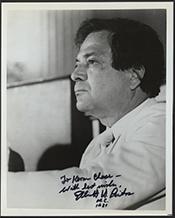
Elliott Levitas
Former U.S. Representative · Georgia District 4 · 1975–1985 · Democratic
Elliott Levitas represented Georgia's District 4 in the United States House of Representatives (1975–1985) for the Democratic party. The page below collects sourced biographical facts, term history, committee roles, and provenance for Levitas.
Bioguide ID: L000265
Key facts
- Full name
- Elliott Levitas
- State
- Georgia
- District
- District 4
- Party
- Democratic
- House service
- 1975–1985
- First House term
- 1975
- Status
- Left office
- Current term ends
- —
- Born
- 1930
- Bioguide ID
- L000265
- Committee assignments
- —
- Dataset version
- 1.20260605
Biographical narrative
972 words · sourced from the Wikipedia REST extract
Elliott H. Levitas was an American politician and lawyer who served as a U.S. Representative for Georgia's 4th congressional district from 1975 to 1985. A member of the Democratic Party, he was notable for being the first Jewish congressman elected in the state of Georgia. Throughout his five terms in Congress, Levitas was recognized for his commitment to environmental issues and civil rights, reflecting a progressive stance during a transformative period in American politics.
Early life and career
Elliott Harris Levitas was born on December 26, 1930, in Atlanta, Georgia. He completed his secondary education at Henry W. Grady High School in 1948. Following high school, Levitas attended Emory University in Atlanta, where he became a member of the secret honor society D.V.S. His academic pursuits continued at the Emory University School of Law, where he earned his Juris Doctor degree in 1956. Levitas was also a Rhodes Scholar, which allowed him to study at the University of Oxford in England, where he obtained a Master of Laws degree in 1958. Additionally, he undertook further legal studies at the University of Michigan from 1954 to 1955.
After being admitted to the Georgia bar in 1955, Levitas began practicing law in Atlanta. His early career was marked by significant involvement in the local Jewish community and organizations such as the Anti-Defamation League. Levitas served in the United States Air Force from 1955 to 1958, contributing to his sense of civic duty and public service.
Levitas's political engagement began to take shape in the 1960s. He was a delegate to the 1964 Democratic National Convention, which nominated the Lyndon B. Johnson and Hubert Humphrey ticket. This convention was notable as it marked the first time since the Reconstruction era that a Democratic slate lost the electoral votes of Georgia.
In 1964, Levitas was elected to the Georgia House of Representatives, where he served from 1965 to 1974. His tenure in the state legislature was characterized by a commitment to civil rights. He gained recognition for his support of civil rights activist Julian Bond during a contentious battle over Bond's election to the legislature. Levitas was one of only five white legislators to vote in favor of seating Bond. During his time in the state House, he also made headlines for his vote in the 1966 gubernatorial race, where he sided with Republican Bo Callaway over the Democratic nominee, Lester Maddox, a known segregationist. Levitas's legislative career in Georgia spanned five terms, during which he established a reputation as a progressive voice.
House tenure
Elliott Levitas was elected to the United States House of Representatives as a Democrat for Georgia's 4th congressional district, beginning his first term on January 3, 1975. He served five consecutive terms, concluding his congressional career on January 3, 1985. His election came during the Watergate class of 1974, a significant political shift that saw many new members elected to Congress in the wake of the Watergate scandal.
Levitas represented a district that included much of DeKalb County, located northeast of Atlanta. Prior to his election, the area had been represented by Republican Benjamin B. Blackburn for four terms. Levitas's arrival in Congress marked a shift in representation for the district, as he brought a Democratic perspective to the legislative process.
During his time in Congress, Levitas quickly became known for his advocacy on environmental issues. His commitment to these causes led him to rise to the chairmanship of the committee responsible for overseeing environmental matters. His legislative efforts were characterized by a focus on policies aimed at protecting natural resources and promoting sustainable practices.
Despite his accomplishments, Levitas faced challenges in his political career. In 1984, he ran for re-election to the 99th United States Congress but was defeated by Republican candidate Pat Swindall. This loss occurred in a political climate influenced by the broader national trends of the time, including the popularity of President Ronald Reagan, who carried the district by a significant margin.
Legislative focus and committees
Throughout his tenure in the U.S. House of Representatives, Elliott Levitas concentrated on a range of legislative issues, with a notable emphasis on environmental protection and civil rights. His leadership in environmental matters was particularly significant, as he played a crucial role in shaping policies that addressed pressing ecological concerns. As chairman of the relevant committee, Levitas worked on legislation aimed at safeguarding the environment and promoting responsible stewardship of natural resources.
In addition to his environmental advocacy, Levitas maintained a strong commitment to civil rights throughout his political career. His early support for Julian Bond in the Georgia legislature exemplified his dedication to advancing social justice and equality. Levitas's legislative focus reflected broader national movements during the 1970s and 1980s, as issues of civil rights and environmental protection gained prominence in American political discourse.
Levitas's work in Congress was marked by collaboration with colleagues across party lines, as he sought to build coalitions to advance his legislative goals. His ability to navigate the complexities of congressional politics allowed him to effectively advocate for the interests of his constituents and the causes he championed.
After leaving Congress, Levitas continued his professional career as a partner at the law firm Kilpatrick Townsend & Stockton. One of his most notable cases involved the Cobell v. Norton lawsuit, which addressed claims by the Blackfeet tribe against the U.S. government regarding compensation for land use. The case resulted in a landmark $3.4 billion verdict, which was the largest class-action award against the U.S. government at that time.
Elliott H. Levitas passed away on December 16, 2022, just ten days before his 92nd birthday. He was laid to rest at Arlington Memorial Park near Atlanta. In recognition of his contributions to public service, Emory University, his alma mater, established an annual award in his honor to recognize outstanding graduating seniors in political science.
Notable legislation
Sponsored and co-sponsored legislation for Elliott Levitas is pending operator curation. The biographical narrative above carries the same provenance trail until per-bill rows are written.
Sources
- [1]https://en.wikipedia.org/wiki/Elliott_H._LevitasWikipedia · retrieved 2026-06-05
Notable quotes
Sourced quotes for Elliott Levitas are pending operator curation. Narrative-scope provenance remains attached below.
Sources
- [1]https://en.wikipedia.org/wiki/Elliott_H._LevitasWikipedia · retrieved 2026-06-05
Key positions
Curated policy positions for Elliott Levitas are pending operator review. The biographical narrative above carries the same provenance trail until per-topic positions are written.
Sources
- [1]https://en.wikipedia.org/wiki/Elliott_H._LevitasWikipedia · retrieved 2026-06-05
Terms served
- 1975–1977U.S. House · Term 1 · Democratic
- 1977–1979U.S. House · Term 2 · Democratic
- 1979–1981U.S. House · Term 3 · Democratic
- 1981–1983U.S. House · Term 4 · Democratic
- 1983–1985U.S. House · Term 5 · Democratic
Sources & provenance
Every attributable claim above carries a per-section [N] marker that resolves to the corresponding URL below. Each entry records the upstream provider, the canonical URL, and the timestamp at which the source was retrieved by the ingest pipeline.
Key facts
- https://bioguide.congress.gov/search/bio/L000265bioguide · retrieved 2026-06-05
- https://www.govtrack.us/congress/members/406766govtrack · retrieved 2026-06-05
Biographical narrative
- https://en.wikipedia.org/wiki/Elliott_H._Levitaswikipedia · retrieved 2026-06-05
Find your representative
Every U.S. state elects representatives by district. Browse Georgia’s delegation, the full former-representative roster, or explore the role and term length.
Related on The Candidate
- Preceded by Benjamin BlackburnEarlier holder of the Georgia District 4 House seat · Republican.Open
- Succeeded by Patrick SwindallLater holder of the Georgia District 4 House seat · Republican.Open
- Andrew SloanFormer U.S. Representative · Georgia District 1 · RepublicanOpen
- Anthony WayneFormer U.S. Representative · Georgia District 1Open
- Archibald MacIntyreFormer U.S. Representative · Georgia District 1 · DemocraticOpen
- Bo GinnFormer U.S. Representative · Georgia District 1 · DemocraticOpen