
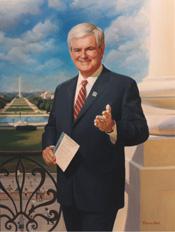
Historical · U.S. House · Georgia · District 6
Newton Gingrich
Former U.S. Representative · Georgia District 6 · 1979–1999 · Republican
Newton Gingrich represented Georgia's District 6 in the United States House of Representatives (1979–1999) for the Republican party. The page below collects sourced biographical facts, term history, committee roles, and provenance for Gingrich.
Bioguide ID: G000225
Key facts
- Full name
- Newton Gingrich
- State
- Georgia
- District
- District 6
- Party
- Republican
- House service
- 1979–1999
- First House term
- 1979
- Status
- Left office
- Current term ends
- —
- Born
- 1943
- Bioguide ID
- G000225
- Committee assignments
- —
- Dataset version
- 1.20260605
Biographical narrative
900 words · sourced from the Wikipedia REST extract
Newton Leroy Gingrich is an American politician who served as a U.S. Representative for Georgia's 6th congressional district from 1979 until his resignation in 1999. A member of the Republican Party, he held significant leadership roles during his tenure, including serving as the 50th Speaker of the House from 1995 to 1999. Gingrich is known for his role in shaping Republican strategies during the 1990s, particularly through the "Contract with America," which played a crucial part in the Republican Party's success in the 1994 congressional elections. After leaving Congress, he remained active in public policy and political consulting, including a bid for the Republican presidential nomination in 2012.
Early life and career
Gingrich was born on June 17, 1943, in Harrisburg, Pennsylvania, as Newton Leroy McPherson. His early family life was marked by instability; his biological parents married when his mother was just 16, but the marriage ended shortly after. In 1946, his mother remarried Robert Gingrich, a career Army officer who adopted him. This new family dynamic led to a childhood spent on military bases, including time in Europe, where he lived in Orléans, France, and Stuttgart, Germany. Gingrich's upbringing was influenced by his adoptive father's military career and the Lutheran faith of his family.
Gingrich's education began in earnest when his family moved to Georgia in 1960, where he graduated from Baker High School in Columbus. His interest in politics was evident from a young age, and he was particularly inspired by historical events, such as the Battle of Verdun, which he visited during his time in France. He pursued higher education at Emory University, earning a Bachelor of Arts degree in history in 1965. He continued his studies at Tulane University, where he completed a Master’s degree in 1968 and a PhD in European history in 1971. His doctoral dissertation focused on Belgian education policy in the Congo from 1945 to 1960.
Gingrich began his professional career as a professor at West Georgia College, where he taught history and geography. However, he spent little time in the classroom, as he was more engaged in political activities. His early political career included serving as the southern regional director for Nelson Rockefeller during the 1968 Republican primaries. Gingrich's ambition to enter politics led him to run for the U.S. House of Representatives on three occasions, although he faced setbacks in his initial attempts.
House tenure
Gingrich's political career in the U.S. House of Representatives began when he was elected in November 1978, making him the first Republican to represent Georgia's 6th congressional district. His election marked a significant shift in the political landscape of the region, which had been dominated by Democrats. Gingrich's tenure in the House spanned a total of ten terms, during which he became known for his strategic thinking and leadership abilities.
In 1989, Gingrich was elected as House minority whip, a position he held until 1995. His leadership was instrumental in the Republican Party's resurgence during the early 1990s, culminating in the 1994 congressional elections, where the Republicans gained a majority in the House for the first time in 40 years. This victory was significantly attributed to the "Contract with America," a document outlining the party's legislative agenda, which Gingrich co-authored and promoted.
Following the Republican victory, Gingrich was elected Speaker of the House in 1995. During his time as Speaker, he oversaw several significant legislative initiatives, including welfare reform and a capital gains tax cut. His leadership style was often characterized by a confrontational approach, which contributed to multiple government shutdowns during his tenure. In 1998, the House voted to impeach President Bill Clinton along party lines, a move that further polarized the political landscape.
However, Gingrich's time as Speaker was not without challenges. The 1998 congressional elections did not yield the results Republicans had hoped for, leading to a loss of seats in the House. Additionally, Gingrich faced scrutiny over ethics violations, resulting in a reprimand from the House. Under pressure from his colleagues and amid declining support, he announced that he would not seek re-election as Speaker and subsequently resigned from the House on January 3, 1999.
Legislative focus and committees
Throughout his congressional career, Gingrich focused on various legislative issues, often emphasizing conservative principles and a commitment to reform. His leadership in the House was marked by efforts to reshape welfare policies and reduce government spending. The welfare reform legislation passed during his tenure aimed to change the structure of welfare assistance, promoting work requirements and state control over welfare programs.
Gingrich's role in the House also included participation in several committees, where he influenced policy discussions and legislative outcomes. His strategic approach to politics involved not only legislative initiatives but also a focus on communication and media engagement, which helped to elevate the Republican Party's visibility during the 1990s.
After leaving Congress, Gingrich continued to engage in public policy debates and political consulting. He founded and chaired various policy think tanks, contributing to discussions on health care, education, and economic reform. His involvement in politics extended to a bid for the Republican presidential nomination in 2012, where he was considered a prominent candidate at various points during the campaign.
In summary, Gingrich's career in the U.S. House of Representatives was marked by significant achievements and challenges. His leadership during a transformative period in American politics left a lasting impact on the Republican Party and the legislative process.
Notable legislation
Sponsored and co-sponsored legislation for Newton Gingrich is pending operator curation. The biographical narrative above carries the same provenance trail until per-bill rows are written.
Sources
- [1]https://en.wikipedia.org/wiki/Newt_GingrichWikipedia · retrieved 2026-06-05
Notable quotes
Sourced quotes for Newton Gingrich are pending operator curation. Narrative-scope provenance remains attached below.
Sources
- [1]https://en.wikipedia.org/wiki/Newt_GingrichWikipedia · retrieved 2026-06-05
Key positions
Curated policy positions for Newton Gingrich are pending operator review. The biographical narrative above carries the same provenance trail until per-topic positions are written.
Sources
- [1]https://en.wikipedia.org/wiki/Newt_GingrichWikipedia · retrieved 2026-06-05
Terms served
- 1979–1981U.S. House · Term 1 · Republican
- 1981–1983U.S. House · Term 2 · Republican
- 1983–1985U.S. House · Term 3 · Republican
- 1985–1987U.S. House · Term 4 · Republican
- 1987–1989U.S. House · Term 5 · Republican
- 1989–1991U.S. House · Term 6 · Republican
- 1991–1993U.S. House · Term 7 · Republican
- 1993–1995U.S. House · Term 8 · Republican
- 1995–1997U.S. House · Term 9 · Republican
- 1997–1999U.S. House · Term 10 · Republican
Sources & provenance
Every attributable claim above carries a per-section [N] marker that resolves to the corresponding URL below. Each entry records the upstream provider, the canonical URL, and the timestamp at which the source was retrieved by the ingest pipeline.
Key facts
- https://bioguide.congress.gov/search/bio/G000225bioguide · retrieved 2026-06-05
- https://www.govtrack.us/congress/members/404587govtrack · retrieved 2026-06-05
Biographical narrative
- https://en.wikipedia.org/wiki/Newt_Gingrichwikipedia · retrieved 2026-06-05
Find your representative
Every U.S. state elects representatives by district. Browse Georgia’s delegation, the full former-representative roster, or explore the role and term length.
Related on The Candidate
- Preceded by John Flynt Jr.Earlier holder of the Georgia District 6 House seat · Democratic.Open
- Succeeded by Tom PriceLater holder of the Georgia District 6 House seat · Republican.Open
- Andrew SloanFormer U.S. Representative · Georgia District 1 · RepublicanOpen
- Anthony WayneFormer U.S. Representative · Georgia District 1Open
- Archibald MacIntyreFormer U.S. Representative · Georgia District 1 · DemocraticOpen
- Bo GinnFormer U.S. Representative · Georgia District 1 · DemocraticOpen