
Historical · U.S. House · Illinois · District 18
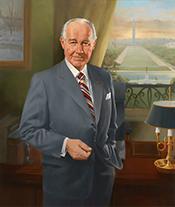
Robert Michel
Former U.S. Representative · Illinois District 18 · 1957–1995 · Republican
Robert Michel represented Illinois's District 18 in the United States House of Representatives (1957–1995) for the Republican party. The page below collects sourced biographical facts, term history, committee roles, and provenance for Michel.
Bioguide ID: M000692
Key facts
- Full name
- Robert Michel
- State
- Illinois
- District
- District 18
- Party
- Republican
- House service
- 1957–1995
- First House term
- 1957
- Status
- Left office
- Current term ends
- —
- Born
- 1923
- Bioguide ID
- M000692
- Committee assignments
- —
- Dataset version
- 1.20260605
Biographical narrative
961 words · sourced from the Wikipedia REST extract
Robert H. Michel was a prominent American politician who served as a Republican member of the United States House of Representatives for Illinois's 18th congressional district from 1957 until 1995. Throughout his lengthy tenure in Congress, Michel became known for his bipartisan approach and was respected across party lines. He held significant leadership roles, including serving as House Minority Leader for the last 14 years of his congressional career. Michel's political journey spanned a period of substantial change in American politics, particularly during the rise of more confrontational styles of leadership within the Republican Party.
Early life and career
Robert Henry Michel was born on March 2, 1923, in Peoria, Illinois. He was the son of Anna Baer and Charles Jean Michel, the latter of whom was an immigrant from Alsace, while his mother was the daughter of German immigrants. Michel grew up in Peoria and attended Peoria High School, where he likely developed an early interest in public service and leadership. Following his high school education, he pursued higher education at Bradley University, where he earned a Bachelor of Science degree in 1948.
Michel's life took a significant turn when the United States entered World War II. He enlisted in the Army and served as an infantryman in the 39th Infantry Regiment. His military service included participation in major campaigns in Europe, such as the Invasion of Normandy in 1944. Michel's service was marked by bravery; he was wounded in action and subsequently awarded two Bronze Stars, the Purple Heart, and four battle stars for his contributions during the war. After returning from military service, he transitioned into a political career, initially working as an administrative assistant to U.S. Representative Harold Velde from 1949 until 1956. This role provided him with valuable experience in the workings of Congress and the legislative process.
House tenure
Michel's electoral career began when he was elected to the U.S. House of Representatives in 1956. He represented Illinois's 18th congressional district, a position he held for nearly four decades, until his retirement on January 3, 1995. During his time in Congress, Michel was known for his ability to work across party lines, often forming friendships with prominent Democrats, including Speaker Thomas "Tip" O'Neill and Ways and Means Chairman Dan Rostenkowski. Despite being a member of the minority party for the majority of his tenure, Michel's reputation for bipartisanship allowed him to navigate the complexities of a Congress often dominated by Democratic leadership.
Throughout his congressional career, Michel served in various leadership roles. He was appointed Minority Whip during the 94th through the 96th Congress and later ascended to the position of House Minority Leader from the 97th Congress through the 103rd Congress. His leadership was characterized by a focus on negotiation and compromise, which often led to successful legislative outcomes even in a challenging political environment. Michel's tenure included significant events and legislative battles, including his support for various civil rights measures and his involvement in budgetary negotiations.
Michel's re-election campaigns were not without challenges. Notably, his most difficult re-election occurred during the 1982 midterms, when he faced a tight race amid public dissatisfaction with President Ronald Reagan's economic policies and the recession of the early 1980s. To bolster his campaign, President Reagan visited Peoria to lend support. Michel's ability to maintain his seat during such turbulent times underscored his political acumen and connection to his constituents.
Legislative focus and committees
Throughout his congressional career, Michel was actively involved in various legislative matters, particularly in the areas of appropriations and civil rights. He served on the House Appropriations Committee from 1959 to 1980, including a significant tenure as the ranking Republican on the Labor, Health, Education, and Welfare Subcommittee. This position allowed him to influence funding decisions and advocate for policies that aligned with his constituents' needs.
Michel's voting record reflected a complex stance on civil rights legislation. He voted in favor of several key civil rights acts, including those in 1957, 1960, 1964, and 1968, as well as the 24th Amendment to the U.S. Constitution. He also supported the establishment of Martin Luther King Jr. Day as a federal holiday in 1983. However, his record was not without controversy; in 1988, he faced backlash for comments regarding his past participation in blackface minstrel shows, which he later clarified as an attempt to engage with changing cultural norms.
In the early 1990s, Michel's leadership style came under scrutiny from a new generation of Republican congressmen, including Newt Gingrich, who criticized him for being too accommodating and not aggressive enough in pursuing Republican objectives. Despite this criticism, Michel's supporters argued that his approach facilitated bipartisan cooperation and legislative progress. His ability to socialize with Democrats and engage in informal negotiations was seen as a strength that helped advance various bills through the legislative process.
Michel's final years in Congress were marked by significant political shifts, particularly with the rise of Gingrich and the Republican Revolution, which aimed to reclaim control of the House of Representatives. Michel's decision not to seek re-election in the 1994 midterm elections was influenced by the changing dynamics within the Republican caucus, as well as the growing support for Gingrich's more confrontational leadership style. Had he chosen to run again, he would have entered a Republican-controlled House for the first time in his career, but it was likely that the caucus would have favored Gingrich for the role of Speaker.
Robert H. Michel's legacy is characterized by his long service in Congress, his commitment to bipartisanship, and his ability to navigate the complexities of American politics during a time of significant change. His contributions to legislative processes and his leadership roles have left an enduring impact on the House of Representatives and the political landscape of the United States.
Notable legislation
Sponsored and co-sponsored legislation for Robert Michel is pending operator curation. The biographical narrative above carries the same provenance trail until per-bill rows are written.
Sources
- [1]https://en.wikipedia.org/wiki/Robert_H._MichelWikipedia · retrieved 2026-06-05
Notable quotes
Sourced quotes for Robert Michel are pending operator curation. Narrative-scope provenance remains attached below.
Sources
- [1]https://en.wikipedia.org/wiki/Robert_H._MichelWikipedia · retrieved 2026-06-05
Key positions
Curated policy positions for Robert Michel are pending operator review. The biographical narrative above carries the same provenance trail until per-topic positions are written.
Sources
- [1]https://en.wikipedia.org/wiki/Robert_H._MichelWikipedia · retrieved 2026-06-05
Terms served
- 1957–1959U.S. House · Term 1 · Republican
- 1959–1961U.S. House · Term 2 · Republican
- 1961–1963U.S. House · Term 3 · Republican
- 1963–1965U.S. House · Term 4 · Republican
- 1965–1967U.S. House · Term 5 · Republican
- 1967–1969U.S. House · Term 6 · Republican
- 1969–1971U.S. House · Term 7 · Republican
- 1971–1973U.S. House · Term 8 · Republican
- 1973–1975U.S. House · Term 9 · Republican
- 1975–1977U.S. House · Term 10 · Republican
- 1977–1979U.S. House · Term 11 · Republican
- 1979–1981U.S. House · Term 12 · Republican
- 1981–1983U.S. House · Term 13 · Republican
- 1983–1985U.S. House · Term 14 · Republican
- 1985–1987U.S. House · Term 15 · Republican
- 1987–1989U.S. House · Term 16 · Republican
- 1989–1991U.S. House · Term 17 · Republican
- 1991–1993U.S. House · Term 18 · Republican
- 1993–1995U.S. House · Term 19 · Republican
Sources & provenance
Every attributable claim above carries a per-section [N] marker that resolves to the corresponding URL below. Each entry records the upstream provider, the canonical URL, and the timestamp at which the source was retrieved by the ingest pipeline.
Key facts
- https://bioguide.congress.gov/search/bio/M000692bioguide · retrieved 2026-06-05
- https://www.govtrack.us/congress/members/407676govtrack · retrieved 2026-06-05
Biographical narrative
- https://en.wikipedia.org/wiki/Robert_H._Michelwikipedia · retrieved 2026-06-05
Find your representative
Every U.S. state elects representatives by district. Browse Illinois’s delegation, the full former-representative roster, or explore the role and term length.
Related on The Candidate
- Preceded by Harold VeldeEarlier holder of the Illinois District 18 House seat · Republican.Open
- Succeeded by Ray LaHoodLater holder of the Illinois District 18 House seat · Republican.Open
- Abner TaylorFormer U.S. Representative · Illinois District 1 · RepublicanOpen
- Adam SnyderFormer U.S. Representative · Illinois District 1 · DemocraticOpen
- Arthur MitchellFormer U.S. Representative · Illinois District 1 · DemocraticOpen
- Bennett StewartFormer U.S. Representative · Illinois District 1 · DemocraticOpen