
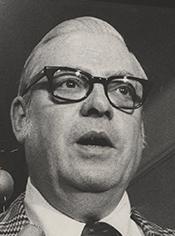
Historical · U.S. House · Illinois · District 5
John Fary
Former U.S. Representative · Illinois District 5 · 1975–1983 · Democratic
John Fary represented Illinois's District 5 in the United States House of Representatives (1975–1983) for the Democratic party. The page below collects sourced biographical facts, term history, committee roles, and provenance for Fary.
Bioguide ID: F000040
Key facts
- Full name
- John Fary
- State
- Illinois
- District
- District 5
- Party
- Democratic
- House service
- 1975–1983
- First House term
- 1975
- Status
- Left office
- Current term ends
- —
- Born
- 1911
- Bioguide ID
- F000040
- Committee assignments
- —
- Dataset version
- 1.20260605
Biographical narrative
976 words · sourced from the Wikipedia REST extract
John G. Fary was a U.S. Representative from Illinois, serving the state's 5th congressional district as a member of the Democratic Party. He held office for a total of four terms in the U.S. House of Representatives, beginning in 1975 and concluding his tenure in 1983. Fary's political career was preceded by significant involvement in state politics, and he was known for his contributions to local communities, particularly in the areas of charitable gaming and aviation infrastructure.
Early life and career
John G. Fary was born on April 11, 1911, in Chicago, Illinois. He spent his formative years in the Back of the Yards and McKinley Park neighborhoods on the South Side of Chicago. Fary's early education included attendance at Saint Peter and Paul grammar school, followed by graduation from Holy Trinity High School. His upbringing in a family that operated a tavern likely influenced his understanding of local businesses and community needs.
Fary pursued higher education at Loyola University Chicago and furthered his studies at the Real Estate School of Illinois and the Mid-West Institute. His academic background provided him with a foundation for his later work in public service and real estate. Before entering the U.S. Congress, he served in the Illinois House of Representatives from 1955 until 1975. During this time, he developed a reputation for advocating for legislation that benefited his constituents.
One of Fary's notable achievements during his tenure in the Illinois legislature was the successful relegalization of bingo for charitable purposes in 1971. Prior to this legislation, bingo had been outlawed as a form of illegal gambling, which had significant implications for various organizations, including churches and veterans' groups that relied on the game for fundraising. This accomplishment highlighted Fary's commitment to supporting community organizations and enhancing their ability to generate revenue for charitable activities.
In addition to his legislative work, Fary was actively involved in various civic organizations. He was a member of the Knights of Columbus, LaSalle General Assembly, Moose, Eagles, Kiwanis, Lions, Polish National Alliance, Polish Roman Catholic Union, and the Chamber of Commerce. His engagement in these organizations reflected his dedication to community service and his connection to the Polish-American community in Chicago. In his personal life, Fary enjoyed hobbies such as fishing, hunting, and golfing, which provided him with a means to connect with nature and engage with friends and family.
House tenure
Fary's congressional career began when he was elected as a Democrat to the Ninety-fourth Congress through a special election. This election was necessitated by the death of U.S. Representative John Kluczynski. Fary took office on July 8, 1975, and was subsequently reelected to three additional terms, serving until January 3, 1983. His time in Congress was marked by a focus on issues pertinent to his constituents in Illinois's 5th congressional district.
During his tenure, Fary was a member of the Aviation Subcommittee, where he played a significant role in efforts to rebuild Midway Airport, a key transportation hub in Chicago. His work on this subcommittee demonstrated his commitment to improving infrastructure and enhancing the travel experience for residents and visitors alike. The rebuilding of Midway Airport was a critical project that aimed to modernize the facility and accommodate the growing demands of air travel.
Fary's congressional career came to an end following the 1982 Democratic primary, where he was defeated by Chicago Alderman Bill Lipinski. This loss marked a transition in Fary's political journey, concluding his active participation in the U.S. House of Representatives after nearly a decade of service. Throughout his time in office, Fary was recognized for his contributions to the community and was honored as the 1978 National Citizen of the Year by a Polish newspaper in Buffalo, New York. This accolade reflected his influence and standing within the Polish-American community.
Legislative focus and committees
Throughout his congressional career, John G. Fary's legislative focus encompassed a variety of issues, with particular attention to infrastructure, community welfare, and the needs of his constituents. His role on the Aviation Subcommittee underscored his commitment to improving transportation facilities, which are vital for economic development and accessibility in urban areas. The rebuilding of Midway Airport was a significant project that aimed to enhance the airport's capacity and modernize its facilities, thereby benefiting both local residents and travelers.
In addition to his work on aviation, Fary's earlier legislative efforts in the Illinois House of Representatives, particularly regarding the relegalization of bingo for charitable purposes, illustrated his dedication to supporting local organizations and community initiatives. This legislative achievement not only provided a source of revenue for various groups but also reflected his understanding of the importance of community engagement and support.
Fary's involvement in numerous civic organizations further demonstrated his commitment to public service and community development. His participation in groups such as the Knights of Columbus and the Polish National Alliance highlighted his connection to the Polish-American community and his dedication to fostering relationships among diverse groups within his district. These affiliations allowed him to stay attuned to the needs and concerns of his constituents, which informed his legislative priorities.
After leaving Congress, Fary's contributions to his community continued to be recognized. In 1982, a railway bridge located at 67th and Cicero in the South Side of Chicago was named in his honor, serving as a lasting tribute to his service and dedication to the area. Fary's legacy is marked by his commitment to public service, community welfare, and the enhancement of local infrastructure, reflecting the values and needs of the constituents he represented throughout his political career.
John G. Fary passed away on June 7, 1984, in Chicago, Illinois. His funeral was attended by a significant number of mourners, and he was interred at Resurrection Cemetery in Justice, Illinois. His contributions to the community and his service in public office remain a part of the historical narrative of Illinois politics.
Notable legislation
Sponsored and co-sponsored legislation for John Fary is pending operator curation. The biographical narrative above carries the same provenance trail until per-bill rows are written.
Sources
- [1]https://en.wikipedia.org/wiki/John_G._FaryWikipedia · retrieved 2026-06-05
Notable quotes
Sourced quotes for John Fary are pending operator curation. Narrative-scope provenance remains attached below.
Sources
- [1]https://en.wikipedia.org/wiki/John_G._FaryWikipedia · retrieved 2026-06-05
Key positions
Curated policy positions for John Fary are pending operator review. The biographical narrative above carries the same provenance trail until per-topic positions are written.
Sources
- [1]https://en.wikipedia.org/wiki/John_G._FaryWikipedia · retrieved 2026-06-05
Terms served
- 1975–1977U.S. House · Term 1 · Democratic
- 1977–1979U.S. House · Term 2 · Democratic
- 1979–1981U.S. House · Term 3 · Democratic
- 1981–1983U.S. House · Term 4 · Democratic
Sources & provenance
Every attributable claim above carries a per-section [N] marker that resolves to the corresponding URL below. Each entry records the upstream provider, the canonical URL, and the timestamp at which the source was retrieved by the ingest pipeline.
Key facts
- https://bioguide.congress.gov/search/bio/F000040bioguide · retrieved 2026-06-05
- https://www.govtrack.us/congress/members/404001govtrack · retrieved 2026-06-05
Biographical narrative
- https://en.wikipedia.org/wiki/John_G._Farywikipedia · retrieved 2026-06-05
Find your representative
Every U.S. state elects representatives by district. Browse Illinois’s delegation, the full former-representative roster, or explore the role and term length.
Related on The Candidate
- Preceded by Martin GorskiEarlier holder of the Illinois District 5 House seat · Democratic.Open
- Succeeded by Michael FlanaganLater holder of the Illinois District 5 House seat · Republican.Open
- Abner TaylorFormer U.S. Representative · Illinois District 1 · RepublicanOpen
- Adam SnyderFormer U.S. Representative · Illinois District 1 · DemocraticOpen
- Arthur MitchellFormer U.S. Representative · Illinois District 1 · DemocraticOpen
- Bennett StewartFormer U.S. Representative · Illinois District 1 · DemocraticOpen