
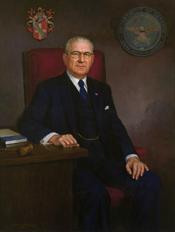
Historical · U.S. House · Louisiana · District 1
Felix Hébert
Former U.S. Representative · Louisiana District 1 · 1941–1977 · Democratic
Felix Hébert represented Louisiana's District 1 in the United States House of Representatives (1941–1977) for the Democratic party. The page below collects sourced biographical facts, term history, committee roles, and provenance for Hébert.
Bioguide ID: H000437
Key facts
- Full name
- Felix Hébert
- State
- Louisiana
- District
- District 1
- Party
- Democratic
- House service
- 1941–1977
- First House term
- 1941
- Status
- Left office
- Current term ends
- —
- Born
- 1901
- Bioguide ID
- H000437
- Committee assignments
- —
- Dataset version
- 1.20260605
Biographical narrative
970 words · sourced from the Wikipedia REST extract
F. Edward Hebert was a prominent American politician and journalist who served as a U.S. Representative for Louisiana's 1st congressional district from 1941 until his retirement in 1977. A member of the Democratic Party, Hebert is recognized for his lengthy tenure in Congress, making him the longest-serving U.S. representative from Louisiana. His legislative career was marked by significant involvement in military affairs, particularly through his role on the House Committee on Armed Services, where he served for nearly three decades, including a term as chairman. Hebert's political journey was influenced by his background in journalism, where he gained recognition for exposing political corruption in Louisiana.
Early life and career
F. Edward Hebert was born on October 12, 1901, in New Orleans, Louisiana, to Felix Joseph Hebert, a streetcar conductor, and Lea Naquin, a teacher. Growing up in a vibrant city, Hebert developed an early interest in sports. However, a childhood accident that left him blind in his left eye at the age of nine curtailed his ability to participate in athletic activities. Despite this setback, he remained engaged in sports by becoming the manager of various athletic teams at Jesuit High School. His passion for journalism emerged during his high school years, where he reported on prep-school sports for The Times-Picayune. He quickly ascended to the position of assistant sports editor before graduating high school.
Hebert continued his education at Tulane University, where he graduated in 1924. His involvement in journalism deepened during his time at Tulane, where he became the first sports editor of the university's publication, the Hullabaloo. After completing his degree, Hebert embarked on a career in public relations at Loyola University in New Orleans and continued to work in journalism, primarily for The Times-Picayune and the New Orleans States. His work as a front-page columnist and political editor allowed him to cover significant political events, including the candidacy and election of Governor Huey Long, who later became a U.S. Senator.
In 1939, Hebert's investigative reporting led to a major exposé on political corruption in Louisiana, known as the "Louisiana scandals." This groundbreaking work resulted in the incarceration of several political figures associated with Long's administration and garnered Hebert significant recognition, including a prestigious award for courage in journalism. His efforts in journalism laid the groundwork for his subsequent entry into politics, as he was encouraged to run for office by former Governor James A. Noe, who had distanced himself from the Long political machine.
House tenure
Hebert's political career began in earnest when he was elected to the 77th United States Congress in 1940, representing Louisiana's 1st congressional district. He was re-elected multiple times, serving a total of 18 consecutive terms in the House of Representatives until he chose not to seek re-election in 1976. His tenure in Congress was characterized by a focus on military and defense issues, largely due to his long-standing involvement with the House Committee on Armed Services. Hebert's service in Congress made him a significant figure in Louisiana politics, and he remains the longest-serving U.S. representative from the state.
During his time in Congress, Hebert was known for his ability to secure military investments for his district, which contributed to the local economy and job creation. His influence in the House was further solidified when he became the chairman of the Armed Services Committee from 1971 to 1975, following the death of the previous chairman. His leadership in this role allowed him to shape defense policy and advocate for military funding that benefited Louisiana.
Hebert's political career was not without controversy. He was a signatory of the Southern Manifesto, which opposed desegregation, and he was known for his resistance to the inclusion of women and minority representatives in leadership roles within the Armed Services Committee. His actions, including requiring female and Black members to share a seat in committee meetings, drew criticism and highlighted the challenges of navigating changing social dynamics within Congress.
Legislative focus and committees
Throughout his congressional career, Hebert's primary focus was on military and defense issues, reflecting his longstanding association with the House Committee on Armed Services. He served on this committee from 1948 until 1975, playing a crucial role in shaping legislation related to national defense and military funding. His chairmanship from 1971 to 1975 was marked by significant military investments in his district, which he leveraged to bolster local economic development.
Hebert's leadership style and approach to committee work were often characterized by traditional views that clashed with the evolving political landscape of the 1970s. His tenure was marked by a generational shift within the Democratic Caucus, as younger and more progressive members sought to challenge the established seniority system. This culminated in a revolt against Hebert's leadership, leading to his removal from the chairmanship of the Armed Services Committee. The younger members of Congress expressed dissatisfaction with his attitudes and remarks, particularly towards newer members, which they perceived as outdated and dismissive.
Despite the challenges he faced in the later years of his career, Hebert's contributions to military policy and his ability to secure funding for Louisiana were notable aspects of his legislative legacy. His work on the Armed Services Committee allowed him to influence key decisions related to defense spending and military readiness, impacting not only his district but also the broader national landscape.
In summary, F. Edward Hebert's career as a U.S. Representative was defined by his extensive service, commitment to military affairs, and the challenges he faced in adapting to changing political dynamics. His background in journalism provided a unique perspective that informed his legislative work, and his long tenure in Congress left a lasting impact on Louisiana's political landscape. Hebert passed away on December 29, 1979, in New Orleans, leaving behind a complex legacy shaped by both his accomplishments and the controversies of his time in office.
Notable legislation
Sponsored and co-sponsored legislation for Felix Hébert is pending operator curation. The biographical narrative above carries the same provenance trail until per-bill rows are written.
Sources
- [1]https://en.wikipedia.org/wiki/F._Edward_H%C3%A9bertWikipedia · retrieved 2026-06-05
Notable quotes
Sourced quotes for Felix Hébert are pending operator curation. Narrative-scope provenance remains attached below.
Sources
- [1]https://en.wikipedia.org/wiki/F._Edward_H%C3%A9bertWikipedia · retrieved 2026-06-05
Key positions
Curated policy positions for Felix Hébert are pending operator review. The biographical narrative above carries the same provenance trail until per-topic positions are written.
Sources
- [1]https://en.wikipedia.org/wiki/F._Edward_H%C3%A9bertWikipedia · retrieved 2026-06-05
Terms served
- 1941–1943U.S. House · Term 1 · Democratic
- 1943–1945U.S. House · Term 2 · Democratic
- 1945–1947U.S. House · Term 3 · Democratic
- 1947–1949U.S. House · Term 4 · Democratic
- 1949–1951U.S. House · Term 5 · Democratic
- 1951–1953U.S. House · Term 6 · Democratic
- 1953–1955U.S. House · Term 7 · Democratic
- 1955–1957U.S. House · Term 8 · Democratic
- 1957–1959U.S. House · Term 9 · Democratic
- 1959–1961U.S. House · Term 10 · Democratic
- 1961–1963U.S. House · Term 11 · Democratic
- 1963–1965U.S. House · Term 12 · Democratic
- 1965–1967U.S. House · Term 13 · Democratic
- 1967–1969U.S. House · Term 14 · Democratic
- 1969–1971U.S. House · Term 15 · Democratic
- 1971–1973U.S. House · Term 16 · Democratic
- 1973–1975U.S. House · Term 17 · Democratic
- 1975–1977U.S. House · Term 18 · Democratic
Sources & provenance
Every attributable claim above carries a per-section [N] marker that resolves to the corresponding URL below. Each entry records the upstream provider, the canonical URL, and the timestamp at which the source was retrieved by the ingest pipeline.
Key facts
- https://bioguide.congress.gov/search/bio/H000437bioguide · retrieved 2026-06-05
- https://www.govtrack.us/congress/members/405303govtrack · retrieved 2026-06-05
Biographical narrative
- https://en.wikipedia.org/wiki/F._Edward_H%C3%A9bertwikipedia · retrieved 2026-06-05
Find your representative
Every U.S. state elects representatives by district. Browse Louisiana’s delegation, the full former-representative roster, or explore the role and term length.
Related on The Candidate
- Preceded by Joachim FernándezEarlier holder of the Louisiana District 1 House seat · Democratic.Open
- Succeeded by Richard TonryLater holder of the Louisiana District 1 House seat · Democratic.Open
- Adolph MeyerFormer U.S. Representative · Louisiana District 1 · DemocraticOpen
- Albert EstopinalFormer U.S. Representative · Louisiana District 1 · DemocraticOpen
- Benjamin FlandersFormer U.S. Representative · Louisiana District 1 · UnionistOpen
- Bobby JindalFormer U.S. Representative · Louisiana District 1 · RepublicanOpen