
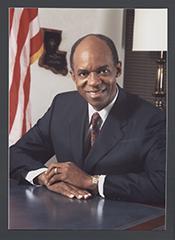
Historical · U.S. House · Louisiana · District 2
William Jefferson
Former U.S. Representative · Louisiana District 2 · 1991–2009 · Democratic
William Jefferson represented Louisiana's District 2 in the United States House of Representatives (1991–2009) for the Democratic party. The page below collects sourced biographical facts, term history, committee roles, and provenance for Jefferson.
Bioguide ID: J000070
Key facts
- Full name
- William Jefferson
- State
- Louisiana
- District
- District 2
- Party
- Democratic
- House service
- 1991–2009
- First House term
- 1991
- Status
- Left office
- Current term ends
- —
- Born
- 1947
- Bioguide ID
- J000070
- Committee assignments
- —
- Dataset version
- 1.20260605
Biographical narrative
972 words · sourced from the Wikipedia REST extract
William J. Jefferson is a former American politician who served as a U.S. Representative for Louisiana's 2nd congressional district from 1991 until 2009. A member of the Democratic Party, Jefferson was notable for being the first African American congressman from Louisiana since the Reconstruction era. His political career, however, was marred by a significant corruption scandal that culminated in his conviction and imprisonment, marking a controversial chapter in his long tenure in public service.
Early life and career
William Jennings Jefferson was born on March 14, 1947, in Lake Providence, Louisiana, a small town in East Carroll Parish. He was raised in a family of nine siblings, where he and his brothers and sisters worked on their father's farm. The Jefferson family was one of the few African American families in their area to own land during the mid-20th century, which distinguished them from many others who were engaged in sharecropping. Despite their land ownership, the family faced economic hardships and lived in poverty.
Jefferson completed his secondary education at G. W. Griffin High School in Lake Providence. He pursued higher education at Southern University in Baton Rouge, a historically black institution, where he earned a bachelor's degree in 1969. During his time at Southern University, he was involved in the Army ROTC program and led a protest against inadequate campus facilities, successfully negotiating improvements with the state governor at the time. After graduating, Jefferson was commissioned as a second lieutenant in the United States Army and served in a reserve capacity until 1975.
In 1972, Jefferson obtained a Juris Doctor degree from Harvard Law School, furthering his academic credentials. He began his legal career as a clerk for Judge Alvin Benjamin Rubin in the United States District Court for the Eastern District of Louisiana before establishing his own practice in 1972 and 1973. In 1996, he earned a Master of Laws (LLM) in taxation from Georgetown University Law Center in Washington, D.C.
Jefferson's family includes notable figures in Louisiana politics. His siblings include Betty Jefferson, who served as the assessor for New Orleans, and Mose Jefferson, who was involved in local political operations. Jefferson is also the uncle of Angela Coleman. He and his wife, Andrea Jefferson, have five daughters, all of whom have pursued higher education, with several graduating from prestigious institutions such as Harvard College and Harvard Law School.
House tenure
Jefferson's political career began in earnest when he served as a legislative assistant to U.S. Senator J. Bennett Johnston from 1973 to 1975. He moved to New Orleans in 1976 and entered the Louisiana Senate in 1979, where he served until 1990. His tenure in the state legislature was marked by two unsuccessful attempts to become mayor of New Orleans, first challenging Dutch Morial in 1982 and later losing to Sidney Barthelemy in a runoff in 1986.
In 1990, Jefferson sought a seat in the U.S. House of Representatives after the retirement of long-serving incumbent Lindy Boggs. He participated in a nonpartisan blanket primary for Louisiana's 2nd congressional district, finishing first among seven candidates with 24 percent of the vote. In the subsequent runoff, he defeated Marc Morial, the son of Dutch Morial, securing his position with 52 percent of the vote. Jefferson was re-elected seven times during his congressional career, serving a total of nine terms.
Throughout his time in the House, Jefferson was a member of the Congressional Black Caucus and was recognized as a prominent figure in Louisiana politics. He considered running for governor in 1995 but ultimately did not enter the race. In 1999, he did run for governor in the Louisiana gubernatorial election as the de facto Democratic candidate but lost to incumbent Republican Mike Foster, receiving only 29.5 percent of the vote.
Legislative focus and committees
During his tenure in Congress, Jefferson focused on various issues pertinent to his constituents and the broader community. His legislative priorities included economic development, education, and healthcare, particularly in relation to the needs of the New Orleans area and the African American community. Jefferson was known for his efforts to secure federal funding for projects aimed at improving infrastructure and economic opportunities in his district.
Jefferson's influence extended beyond legislative matters, as he and his family were known for their effective get-out-the-vote organization, the Progressive Democrats. This group played a significant role in mobilizing voters in South Louisiana, particularly among African American communities. His brother, Mose Jefferson, was instrumental in managing this operation, which was recognized for its effectiveness in local elections.
However, Jefferson's political career faced a severe setback beginning in 2006 when he became the subject of a federal investigation into allegations of bribery and racketeering. Prosecutors accused him of using his congressional office to solicit payments from companies seeking business deals in Africa. The investigation gained national attention when authorities discovered a substantial amount of cash hidden in his home freezer, leading to his indictment in 2007.
Despite the legal challenges, Jefferson sought re-election in 2008 and won his party's nomination in a runoff election. However, he was ultimately defeated in the general election by Republican Joseph Cao, marking a significant upset in a district that had traditionally leaned Democratic.
Following his conviction and sentencing to thirteen years in federal prison for bribery, Jefferson's political career effectively ended. He began serving his sentence in May 2012 at a federal facility in Texas. In 2017, after a U.S. District judge dismissed several charges against him, he was released pending further legal action. Ultimately, he accepted a plea deal and was sentenced to time served in December 2017.
Jefferson's career reflects the complexities of American politics, particularly in the context of race, governance, and the legal challenges that can arise within public service. His legacy remains intertwined with both his contributions to Louisiana politics and the controversies that led to his downfall.
Notable legislation
Sponsored and co-sponsored legislation for William Jefferson is pending operator curation. The biographical narrative above carries the same provenance trail until per-bill rows are written.
Sources
- [1]https://en.wikipedia.org/wiki/William_Jefferson_(politician)Wikipedia · retrieved 2026-06-05
Notable quotes
Sourced quotes for William Jefferson are pending operator curation. Narrative-scope provenance remains attached below.
Sources
- [1]https://en.wikipedia.org/wiki/William_Jefferson_(politician)Wikipedia · retrieved 2026-06-05
Key positions
Curated policy positions for William Jefferson are pending operator review. The biographical narrative above carries the same provenance trail until per-topic positions are written.
Sources
- [1]https://en.wikipedia.org/wiki/William_Jefferson_(politician)Wikipedia · retrieved 2026-06-05
Terms served
- 1991–1993U.S. House · Term 1 · Democratic
- 1993–1995U.S. House · Term 2 · Democratic
- 1995–1997U.S. House · Term 3 · Democratic
- 1997–1999U.S. House · Term 4 · Democratic
- 1999–2001U.S. House · Term 5 · Democratic
- 2001–2003U.S. House · Term 6 · Democratic
- 2003–2005U.S. House · Term 7 · Democratic
- 2005–2007U.S. House · Term 8 · Democratic
- 2007–2009U.S. House · Term 9 · Democratic
Sources & provenance
Every attributable claim above carries a per-section [N] marker that resolves to the corresponding URL below. Each entry records the upstream provider, the canonical URL, and the timestamp at which the source was retrieved by the ingest pipeline.
Key facts
- https://bioguide.congress.gov/search/bio/J000070bioguide · retrieved 2026-06-05
- http://www.house.gov/jeffersonhouse.gov · retrieved 2026-06-05
Biographical narrative
- https://en.wikipedia.org/wiki/William_Jefferson_(politician)wikipedia · retrieved 2026-06-05
Find your representative
Every U.S. state elects representatives by district. Browse Louisiana’s delegation, the full former-representative roster, or explore the role and term length.
Related on The Candidate
- Preceded by Lindy BoggsEarlier holder of the Louisiana District 2 House seat · Democratic.Open
- Succeeded by Joseph CaoLater holder of the Louisiana District 2 House seat · Republican.Open
- Adolph MeyerFormer U.S. Representative · Louisiana District 1 · DemocraticOpen
- Albert EstopinalFormer U.S. Representative · Louisiana District 1 · DemocraticOpen
- Benjamin FlandersFormer U.S. Representative · Louisiana District 1 · UnionistOpen
- Bobby JindalFormer U.S. Representative · Louisiana District 1 · RepublicanOpen