
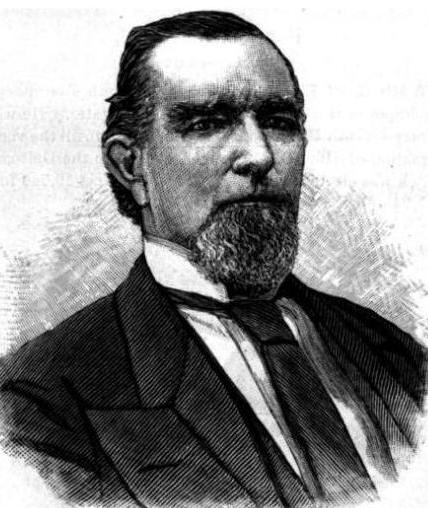
Historical · U.S. House · Louisiana · District 6
Edward Robertson
Former U.S. Representative · Louisiana District 6 · 1877–1889 · Democratic
Edward Robertson represented Louisiana's District 6 in the United States House of Representatives (1877–1889) for the Democratic party. The page below collects sourced biographical facts, term history, committee roles, and provenance for Robertson.
Bioguide ID: R000321
Key facts
- Full name
- Edward Robertson
- State
- Louisiana
- District
- District 6
- Party
- Democratic
- House service
- 1877–1889
- First House term
- 1877
- Status
- Left office
- Current term ends
- —
- Born
- 1823
- Bioguide ID
- R000321
- Committee assignments
- —
- Dataset version
- 1.20260606
Biographical narrative
975 words · sourced from the Wikipedia REST extract
Edward Robertson was a notable figure in American politics during the late 19th century, serving as a U.S. Representative from Louisiana. A member of the Democratic Party, he represented Louisiana's 6th congressional district across four terms in the House of Representatives. His political career was marked by significant involvement in legislative matters concerning the Mississippi River and its levees, reflecting the importance of these issues to his constituents and the broader region. Robertson's life spanned a period of considerable change in the United States, including the Civil War and the Reconstruction era, during which he played a role in shaping the legislative landscape of his time.
Early life and career
Edward White Robertson was born on June 13, 1823, near Nashville, Tennessee. His early life was characterized by a series of relocations that would ultimately lead him to Louisiana. In 1825, when he was just two years old, his family moved to Iberville Parish, Louisiana. This transition would lay the groundwork for his future political career, as he became deeply rooted in the local community.
Robertson's education began in local country schools, where he received foundational instruction. He furthered his studies at the preparatory department of Centenary College in Jackson, Louisiana, and later attended Augusta College in Kentucky in 1842. His academic pursuits continued at Nashville University, where he began studying law in 1845. This legal education would prove invaluable as he embarked on a career in public service.
In addition to his educational endeavors, Robertson served his country during the Mexican-American War in 1846. He enlisted as an orderly sergeant in the Second Regiment of the Louisiana Volunteers, an experience that would enhance his leadership skills and commitment to public service. Following the war, he began his political career by serving in the Louisiana House of Representatives from 1847 to 1849. His early political involvement laid the foundation for his future roles in state and national governance.
Robertson graduated from the law department of the University of Louisiana in 1850 and was admitted to the bar the same year. He began practicing law in Iberville and East Baton Rouge Parishes, where he built a reputation as a competent attorney. His legal career was complemented by a return to politics when he was elected again to the Louisiana House of Representatives in 1853. His growing influence in the state led to his appointment as the Louisiana state Auditor of Public Accounts, a position he held from 1857 to 1862. This role involved overseeing the financial operations of the state, further solidifying his expertise in governance and public finance.
House tenure
Robertson's congressional career began in earnest when he was elected as a Democrat to the U.S. House of Representatives. He served in the Forty-fifth, Forty-sixth, and Forty-seventh Congresses from March 4, 1877, to March 3, 1883. His tenure in Congress was marked by his leadership roles and committee assignments, particularly those related to the Mississippi River, which was a critical issue for Louisiana and the surrounding states.
During the Forty-fifth Congress, Robertson served as the chairman of the Committee on the Mississippi Levees. This position allowed him to influence legislation concerning flood control and infrastructure improvements along the river, which were vital for the agricultural economy of the region. His work on this committee underscored the importance of the Mississippi River to the livelihoods of many constituents and the overall economic health of Louisiana.
In the Forty-sixth Congress, he continued his focus on river-related issues as a member of the Committee on Levees and Improvements of the Mississippi River. His involvement in these committees reflected a commitment to addressing the challenges posed by flooding and the need for improved infrastructure to support navigation and commerce along the river.
Despite his contributions, Robertson faced challenges in his political career. He was an unsuccessful candidate for renomination in 1882 for the Forty-eighth Congress, which marked a temporary setback in his legislative career. However, he returned to Congress when he was elected to the Fiftieth Congress, serving from March 4, 1887, until his death in 1887. His ability to return to the House demonstrated his resilience and the continued support of his constituents.
Legislative focus and committees
Throughout his congressional tenure, Edward Robertson's legislative focus was largely centered on issues related to the Mississippi River and the surrounding communities. His leadership roles on committees dedicated to levee construction and river improvements highlighted the significance of these matters to the state of Louisiana. The Mississippi River was not only a vital transportation route but also a critical resource for agriculture and commerce, making its management a priority for lawmakers in the region.
As chairman of the Committee on the Mississippi Levees during the Forty-fifth Congress, Robertson was instrumental in advocating for policies and funding aimed at improving flood control measures. The devastating impacts of flooding on agricultural lands and communities underscored the urgency of his work. His efforts contributed to the development of infrastructure that would help protect the livelihoods of farmers and residents along the river.
In addition to his focus on levees, Robertson's legislative work encompassed broader issues affecting his constituents. His background as a lawyer and state auditor provided him with a unique perspective on financial matters, which likely informed his approach to budgeting and resource allocation in Congress. He was aware of the economic challenges facing Louisiana, particularly in the post-Civil War era, and sought to address these through his legislative initiatives.
Robertson's career was cut short by his death on August 2, 1887, in Baton Rouge, Louisiana. He was buried in Magnolia Cemetery in Baton Rouge, leaving behind a legacy of public service and commitment to the welfare of his constituents. His contributions to the U.S. House of Representatives and the state of Louisiana remain a part of the historical narrative of the region during a transformative period in American history.
Notable legislation
Sponsored and co-sponsored legislation for Edward Robertson is pending operator curation. The biographical narrative above carries the same provenance trail until per-bill rows are written.
Sources
- [1]https://en.wikipedia.org/wiki/Edward_White_RobertsonWikipedia · retrieved 2026-06-06
Notable quotes
Sourced quotes for Edward Robertson are pending operator curation. Narrative-scope provenance remains attached below.
Sources
- [1]https://en.wikipedia.org/wiki/Edward_White_RobertsonWikipedia · retrieved 2026-06-06
Key positions
Curated policy positions for Edward Robertson are pending operator review. The biographical narrative above carries the same provenance trail until per-topic positions are written.
Sources
- [1]https://en.wikipedia.org/wiki/Edward_White_RobertsonWikipedia · retrieved 2026-06-06
Terms served
- 1877–1879U.S. House · Term 1 · Democratic
- 1879–1881U.S. House · Term 2 · Democratic
- 1881–1883U.S. House · Term 3 · Democratic
- 1887–1889U.S. House · Term 4 · Democratic
Sources & provenance
Every attributable claim above carries a per-section [N] marker that resolves to the corresponding URL below. Each entry records the upstream provider, the canonical URL, and the timestamp at which the source was retrieved by the ingest pipeline.
Key facts
- https://bioguide.congress.gov/search/bio/R000321bioguide · retrieved 2026-06-06
- https://www.govtrack.us/congress/members/409292govtrack · retrieved 2026-06-06
Biographical narrative
- https://en.wikipedia.org/wiki/Edward_White_Robertsonwikipedia · retrieved 2026-06-06
Find your representative
Every U.S. state elects representatives by district. Browse Louisiana’s delegation, the full former-representative roster, or explore the role and term length.
Related on The Candidate
- Preceded by Charles NashEarlier holder of the Louisiana District 6 House seat · Republican.Open
- Succeeded by George FavrotLater holder of the Louisiana District 6 House seat · Democratic.Open
- Adolph MeyerFormer U.S. Representative · Louisiana District 1 · DemocraticOpen
- Albert EstopinalFormer U.S. Representative · Louisiana District 1 · DemocraticOpen
- Benjamin FlandersFormer U.S. Representative · Louisiana District 1 · UnionistOpen
- Bobby JindalFormer U.S. Representative · Louisiana District 1 · RepublicanOpen