
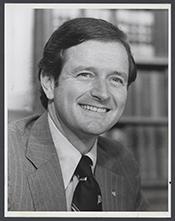
Historical · U.S. House · Louisiana · District 6
William Moore III
Former U.S. Representative · Louisiana District 6 · 1975–1987 · Republican
William Moore III represented Louisiana's District 6 in the United States House of Representatives (1975–1987) for the Republican party. The page below collects sourced biographical facts, term history, committee roles, and provenance for III.
Bioguide ID: M000923
Key facts
- Full name
- William Moore III
- State
- Louisiana
- District
- District 6
- Party
- Republican
- House service
- 1975–1987
- First House term
- 1975
- Status
- Left office
- Current term ends
- —
- Born
- 1939
- Bioguide ID
- M000923
- Committee assignments
- —
- Dataset version
- 1.20260605
Biographical narrative
866 words · sourced from the Wikipedia REST extract
W. Henson Moore is a former U.S. Representative from Louisiana, who served in the House of Representatives for six terms from 1975 until 1987. A member of the Republican Party, he represented Louisiana's 6th congressional district, which encompasses areas around Baton Rouge. Moore is notable for being only the second Republican to hold a congressional seat from Louisiana since the Reconstruction era. His political career included a bid for the U.S. Senate in 1986, although he was ultimately unsuccessful in that campaign.
Early life and career
W. Henson Moore was born on October 4, 1939, in Lake Charles, Louisiana, to W.H. Moore, II, an executive in the oil industry, and Madge Pearce. His family later relocated to Hackberry in Cameron Parish before settling in Baton Rouge, where Moore completed his high school education at Baton Rouge High School, graduating in 1958. During his high school years, he demonstrated early leadership abilities by being elected governor of the Boys State program, a civic education initiative aimed at teaching young people about government and citizenship.
Following high school, Moore attended Louisiana State University (LSU) in Baton Rouge, where he earned a Bachelor of Arts degree in 1961. He continued his education at the LSU Law Center, receiving his Juris Doctor degree in 1965. After being admitted to the bar in 1966, he joined the law firm Dale, Woen, Richardson, Taylor, and Mathews in Baton Rouge, initially as an associate and later as a full member. In addition to his law degree, Moore pursued further education and obtained a master's degree from LSU in 1973.
Moore's public service began with his enlistment in the United States Army, where he served from 1965 to 1967. His political journey took a significant turn in 1969 when he switched his party affiliation from Democrat to Republican, influenced by his support for Richard M. Nixon during the 1968 presidential election. Subsequently, he became active in the Republican Party, serving on the Louisiana Republican State Central Committee from 1971 until 1975, the year he was elected to Congress. He also participated as a delegate at the 1984 Republican National Convention, which renominated President Ronald Reagan and Vice President George H.W. Bush.
House tenure
Moore's congressional career began when he was elected to the U.S. House of Representatives on November 5, 1974, during a mid-term election that saw significant Democratic gains across the country. He succeeded John Richard Rarick, a Conservative Democrat who had lost the Democratic primary to Jeff LaCaze, a more liberal candidate. The general election between Moore and LaCaze was closely contested, with Moore winning by a narrow margin of just 14 votes. However, due to a malfunctioning voting machine, a special election was mandated by the Louisiana courts.
In the special election held on January 7, 1975, Moore secured a decisive victory over LaCaze, garnering 54.1 percent of the vote compared to LaCaze's 45.9 percent. This election marked a significant moment in Louisiana's political landscape, as Moore became a prominent figure in the Republican Party during a time when the party was still establishing its presence in the state following the Civil Rights Movement and Reconstruction.
Throughout his six terms in the House, Moore maintained a conservative voting record. He was known for his fiscal conservatism, often advocating for reduced taxes and cautioning against increased government spending. His political philosophy emphasized the need for responsible budgeting and the importance of addressing the national deficit. Moore frequently articulated concerns about the reliance on foreign capital to finance the American deficit, underscoring the need for a sustainable economic strategy.
Legislative focus and committees
During his tenure in Congress, Moore served on various committees that shaped his legislative priorities. His work often reflected his commitment to conservative principles, focusing on issues such as fiscal responsibility, economic development, and job creation. He was particularly vocal about the need for Louisiana to enhance its economic image and opportunities, advocating for the expansion of port facilities and tourism initiatives within the state.
In 1986, Moore sought to elevate his political career by running for the U.S. Senate seat vacated by the retiring Russell B. Long. His candidacy was notable as he was the first Republican to receive organizational support for a Senate run in Louisiana since 1962. Moore's campaign emphasized a vision for Louisiana that included greater job opportunities and a focus on education funding through the establishment of a trust fund for offshore revenues. He positioned himself as a candidate who could bring a fresh perspective to the state's political landscape.
In the nonpartisan blanket primary for the Senate, Moore led the race initially, but ultimately lost to Democrat John B. Breaux, who would go on to serve in the Senate. Despite this setback, Moore's political career left a lasting impact on Louisiana's Republican Party and highlighted the evolving political dynamics within the state during the late 20th century.
After concluding his service in the House on January 3, 1987, Moore continued to engage in various professional pursuits, including his work as an attorney and businessman. His legacy remains tied to his role in shaping the Republican presence in Louisiana and his contributions to legislative discussions during a transformative period in American politics.
Notable legislation
Sponsored and co-sponsored legislation for William Moore III is pending operator curation. The biographical narrative above carries the same provenance trail until per-bill rows are written.
Sources
- [1]https://en.wikipedia.org/wiki/Henson_MooreWikipedia · retrieved 2026-06-05
Notable quotes
Sourced quotes for William Moore III are pending operator curation. Narrative-scope provenance remains attached below.
Sources
- [1]https://en.wikipedia.org/wiki/Henson_MooreWikipedia · retrieved 2026-06-05
Key positions
Curated policy positions for William Moore III are pending operator review. The biographical narrative above carries the same provenance trail until per-topic positions are written.
Sources
- [1]https://en.wikipedia.org/wiki/Henson_MooreWikipedia · retrieved 2026-06-05
Terms served
- 1975–1977U.S. House · Term 1 · Republican
- 1977–1979U.S. House · Term 2 · Republican
- 1979–1981U.S. House · Term 3 · Republican
- 1981–1983U.S. House · Term 4 · Republican
- 1983–1985U.S. House · Term 5 · Republican
- 1985–1987U.S. House · Term 6 · Republican
Sources & provenance
Every attributable claim above carries a per-section [N] marker that resolves to the corresponding URL below. Each entry records the upstream provider, the canonical URL, and the timestamp at which the source was retrieved by the ingest pipeline.
Key facts
- https://bioguide.congress.gov/search/bio/M000923bioguide · retrieved 2026-06-05
- https://www.govtrack.us/congress/members/407894govtrack · retrieved 2026-06-05
Biographical narrative
- https://en.wikipedia.org/wiki/Henson_Moorewikipedia · retrieved 2026-06-05
Find your representative
Every U.S. state elects representatives by district. Browse Louisiana’s delegation, the full former-representative roster, or explore the role and term length.
Related on The Candidate
- Preceded by John RarickEarlier holder of the Louisiana District 6 House seat · Democratic.Open
- Succeeded by Richard BakerLater holder of the Louisiana District 6 House seat · Republican.Open
- Adolph MeyerFormer U.S. Representative · Louisiana District 1 · DemocraticOpen
- Albert EstopinalFormer U.S. Representative · Louisiana District 1 · DemocraticOpen
- Benjamin FlandersFormer U.S. Representative · Louisiana District 1 · UnionistOpen
- Bobby JindalFormer U.S. Representative · Louisiana District 1 · RepublicanOpen