
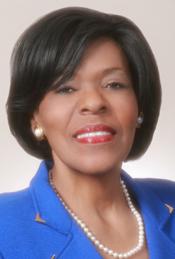
Historical · U.S. House · Michigan · District 13
Carolyn Kilpatrick
Former U.S. Representative · Michigan District 13 · 1997–2011 · Democratic
Carolyn Kilpatrick represented Michigan's District 13 in the United States House of Representatives (1997–2011) for the Democratic party. The page below collects sourced biographical facts, term history, committee roles, and provenance for Kilpatrick.
Bioguide ID: K000180
Key facts
- Full name
- Carolyn Kilpatrick
- State
- Michigan
- District
- District 13
- Party
- Democratic
- House service
- 1997–2011
- First House term
- 1997
- Status
- Left office
- Current term ends
- —
- Born
- 1945
- Bioguide ID
- K000180
- Committee assignments
- —
- Dataset version
- 1.20260605
Biographical narrative
809 words · sourced from the Wikipedia REST extract
Carolyn C. Kilpatrick was an American politician who served as a U.S. Representative for Michigan's 13th congressional district from 1997 until 2011. A member of the Democratic Party, she was known for her long tenure in Congress and her leadership within various caucuses. Kilpatrick's political career was marked by her advocacy for her constituents and her involvement in significant legislative matters. She was also the mother of Kwame Kilpatrick, a former mayor of Detroit.
Early life and career
Carolyn Jean Cheeks was born on June 25, 1945, in Detroit, Michigan. She completed her secondary education at the Detroit High School of Commerce. Following her graduation, she pursued higher education, attending Ferris State University in Big Rapids, Michigan, from 1968 to 1970. Kilpatrick later earned a Bachelor of Science degree from Western Michigan University in 1972, followed by a Master of Science degree from the University of Michigan in 1977.
Before entering politics, Kilpatrick worked as a high school teacher, where she contributed to the education of young people in her community. Her political career began in earnest when she was elected to the Michigan House of Representatives, where she served from 1979 until 1996. During her time in the state legislature, she gained experience in governance and developed a network of political connections that would benefit her in her future congressional career.
House tenure
Kilpatrick's journey to the U.S. House of Representatives began in 1996 when she challenged the three-term incumbent Barbara-Rose Collins in the Democratic primary for what was then Michigan's 15th congressional district. In a surprising upset, Kilpatrick won the primary with a significant margin, securing 51.6 percent of the vote compared to Collins' 30.6 percent. This victory effectively ensured her election in a heavily Democratic district, which had a majority African American population.
Once in Congress, Kilpatrick was re-elected six times, consistently receiving overwhelming support from her constituents. She never garnered less than 80 percent of the vote in her subsequent elections. After the 2000 Census, her district was renumbered as the 13th congressional district, but she continued to enjoy strong electoral support. Notably, she faced no major-party opposition in the 2004 election and was unopposed in 2006.
However, Kilpatrick's political career faced challenges in the following years. In the 2008 Democratic primary, she encountered serious opposition for the first time from former State Representative Mary D. Waters and State Senator Martha Scott. Despite the controversies surrounding her son, Kwame Kilpatrick, who was embroiled in a scandal, she managed to win the primary with 39.1 percent of the vote.
The 2010 primary presented a more significant challenge, as State Senator Hansen Clarke emerged as her principal opponent. Kilpatrick lost the primary election, marking a notable shift in her political career. This defeat was attributed in part to the ongoing controversies surrounding her family, particularly her son's legal troubles.
Legislative focus and committees
During her time in the U.S. House of Representatives, Kilpatrick served on the Committee on Appropriations, where she contributed to discussions and decisions regarding federal funding and budgetary allocations. Within this committee, she was a member of the Subcommittee on Transportation, Housing and Urban Development, and Related Agencies, focusing on issues related to infrastructure, housing, and urban development.
Kilpatrick was also active in several caucuses and organizations within Congress. She was a member of the Congressional Black Caucus, which aimed to address the concerns of African Americans and promote their interests in legislative matters. Additionally, she participated in the Congressional Progressive Caucus, which advocated for progressive policies and social justice issues. Kilpatrick was appointed as the chairwoman of the Congressional Black Caucus for the 110th Congress, serving from 2007 to 2009.
Throughout her congressional career, Kilpatrick was involved in various legislative decisions and votes that reflected her political values and priorities. For instance, she was one of the 31 House Democrats who voted against counting the 20 electoral votes from Ohio in the 2004 presidential election, a decision that highlighted her stance on electoral integrity. Furthermore, on September 29, 2008, she voted against the Emergency Economic Stabilization Act of 2008, which aimed to address the financial crisis.
Kilpatrick's legislative focus encompassed a range of issues, including education, housing, and social justice. Her background as an educator informed her commitment to improving educational opportunities for her constituents. Additionally, her involvement in housing and urban development initiatives reflected her dedication to addressing the needs of urban communities.
In summary, Carolyn C. Kilpatrick's political career spanned over a decade in the U.S. House of Representatives, during which she served her constituents in Michigan with a focus on education, housing, and social justice. Her tenure was marked by significant electoral victories, leadership roles within congressional caucuses, and active participation in key legislative discussions. Despite facing challenges in her later political career, Kilpatrick's contributions to Congress and her community remain a notable aspect of her legacy.
Notable legislation
Sponsored and co-sponsored legislation for Carolyn Kilpatrick is pending operator curation. The biographical narrative above carries the same provenance trail until per-bill rows are written.
Sources
- [1]https://en.wikipedia.org/wiki/Carolyn_Cheeks_KilpatrickWikipedia · retrieved 2026-06-05
Notable quotes
Sourced quotes for Carolyn Kilpatrick are pending operator curation. Narrative-scope provenance remains attached below.
Sources
- [1]https://en.wikipedia.org/wiki/Carolyn_Cheeks_KilpatrickWikipedia · retrieved 2026-06-05
Key positions
Curated policy positions for Carolyn Kilpatrick are pending operator review. The biographical narrative above carries the same provenance trail until per-topic positions are written.
Sources
- [1]https://en.wikipedia.org/wiki/Carolyn_Cheeks_KilpatrickWikipedia · retrieved 2026-06-05
Terms served
- 1997–1999U.S. House · Term 1 · Democratic
- 1999–2001U.S. House · Term 2 · Democratic
- 2001–2003U.S. House · Term 3 · Democratic
- 2003–2005U.S. House · Term 4 · Democratic
- 2005–2007U.S. House · Term 5 · Democratic
- 2007–2009U.S. House · Term 6 · Democratic
- 2009–2011U.S. House · Term 7 · Democratic
Sources & provenance
Every attributable claim above carries a per-section [N] marker that resolves to the corresponding URL below. Each entry records the upstream provider, the canonical URL, and the timestamp at which the source was retrieved by the ingest pipeline.
Key facts
- https://bioguide.congress.gov/search/bio/K000180bioguide · retrieved 2026-06-05
- http://www.house.gov/kilpatrickhouse.gov · retrieved 2026-06-05
Biographical narrative
- https://en.wikipedia.org/wiki/Carolyn_Cheeks_Kilpatrickwikipedia · retrieved 2026-06-05
Find your representative
Every U.S. state elects representatives by district. Browse Michigan’s delegation, the full former-representative roster, or explore the role and term length.
Related on The Candidate
- Preceded by William FordEarlier holder of the Michigan District 13 House seat · Democratic.Open
- Succeeded by Hansen ClarkeLater holder of the Michigan District 13 House seat · Democratic.Open
- Alexander BuelFormer U.S. Representative · Michigan District 1 · DemocraticOpen
- Alfred LuckingFormer U.S. Representative · Michigan District 1 · DemocraticOpen
- Alpheus WilliamsFormer U.S. Representative · Michigan District 1 · DemocraticOpen
- Bart StupakFormer U.S. Representative · Michigan District 1 · DemocraticOpen