
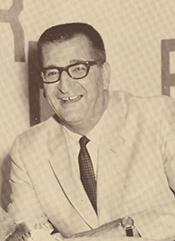
Historical · U.S. House · Michigan · District 3
Garry Brown
Former U.S. Representative · Michigan District 3 · 1967–1979 · Republican
Garry Brown represented Michigan's District 3 in the United States House of Representatives (1967–1979) for the Republican party. The page below collects sourced biographical facts, term history, committee roles, and provenance for Brown.
Bioguide ID: B000917
Key facts
- Full name
- Garry Brown
- State
- Michigan
- District
- District 3
- Party
- Republican
- House service
- 1967–1979
- First House term
- 1967
- Status
- Left office
- Current term ends
- —
- Born
- 1923
- Bioguide ID
- B000917
- Committee assignments
- —
- Dataset version
- 1.20260605
Biographical narrative
812 words · sourced from the Wikipedia REST extract
Garry E. Brown was a U.S. Representative from Michigan, serving in the House of Representatives from 1967 until 1979. A member of the Republican Party, Brown completed six terms in Congress, where he was involved in various legislative activities and served on multiple committees. His political career was preceded by a background in law and public service, including military service during World War II.
Early life and career
Garry Eldridge Brown was born on August 12, 1923, in Schoolcraft, Michigan. He came from a family with a notable political heritage; both his great-grandfather, Ebenezer Lakin Brown, and his grandfather, Addison Makepeace Brown, were active in the Michigan State Legislature. This familial connection to politics may have influenced his eventual career path.
During World War II, Brown served in the United States Army as a second lieutenant in the Twenty-fourth Infantry Regiment, stationed in Japan. His military service provided him with valuable leadership experience and a sense of duty that would later inform his political career. After the war, he transitioned into public service, working for the Federal Bureau of Investigation under J. Edgar Hoover. This role allowed him to gain insights into federal law enforcement and government operations.
Brown pursued higher education, earning a Bachelor of Arts degree from Kalamazoo College in 1951. He then attended George Washington University Law School, where he obtained his Bachelor of Laws (LL.B.) in 1954. Following his graduation, he was admitted to the bar and began practicing law in Kalamazoo, Michigan. His legal career was complemented by public service; he served as a commissioner of the United States District Court for the Western District of Michigan from 1957 to 1962. Additionally, he was a delegate to the Michigan Constitutional Convention from 1961 to 1962, contributing to the state's legal framework.
Before entering the U.S. House of Representatives, Brown served in the Michigan State Senate from 1963 to 1966. During his tenure, he held the position of minority floor leader and chaired the Republican Senate Policy Committee. He represented two districts during his time in the Senate: the 6th district from 1963 to 1964 and the 21st district from 1965 to 1966. His experience in the state legislature laid the groundwork for his subsequent election to Congress.
House tenure
In 1966, Garry Brown was elected to the U.S. House of Representatives, defeating incumbent Democrat Paul H. Todd, Jr., who was part of a group known as the "Five Fluke Freshmen." Brown's election marked the beginning of his six-term tenure in the House, where he served from January 3, 1967, until January 3, 1979. Throughout his time in Congress, he was involved in various legislative initiatives and was recognized for his contributions to the House.
During his tenure, Brown was noted for his involvement in significant political events, including the Watergate scandal. In October 1972, he played a role in obstructing efforts led by Representative Wright Patman from Texas, who sought to investigate the flow of illegal campaign funds related to the Watergate burglars. However, as the situation developed and became more public through court proceedings and televised Senate hearings, Brown later acknowledged that his initial stance had been misguided.
Despite his active participation in Congress, Brown faced challenges in his political career. He was an unsuccessful candidate for reelection in 1978, losing to Democrat Howard E. Wolpe. This defeat marked the end of his congressional service, concluding a significant chapter in his political journey.
Legislative focus and committees
During his time in the House of Representatives, Garry Brown was involved in various legislative matters and served on multiple committees. His work often reflected the interests and concerns of his constituents in Michigan's 3rd congressional district. While specific details regarding the bills he sponsored or the committees he served on are not provided, it is known that he engaged in issues pertinent to his district and the broader national landscape.
Brown's legislative focus included addressing the needs of his constituents and participating in discussions surrounding key national issues of the time. His background in law and experience in public service likely informed his approach to governance and policy-making. As a member of the Republican Party, he aligned with the party's values and priorities during a period of significant political change in the United States.
After leaving Congress, Brown returned to the practice of law and continued to reside in Washington, D.C. until his death. His legal expertise and political experience contributed to his ongoing involvement in public affairs, even after his congressional tenure had concluded.
Garry E. Brown passed away on August 27, 1998, in Washington, D.C. He was laid to rest in Schoolcraft, Michigan, where he had spent his early years and where his family's roots in the area extended back to the 1830s. Brown's life and career reflect a commitment to public service, shaped by his early experiences and his family's political legacy.
Notable legislation
Sponsored and co-sponsored legislation for Garry Brown is pending operator curation. The biographical narrative above carries the same provenance trail until per-bill rows are written.
Sources
- [1]https://en.wikipedia.org/wiki/Garry_E._BrownWikipedia · retrieved 2026-06-05
Notable quotes
Sourced quotes for Garry Brown are pending operator curation. Narrative-scope provenance remains attached below.
Sources
- [1]https://en.wikipedia.org/wiki/Garry_E._BrownWikipedia · retrieved 2026-06-05
Key positions
Curated policy positions for Garry Brown are pending operator review. The biographical narrative above carries the same provenance trail until per-topic positions are written.
Sources
- [1]https://en.wikipedia.org/wiki/Garry_E._BrownWikipedia · retrieved 2026-06-05
Terms served
- 1967–1969U.S. House · Term 1 · Republican
- 1969–1971U.S. House · Term 2 · Republican
- 1971–1973U.S. House · Term 3 · Republican
- 1973–1975U.S. House · Term 4 · Republican
- 1975–1977U.S. House · Term 5 · Republican
- 1977–1979U.S. House · Term 6 · Republican
Sources & provenance
Every attributable claim above carries a per-section [N] marker that resolves to the corresponding URL below. Each entry records the upstream provider, the canonical URL, and the timestamp at which the source was retrieved by the ingest pipeline.
Key facts
- https://bioguide.congress.gov/search/bio/B000917bioguide · retrieved 2026-06-05
- https://www.govtrack.us/congress/members/401873govtrack · retrieved 2026-06-05
Biographical narrative
- https://en.wikipedia.org/wiki/Garry_E._Brownwikipedia · retrieved 2026-06-05
Find your representative
Every U.S. state elects representatives by district. Browse Michigan’s delegation, the full former-representative roster, or explore the role and term length.
Related on The Candidate
- Preceded by Paul Todd Jr.Earlier holder of the Michigan District 3 House seat · Democratic.Open
- Succeeded by Howard Wolpe IIILater holder of the Michigan District 3 House seat · Democratic.Open
- Alexander BuelFormer U.S. Representative · Michigan District 1 · DemocraticOpen
- Alfred LuckingFormer U.S. Representative · Michigan District 1 · DemocraticOpen
- Alpheus WilliamsFormer U.S. Representative · Michigan District 1 · DemocraticOpen
- Bart StupakFormer U.S. Representative · Michigan District 1 · DemocraticOpen