
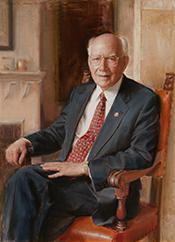
Historical · U.S. House · Michigan · District 3
Vernon Ehlers
Former U.S. Representative · Michigan District 3 · 1993–2011 · Republican
Vernon Ehlers represented Michigan's District 3 in the United States House of Representatives (1993–2011) for the Republican party. The page below collects sourced biographical facts, term history, committee roles, and provenance for Ehlers.
Bioguide ID: E000092
Key facts
- Full name
- Vernon Ehlers
- State
- Michigan
- District
- District 3
- Party
- Republican
- House service
- 1993–2011
- First House term
- 1993
- Status
- Left office
- Current term ends
- —
- Born
- 1934
- Bioguide ID
- E000092
- Committee assignments
- —
- Dataset version
- 1.20260605
Biographical narrative
927 words · sourced from the Wikipedia REST extract
Vernon J. Ehlers was an American physicist and politician who served as a U.S. Representative for Michigan's 3rd congressional district from 1993 until his retirement in 2011. A member of the Republican Party, Ehlers was notable for being the first research physicist elected to Congress. His legislative career was marked by a commitment to education, science, and environmental issues, alongside a moderate Republican stance on various political matters. Prior to his tenure in the U.S. House, he held positions in both the Michigan House of Representatives and the Michigan Senate. Ehlers passed away on August 15, 2017, at the age of 83.
Early life and career
Vernon J. Ehlers was born on February 6, 1934, in Pipestone, Minnesota. He pursued higher education at Calvin College in Grand Rapids, Michigan, where he studied for three years before transferring to the University of California, Berkeley. At Berkeley, he earned a bachelor's degree in physics and subsequently completed his Ph.D. in nuclear physics in 1960. His doctoral dissertation focused on the nuclear spins and moments of several radioactive gallium isotopes, contributing to the field of nuclear physics.
Following the completion of his education, Ehlers spent six years at Berkeley, engaging in both teaching and research. In 1966, he returned to Michigan to join the faculty at Calvin College, where he taught physics for 16 years. During his time at Calvin, he also served as the chairman of the Physics Department, further establishing his academic credentials.
Ehlers began his political career by serving on the Kent County Board of Commissioners from 1975 to 1982. He then transitioned to state politics, serving in the Michigan House of Representatives from 1983 to 1985, followed by a term in the Michigan Senate from 1985 until 1993. His experience in local and state government laid the groundwork for his subsequent election to the U.S. Congress.
House tenure
Ehlers was elected to the U.S. House of Representatives in a special election in 1993, filling the vacancy left by the late Congressman Paul B. Henry. He won a full term in the 1994 elections and was subsequently re-elected multiple times, serving a total of nine terms in Congress. Throughout his tenure, Ehlers faced minimal significant opposition from Democratic candidates, which contributed to his sustained presence in the House.
During his time in Congress, Ehlers was involved in various committee assignments that reflected his expertise and interests. He served on the Committee on Education and Labor, where he was a member of subcommittees focusing on early childhood education, elementary and secondary education, and higher education. Additionally, he was a member of the Committee on House Administration, where he held the position of chairman during the 109th Congress after the resignation of Bob Ney. Ehlers also served on the Committee on Science and Technology, where he was the ranking member of the Subcommittee on Research and Science Education, as well as the Committee on Transportation and Infrastructure, where he participated in subcommittees related to aviation, maritime transportation, and water resources.
Ehlers' political career was characterized by a moderate Republican stance. He was known for his willingness to cross party lines on certain issues, particularly those related to environmental protection and government spending. His voting record demonstrated a balance between conservative and liberal positions, as noted by the National Journal, which indicated that his votes were evenly split between these two ideological categories in 2006.
Legislative focus and committees
Throughout his congressional career, Ehlers was particularly focused on issues related to education, science, and technology. He was a co-chair of the STEM (science, technology, engineering, and mathematics) Education Caucus, advocating for policies that promoted education in these critical fields. His commitment to science and education was further reflected in his participation in various committees and subcommittees that addressed these topics.
Ehlers was also active in environmental issues, aligning with organizations such as the Republican Main Street Partnership and Republicans for Environmental Protection. He was recognized for his unique position within the Michigan Congressional delegation, being the only member from either party to support raising fuel economy standards for automobiles in 2001 and 2005. His legislative actions indicated a nuanced approach to environmental policy, as he often sought to balance economic interests with ecological considerations.
In addition to his work on education and environmental issues, Ehlers took a strong stance against online gambling. He was a staunch advocate for a federal prohibition on online poker and co-sponsored multiple bills aimed at restricting internet gambling.
Ehlers' voting record on social issues was more conservative, particularly regarding LGBTQ+ rights. He consistently voted in favor of the Federal Marriage Amendment and against hate crimes legislation and job discrimination protections based on sexual orientation. However, in a notable departure from his previous positions, he voted in favor of repealing the "Don't Ask, Don't Tell" policy in 2010, allowing openly gay individuals to serve in the military. He also supported the DREAM Act, which aimed to provide a pathway to citizenship for undocumented immigrants who were brought to the U.S. as children.
Ehlers' contributions to science and policy were not limited to his legislative work; he authored numerous articles in scientific journals, focusing on topics within nuclear physics and science policy. His academic background and professional experience informed his approach to legislation and advocacy in Congress.
In summary, Vernon J. Ehlers' career as a U.S. Representative was marked by a blend of scientific expertise and political acumen. His commitment to education, science, and environmental issues, along with his moderate Republican stance, defined his legislative priorities and contributions to the U.S. House of Representatives.
Notable legislation
Sponsored and co-sponsored legislation for Vernon Ehlers is pending operator curation. The biographical narrative above carries the same provenance trail until per-bill rows are written.
Sources
- [1]https://en.wikipedia.org/wiki/Vern_EhlersWikipedia · retrieved 2026-06-05
Notable quotes
Sourced quotes for Vernon Ehlers are pending operator curation. Narrative-scope provenance remains attached below.
Sources
- [1]https://en.wikipedia.org/wiki/Vern_EhlersWikipedia · retrieved 2026-06-05
Key positions
Curated policy positions for Vernon Ehlers are pending operator review. The biographical narrative above carries the same provenance trail until per-topic positions are written.
Sources
- [1]https://en.wikipedia.org/wiki/Vern_EhlersWikipedia · retrieved 2026-06-05
Terms served
- 1993–1995U.S. House · Term 1 · Republican
- 1995–1997U.S. House · Term 2 · Republican
- 1997–1999U.S. House · Term 3 · Republican
- 1999–2001U.S. House · Term 4 · Republican
- 2001–2003U.S. House · Term 5 · Republican
- 2003–2005U.S. House · Term 6 · Republican
- 2005–2007U.S. House · Term 7 · Republican
- 2007–2009U.S. House · Term 8 · Republican
- 2009–2011U.S. House · Term 9 · Republican
Sources & provenance
Every attributable claim above carries a per-section [N] marker that resolves to the corresponding URL below. Each entry records the upstream provider, the canonical URL, and the timestamp at which the source was retrieved by the ingest pipeline.
Key facts
- https://bioguide.congress.gov/search/bio/E000092bioguide · retrieved 2026-06-05
- http://www.house.gov/ehlershouse.gov · retrieved 2026-06-05
Biographical narrative
- https://en.wikipedia.org/wiki/Vern_Ehlerswikipedia · retrieved 2026-06-05
Find your representative
Every U.S. state elects representatives by district. Browse Michigan’s delegation, the full former-representative roster, or explore the role and term length.
Related on The Candidate
- Preceded by Howard Wolpe IIIEarlier holder of the Michigan District 3 House seat · Democratic.Open
- Succeeded by Justin AmashLater holder of the Michigan District 3 House seat · Libertarian.Open
- Alexander BuelFormer U.S. Representative · Michigan District 1 · DemocraticOpen
- Alfred LuckingFormer U.S. Representative · Michigan District 1 · DemocraticOpen
- Alpheus WilliamsFormer U.S. Representative · Michigan District 1 · DemocraticOpen
- Bart StupakFormer U.S. Representative · Michigan District 1 · DemocraticOpen