
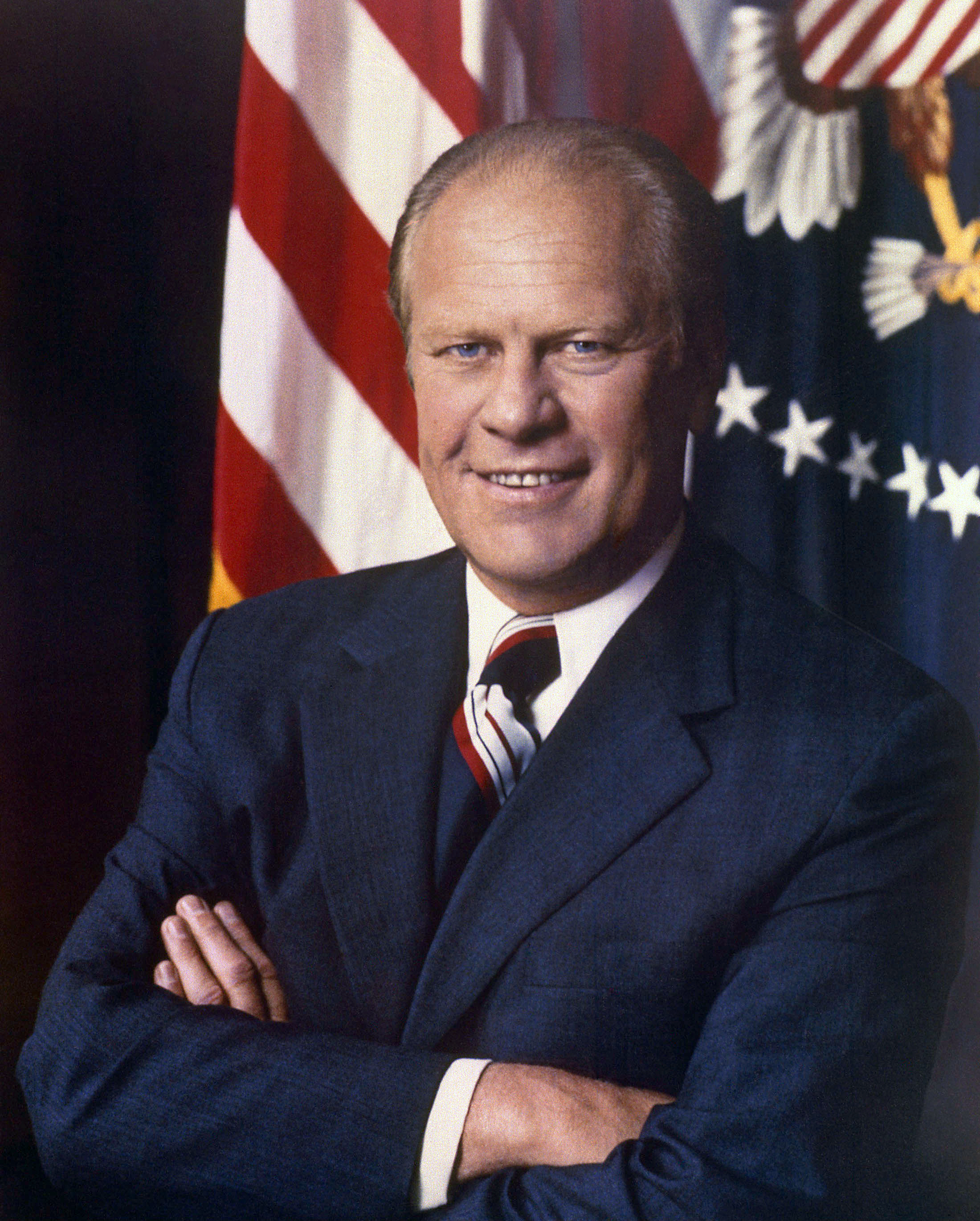
Historical · U.S. House · Michigan · District 5
Gerald Ford Jr.
Former U.S. Representative · Michigan District 5 · 1949–1975 · Republican
Gerald Ford Jr. represented Michigan's District 5 in the United States House of Representatives (1949–1975) for the Republican party. The page below collects sourced biographical facts, term history, committee roles, and provenance for Jr..
Bioguide ID: F000260
Key facts
- Full name
- Gerald Ford Jr.
- State
- Michigan
- District
- District 5
- Party
- Republican
- House service
- 1949–1975
- First House term
- 1949
- Status
- Left office
- Current term ends
- —
- Born
- 1913
- Bioguide ID
- F000260
- Committee assignments
- —
- Dataset version
- 1.20260605
Biographical narrative
961 words · sourced from the Wikipedia REST extract
Gerald R. Ford Jr. was a prominent American politician who served as a U.S. Representative for Michigan's 5th congressional district from 1949 until 1975. A member of the Republican Party, Ford's political career spanned nearly three decades, during which he also held significant leadership roles, including serving as the House Minority Leader. His tenure in Congress laid the groundwork for his later ascension to national prominence, culminating in his presidency from 1974 to 1977, following the resignation of Richard Nixon.
Early life and career
Gerald R. Ford Jr. was born Leslie Lynch King Jr. on July 14, 1913, in Omaha, Nebraska. He was the only child of Dorothy Ayer Gardner and Leslie Lynch King Sr., a wool trader. Shortly after his birth, his parents separated, and his mother moved with him to Oak Park, Illinois, before eventually settling in Grand Rapids, Michigan. Following his parents' divorce in December 1913, Ford was raised primarily by his mother, who later remarried Gerald Rudolff Ford, a salesman in a family-owned paint and varnish company. Although he was never formally adopted, Ford was referred to as Gerald Rudolff Ford Jr. from that point onward, and the name change was officially recognized in 1935.
Ford's upbringing in Grand Rapids was marked by a strong emphasis on education and community involvement. He was active in the Boy Scouts of America, achieving the rank of Eagle Scout in 1927, a distinction that remains notable as he is the only Eagle Scout to have become President of the United States. He attended Grand Rapids South High School, where he excelled as a student and athlete, particularly in football, serving as the captain of the team.
After high school, Ford enrolled at the University of Michigan, where he played as a center and linebacker for the university's football team. His contributions helped the Wolverines achieve two undefeated seasons and national championships in 1932 and 1933. Despite a less successful senior year, Ford's athletic prowess earned him recognition and respect, setting the stage for his future endeavors.
Following his time at the University of Michigan, Ford pursued a legal education at Yale Law School. His academic achievements were complemented by his service in the U.S. Naval Reserve during World War II, where he served from 1942 to 1946. After the war, Ford returned to Michigan and began his political career, which would lead him to the U.S. House of Representatives.
House tenure
Ford was elected to the U.S. House of Representatives in 1948, representing Michigan's 5th congressional district. He took office in 1949 and would go on to serve a total of 13 terms in Congress, making significant contributions to legislative processes and party leadership. Throughout his time in the House, Ford was known for his moderate Republican stance and his ability to work across party lines.
During his early years in Congress, Ford was involved in various legislative initiatives and gained a reputation for his commitment to public service. He was appointed to the Warren Commission, which was tasked with investigating the assassination of President John F. Kennedy. This role further elevated his profile within the political landscape.
In the 1960s, Ford's leadership capabilities were recognized when he was elected House Minority Leader, a position he held for nine years. As Minority Leader, he played a crucial role in guiding the Republican Party's legislative agenda and strategizing against the Democratic majority. His tenure was characterized by a focus on bipartisanship and a commitment to addressing the pressing issues of the time.
Ford's congressional career came to an end in 1975, after which he was appointed Vice President of the United States following the resignation of Spiro Agnew. This appointment marked a significant transition in Ford's political journey, leading him to the presidency after Richard Nixon's resignation in 1974.
Legislative focus and committees
Throughout his time in the House of Representatives, Ford was involved in a wide range of legislative issues, reflecting the diverse needs of his constituents and the broader national landscape. His legislative focus included economic policies, social issues, and foreign affairs, demonstrating his adaptability and responsiveness to the changing political climate.
Ford's role on various committees allowed him to influence key legislation. He served on the Appropriations Committee, which is responsible for allocating federal funding, and he was involved in discussions surrounding budgetary matters and fiscal policy. His experience on this committee provided him with a deep understanding of government funding processes and the importance of fiscal responsibility.
In addition to his work on appropriations, Ford's involvement in the Warren Commission showcased his engagement with significant historical events and issues of national importance. His participation in this investigation not only highlighted his commitment to transparency and accountability in government but also positioned him as a key figure in American political history.
Ford's leadership style was characterized by a willingness to collaborate with colleagues from both parties. His moderate approach and focus on consensus-building were instrumental in navigating the complexities of legislative negotiations during a time of significant political division. This ability to foster cooperation contributed to his reputation as a respected leader within the House.
As a member of Congress, Ford's legislative contributions and leadership roles laid the foundation for his subsequent rise to the vice presidency and ultimately the presidency. His extensive experience in the House provided him with a comprehensive understanding of the legislative process, which he would draw upon during his time in higher office.
In summary, Gerald R. Ford Jr.'s career as a U.S. Representative was marked by a commitment to public service, bipartisan collaboration, and a focus on addressing the pressing issues of his time. His tenure in the House of Representatives not only shaped his political identity but also positioned him for future leadership roles at the national level.
Notable legislation
Sponsored and co-sponsored legislation for Gerald Ford Jr. is pending operator curation. The biographical narrative above carries the same provenance trail until per-bill rows are written.
Sources
- [1]https://en.wikipedia.org/wiki/Gerald_FordWikipedia · retrieved 2026-06-05
Notable quotes
Sourced quotes for Gerald Ford Jr. are pending operator curation. Narrative-scope provenance remains attached below.
Sources
- [1]https://en.wikipedia.org/wiki/Gerald_FordWikipedia · retrieved 2026-06-05
Key positions
Curated policy positions for Gerald Ford Jr. are pending operator review. The biographical narrative above carries the same provenance trail until per-topic positions are written.
Sources
- [1]https://en.wikipedia.org/wiki/Gerald_FordWikipedia · retrieved 2026-06-05
Terms served
- 1949–1951U.S. House · Term 1 · Republican
- 1951–1953U.S. House · Term 2 · Republican
- 1953–1955U.S. House · Term 3 · Republican
- 1955–1957U.S. House · Term 4 · Republican
- 1957–1959U.S. House · Term 5 · Republican
- 1959–1961U.S. House · Term 6 · Republican
- 1961–1963U.S. House · Term 7 · Republican
- 1963–1965U.S. House · Term 8 · Republican
- 1965–1967U.S. House · Term 9 · Republican
- 1967–1969U.S. House · Term 10 · Republican
- 1969–1971U.S. House · Term 11 · Republican
- 1971–1973U.S. House · Term 12 · Republican
- 1973–1975U.S. House · Term 13 · Republican
Sources & provenance
Every attributable claim above carries a per-section [N] marker that resolves to the corresponding URL below. Each entry records the upstream provider, the canonical URL, and the timestamp at which the source was retrieved by the ingest pipeline.
Key facts
- https://bioguide.congress.gov/search/bio/F000260bioguide · retrieved 2026-06-05
- https://www.govtrack.us/congress/members/404212govtrack · retrieved 2026-06-05
Biographical narrative
- https://en.wikipedia.org/wiki/Gerald_Fordwikipedia · retrieved 2026-06-05
Find your representative
Every U.S. state elects representatives by district. Browse Michigan’s delegation, the full former-representative roster, or explore the role and term length.
Related on The Candidate
- Preceded by Bartel JonkmanEarlier holder of the Michigan District 5 House seat · Republican.Open
- Succeeded by Dale KildeeLater holder of the Michigan District 5 House seat · Democratic.Open
- Alexander BuelFormer U.S. Representative · Michigan District 1 · DemocraticOpen
- Alfred LuckingFormer U.S. Representative · Michigan District 1 · DemocraticOpen
- Alpheus WilliamsFormer U.S. Representative · Michigan District 1 · DemocraticOpen
- Bart StupakFormer U.S. Representative · Michigan District 1 · DemocraticOpen