
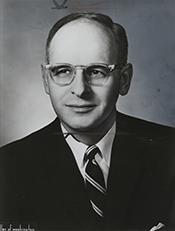
Historical · U.S. House · Michigan · District 6
Charles Chamberlain
Former U.S. Representative · Michigan District 6 · 1957–1975 · Republican
Charles Chamberlain represented Michigan's District 6 in the United States House of Representatives (1957–1975) for the Republican party. The page below collects sourced biographical facts, term history, committee roles, and provenance for Chamberlain.
Bioguide ID: C000275
Key facts
- Full name
- Charles Chamberlain
- State
- Michigan
- District
- District 6
- Party
- Republican
- House service
- 1957–1975
- First House term
- 1957
- Status
- Left office
- Current term ends
- —
- Born
- 1917
- Bioguide ID
- C000275
- Committee assignments
- —
- Dataset version
- 1.20260605
Biographical narrative
969 words · sourced from the Wikipedia REST extract
Charles E. Chamberlain was an American politician who served as a U.S. Representative for Michigan's 6th congressional district from 1957 until 1974. A member of the Republican Party, Chamberlain was elected to nine consecutive terms in the House of Representatives, marking a significant tenure in American politics during a period of considerable change in the nation. His legislative career was characterized by his involvement in key civil rights legislation and his service in various legal and governmental roles prior to his election to Congress.
Early life and career
Charles Ernest Chamberlain was born on July 22, 1917, in Locke Township, Michigan. He grew up in a region that would later become integral to his political identity. After completing his secondary education at Lansing Central High School in Lansing, Michigan, he pursued higher education at the University of Virginia in Charlottesville. There, he earned a Bachelor of Science degree in 1941, which laid the foundation for his future endeavors in law and public service. Following his undergraduate studies, Chamberlain continued his education at the University of Virginia School of Law, where he obtained a Bachelor of Laws degree in 1949.
Chamberlain's early career was marked by his service in the United States Coast Guard during World War II. He enlisted in 1942 and served until 1946, a commitment that reflected his dedication to his country during a tumultuous period in history. After the war, he continued his service in the United States Coast Guard Reserve until 1977, demonstrating a long-term commitment to military service.
In the years following his active duty, Chamberlain transitioned into a legal career. He worked as a private practice lawyer and also served as an agent for the Internal Revenue Service within the United States Treasury Department from 1946 to 1947. His legal expertise was further utilized when he took on the role of assistant prosecutor for Ingham County, Michigan, in 1950. He also served as the city attorney for East Lansing and provided legal counsel to the Michigan State Senate judiciary committee in 1953 and 1954. His experience culminated in his role as the prosecuting attorney for Ingham County from 1955 to 1956, where he gained significant legal and administrative experience that would later inform his legislative work.
Chamberlain's political career began in earnest in 1956 when he successfully ran for the U.S. House of Representatives. He defeated the incumbent Democratic representative, Donald Hayworth, marking the beginning of a long and impactful tenure in Congress.
House tenure
Charles Chamberlain was first elected to the House of Representatives in 1956, officially taking office on January 3, 1957. His election was part of a broader Republican wave during that period, and he quickly established himself as a significant figure within Michigan's political landscape. Over the course of his nine terms in office, he was re-elected to eight subsequent Congresses, serving until December 31, 1974. His tenure in the House spanned a time of considerable social and political upheaval in the United States, including the civil rights movement, the Vietnam War, and significant shifts in domestic policy.
During his time in Congress, Chamberlain was known for his active participation in legislative matters. He was involved in various committees and played a role in shaping policies that would have lasting impacts on American society. His electoral success was marked by a notable victory in 1972, where he narrowly defeated Democrat Milton Robert Carr in a race that highlighted the changing political dynamics in Michigan. Despite the strong Republican sentiment that year, Chamberlain's victory margin was slim, indicating the increasing competitiveness of his district.
Chamberlain's final term in the House concluded in 1974 when he was succeeded by Carr, who had mounted a successful campaign against him. This transition marked the end of Chamberlain's nearly two-decade-long service in Congress, during which he had built a reputation as a dedicated public servant.
Legislative focus and committees
Throughout his congressional career, Charles E. Chamberlain was involved in a range of legislative initiatives, with a particular focus on civil rights. He voted in favor of several landmark pieces of legislation, including the Civil Rights Acts of 1957, 1960, 1964, and 1968. These acts were pivotal in the struggle for civil rights in the United States, addressing issues such as voting rights, discrimination, and segregation. His support for these measures indicated a commitment to advancing civil rights during a critical period in American history.
In addition to his work on civil rights, Chamberlain was also a proponent of the 24th Amendment to the U.S. Constitution, which prohibited poll taxes in federal elections, and he supported the Voting Rights Act of 1965. These legislative efforts were part of a broader movement to ensure equal access to the electoral process for all Americans, particularly for marginalized communities.
Chamberlain's involvement in these significant legislative efforts reflects his engagement with the pressing social issues of his time. His voting record and legislative priorities illustrate a commitment to fostering equality and protecting the rights of citizens, aligning with the broader goals of the Republican Party during the civil rights era.
Beyond his legislative work, Chamberlain was active in various civic organizations. He was a member of the American Legion, the Society of the Cincinnati, Veterans of Foreign Wars, and Kiwanis, indicating his engagement with both veteran affairs and community service. These affiliations highlight his dedication to public service and his connection to the communities he represented.
After his departure from Congress, Chamberlain continued to be involved in various capacities until his passing on November 25, 2002, in Leesburg, Virginia. He died from renal failure and congestive heart failure and was interred in Evergreen Cemetery in Lansing, Michigan. His life and career left a lasting impact on the political landscape of Michigan and the nation, reflecting the complexities and challenges of American governance during the mid-20th century.
Notable legislation
Sponsored and co-sponsored legislation for Charles Chamberlain is pending operator curation. The biographical narrative above carries the same provenance trail until per-bill rows are written.
Sources
- [1]https://en.wikipedia.org/wiki/Charles_E._ChamberlainWikipedia · retrieved 2026-06-05
Notable quotes
Sourced quotes for Charles Chamberlain are pending operator curation. Narrative-scope provenance remains attached below.
Sources
- [1]https://en.wikipedia.org/wiki/Charles_E._ChamberlainWikipedia · retrieved 2026-06-05
Key positions
Curated policy positions for Charles Chamberlain are pending operator review. The biographical narrative above carries the same provenance trail until per-topic positions are written.
Sources
- [1]https://en.wikipedia.org/wiki/Charles_E._ChamberlainWikipedia · retrieved 2026-06-05
Terms served
- 1957–1959U.S. House · Term 1 · Republican
- 1959–1961U.S. House · Term 2 · Republican
- 1961–1963U.S. House · Term 3 · Republican
- 1963–1965U.S. House · Term 4 · Republican
- 1965–1967U.S. House · Term 5 · Republican
- 1967–1969U.S. House · Term 6 · Republican
- 1969–1971U.S. House · Term 7 · Republican
- 1971–1973U.S. House · Term 8 · Republican
- 1973–1975U.S. House · Term 9 · Republican
Sources & provenance
Every attributable claim above carries a per-section [N] marker that resolves to the corresponding URL below. Each entry records the upstream provider, the canonical URL, and the timestamp at which the source was retrieved by the ingest pipeline.
Key facts
- https://bioguide.congress.gov/search/bio/C000275bioguide · retrieved 2026-06-05
- https://www.govtrack.us/congress/members/402418govtrack · retrieved 2026-06-05
Biographical narrative
- https://en.wikipedia.org/wiki/Charles_E._Chamberlainwikipedia · retrieved 2026-06-05
Find your representative
Every U.S. state elects representatives by district. Browse Michigan’s delegation, the full former-representative roster, or explore the role and term length.
Related on The Candidate
- Preceded by Donald HayworthEarlier holder of the Michigan District 6 House seat · Democratic.Open
- Succeeded by James DunnLater holder of the Michigan District 6 House seat · Republican.Open
- Alexander BuelFormer U.S. Representative · Michigan District 1 · DemocraticOpen
- Alfred LuckingFormer U.S. Representative · Michigan District 1 · DemocraticOpen
- Alpheus WilliamsFormer U.S. Representative · Michigan District 1 · DemocraticOpen
- Bart StupakFormer U.S. Representative · Michigan District 1 · DemocraticOpen