
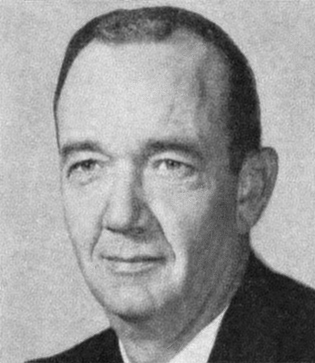
Historical · U.S. House · Michigan · District 7
John Mackie
Former U.S. Representative · Michigan District 7 · 1965–1967 · Democratic
John Mackie represented Michigan's District 7 in the United States House of Representatives (1965–1967) for the Democratic party. The page below collects sourced biographical facts, term history, committee roles, and provenance for Mackie.
Bioguide ID: M000026
Key facts
- Full name
- John Mackie
- State
- Michigan
- District
- District 7
- Party
- Democratic
- House service
- 1965–1967
- First House term
- 1965
- Status
- Left office
- Current term ends
- —
- Born
- 1920
- Bioguide ID
- M000026
- Committee assignments
- —
- Dataset version
- 1.20260605
Biographical narrative
803 words · sourced from the Wikipedia REST extract
John Mackie was a U.S. Representative from Michigan, serving in the House of Representatives during the mid-1960s. A member of the Democratic Party, he held office from 1965 until 1967, representing Michigan's 7th congressional district. Prior to his political career, Mackie was a World War II veteran and a transportation engineer, contributing significantly to infrastructure development in Michigan.
Early life and career
John Currie Mackie was born on June 1, 1920, in Toronto, Ontario, Canada. In 1924, when he was just four years old, he and his family immigrated to the United States, settling in Detroit, Michigan. Mackie grew up in Detroit, where he completed his secondary education at Southeastern High School, graduating in 1938. Following high school, he attended Lawrence Institute of Technology for a brief period before transferring to Michigan State University. He earned a Bachelor of Science degree in Engineering from Michigan State in 1942, and in recognition of his contributions to the field, he was later awarded an honorary Doctor of Laws degree from the same institution in 1965.
Mackie's professional career began in the field of engineering, specifically in airplane engine design, where he worked in Detroit shortly after completing his degree. His career was interrupted by World War II, during which he served in the United States Army Air Corps from 1942 to 1945. Mackie was deployed to the Pacific Theater and attained the rank of first lieutenant before being discharged.
After the war, Mackie returned to Michigan and continued his career in engineering. He worked for an engineering firm in the Flint area from 1946 to 1952. In 1952, he founded the Flint Surveying & Engineering Company, which allowed him to establish a more direct influence on local infrastructure projects. His expertise in transportation engineering led to his election as Genesee County Surveyor, a position he held from 1952 until 1956. Mackie's prominence in the field of transportation engineering grew, and in 1957, he was elected as the State Highway Commissioner of Michigan. He was reelected in 1961, serving in this role until he transitioned to federal office. During his tenure as highway commissioner, Mackie was known for his efforts to expand Michigan's freeway and expressway systems, making the state a leader in the construction of the Interstate Highway System. He was also president of the American Association of State Highway Officials in 1963.
House tenure
Mackie's political career reached a new level when he was elected to the U.S. House of Representatives as a Democrat from Michigan's 7th congressional district. He took office on January 4, 1965, as part of the 89th United States Congress. His election was part of a broader trend of Democratic gains in the mid-1960s, and he was recognized as one of the "Michigan Five Fluke Freshmen," a term used to describe a group of newly elected representatives who were seen as unexpected winners. Mackie's time in Congress was marked by his focus on issues related to transportation and infrastructure, reflecting his background as an engineer and highway commissioner.
During his tenure, Mackie participated in various legislative discussions and initiatives, although specific details about his contributions to particular bills or policies are not extensively documented. His time in office was relatively brief, as he served only one term. In the 1966 election, he was defeated by Republican candidate Donald W. Riegle, Jr., who would later switch parties and become a Democrat in 1973. Mackie's congressional term ended on January 3, 1967, marking the conclusion of his formal political career in the House.
Legislative focus and committees
Throughout his time in Congress, Mackie's background in engineering and transportation heavily influenced his legislative focus. He was particularly concerned with issues related to infrastructure development, reflecting his previous experience as a highway commissioner. Mackie's expertise in transportation engineering positioned him to contribute to discussions on the federal highway system and related policies, although specific committee assignments or legislative initiatives during his term are not detailed in the available records.
Mackie's views on transportation were shaped by his experiences in Michigan, where he had observed the evolution of the automobile industry and its impact on infrastructure. He was known to express concerns about the growing popularity of compact cars, which he believed could threaten tax revenues and pose hazards on highways. His perspective on transportation issues was informed by his professional background, and he advocated for policies that would support the continued expansion and maintenance of the nation's roadways.
After leaving Congress, Mackie continued to be involved in business and resided in Warrenton, Virginia. He passed away on March 5, 2008, after an extended illness. His legacy includes contributions to Michigan's transportation infrastructure, and a welcome center located at the intersection of US 127 and US 10 in Clare, Michigan, is named in his honor, reflecting his impact on the state's development.
Notable legislation
Sponsored and co-sponsored legislation for John Mackie is pending operator curation. The biographical narrative above carries the same provenance trail until per-bill rows are written.
Sources
- [1]https://en.wikipedia.org/wiki/John_C._MackieWikipedia · retrieved 2026-06-05
Notable quotes
Sourced quotes for John Mackie are pending operator curation. Narrative-scope provenance remains attached below.
Sources
- [1]https://en.wikipedia.org/wiki/John_C._MackieWikipedia · retrieved 2026-06-05
Key positions
Curated policy positions for John Mackie are pending operator review. The biographical narrative above carries the same provenance trail until per-topic positions are written.
Sources
- [1]https://en.wikipedia.org/wiki/John_C._MackieWikipedia · retrieved 2026-06-05
Terms served
- 1965–1967U.S. House · Term 1 · Democratic
Sources & provenance
Every attributable claim above carries a per-section [N] marker that resolves to the corresponding URL below. Each entry records the upstream provider, the canonical URL, and the timestamp at which the source was retrieved by the ingest pipeline.
Key facts
- https://bioguide.congress.gov/search/bio/M000026bioguide · retrieved 2026-06-05
- https://www.govtrack.us/congress/members/407054govtrack · retrieved 2026-06-05
Biographical narrative
- https://en.wikipedia.org/wiki/John_C._Mackiewikipedia · retrieved 2026-06-05
Find your representative
Every U.S. state elects representatives by district. Browse Michigan’s delegation, the full former-representative roster, or explore the role and term length.
Related on The Candidate
- Preceded by Robert McIntoshEarlier holder of the Michigan District 7 House seat · Republican.Open
- Succeeded by Nick SmithLater holder of the Michigan District 7 House seat · Republican.Open
- Alexander BuelFormer U.S. Representative · Michigan District 1 · DemocraticOpen
- Alfred LuckingFormer U.S. Representative · Michigan District 1 · DemocraticOpen
- Alpheus WilliamsFormer U.S. Representative · Michigan District 1 · DemocraticOpen
- Bart StupakFormer U.S. Representative · Michigan District 1 · DemocraticOpen