
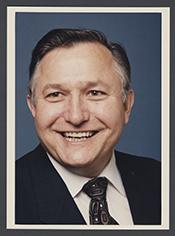
Historical · U.S. House · Michigan · District 7
Nick Smith
Former U.S. Representative · Michigan District 7 · 1993–2005 · Republican
Nick Smith represented Michigan's District 7 in the United States House of Representatives (1993–2005) for the Republican party. The page below collects sourced biographical facts, term history, committee roles, and provenance for Smith.
Bioguide ID: S000597
Key facts
- Full name
- Nick Smith
- State
- Michigan
- District
- District 7
- Party
- Republican
- House service
- 1993–2005
- First House term
- 1993
- Status
- Left office
- Current term ends
- —
- Born
- 1934
- Bioguide ID
- S000597
- Committee assignments
- —
- Dataset version
- 1.20260605
Biographical narrative
933 words · sourced from the Wikipedia REST extract
Nicholas Hart Smith is a retired American politician who served as a Republican member of the United States House of Representatives, representing Michigan's 7th congressional district from 1993 until 2005. Throughout his political career, Smith was known for his conservative voting record and his commitment to serving a limited number of terms in Congress, a promise he upheld by not seeking re-election after his sixth term. His tenure in the House was marked by a mix of local engagement and national controversies, particularly surrounding healthcare legislation.
Early life and career
Nick Smith was born on November 5, 1934, in Addison, Michigan, where he continues to reside. He pursued higher education at Michigan State University, earning a Bachelor of Arts degree in 1957. Following his undergraduate studies, he furthered his education by obtaining a Master of Science in economics from the University of Delaware in 1959. His early career included service in the United States Air Force from 1959 to 1961, where he achieved the rank of captain. During his military service, Smith held various roles, including squadron commander in the Civil Air Patrol and an intelligence officer.
In addition to his military service, Smith has been involved in agriculture, operating a dairy farm in Addison. His local political career began in 1962 when he served on the Somerset Township board of trustees until 1968. During this period, he also held the position of township supervisor and was a member of the Hillsdale County board of supervisors from 1966 to 1968. Following his local government roles, Smith transitioned to federal service, working as the assistant deputy administrator and director of energy at the United States Department of Agriculture from 1972 to 1974.
Smith's political career continued at the state level when he was elected to the Michigan State House of Representatives, representing the 41st District from 1979 to 1983. He then moved to the Michigan Senate, where he served from 1983 until 1993, representing the 19th District. His leadership capabilities were recognized during his time in the Senate, as he was appointed President Pro Tempore, a position he held from 1983 to 1990.
House tenure
In 1992, Smith ran for a seat in the U.S. House of Representatives, contesting the 7th District of Michigan. He won the Republican primary by a narrow margin against fellow state senator Joe Schwarz, who was considered a more moderate Republican. Smith's victory was facilitated by the division of votes among candidates from the western portion of the district, allowing him to secure the nomination with approximately 37 percent of the vote. Notably, no Democratic candidate filed for the general election, which effectively guaranteed Smith's election to Congress.
Smith began his first term in the House in January 1993 and was subsequently re-elected five times, serving a total of six terms until his departure from Congress in January 2005. Throughout his time in the House, Smith maintained a relatively low profile, often characterized as a conservative legislator. He represented a district that was politically marginal, yet he consistently aligned with conservative values and priorities.
His congressional career included a notable moment in 2004, when he became embroiled in a controversy related to the Medicare Modernization Act. At that time, Smith had already announced his decision not to seek re-election, adhering to a self-imposed limit of six terms in the House. He publicly endorsed his son, Brad Smith, as his preferred successor. During the debate over the Medicare bill, Smith reported that members of the House Republican leadership offered significant financial support for his son's campaign in exchange for his vote in favor of the legislation. Smith's refusal to comply with this request drew attention to the political pressures faced by legislators and highlighted issues of ethics within the House.
Despite his efforts to uphold his principles, Smith's son ultimately lost in the Republican primary to Joe Schwarz, who had previously been Smith's opponent. This outcome marked a significant moment in Smith's political legacy, as it underscored the challenges of navigating party dynamics and electoral competition.
Legislative focus and committees
During his tenure in the House, Nick Smith was a member of several committees that shaped his legislative focus. His work primarily revolved around issues pertinent to his constituents in Michigan, with a particular emphasis on agricultural and economic matters, reflecting his background in farming and economics. His experience in the United States Department of Agriculture also informed his approach to legislation affecting rural communities and agricultural policies.
Smith's voting record was consistently conservative, aligning with the broader Republican agenda during his time in office. He participated in debates and discussions on various issues, including healthcare, taxation, and government spending. His conservative stance was a defining feature of his legislative approach, and he often advocated for policies that he believed would benefit his constituents and uphold traditional values.
In addition to his committee work, Smith's tenure was marked by his commitment to limited government and fiscal responsibility. He often expressed concerns about government overreach and advocated for policies that promoted individual freedoms and economic growth. His legislative priorities were shaped by his experiences as a farmer and local government official, which provided him with insights into the needs and challenges faced by rural communities in Michigan.
Overall, Nick Smith's career in the U.S. House of Representatives was characterized by a commitment to conservative principles, a focus on agricultural and economic issues, and a dedication to serving his constituents in Michigan's 7th District. His decision to adhere to a self-imposed term limit and his involvement in significant legislative controversies contributed to his legacy as a member of Congress.
Notable legislation
Sponsored and co-sponsored legislation for Nick Smith is pending operator curation. The biographical narrative above carries the same provenance trail until per-bill rows are written.
Sources
- [1]https://en.wikipedia.org/wiki/Nick_Smith_(American_politician)Wikipedia · retrieved 2026-06-05
Notable quotes
Sourced quotes for Nick Smith are pending operator curation. Narrative-scope provenance remains attached below.
Sources
- [1]https://en.wikipedia.org/wiki/Nick_Smith_(American_politician)Wikipedia · retrieved 2026-06-05
Key positions
Curated policy positions for Nick Smith are pending operator review. The biographical narrative above carries the same provenance trail until per-topic positions are written.
Sources
- [1]https://en.wikipedia.org/wiki/Nick_Smith_(American_politician)Wikipedia · retrieved 2026-06-05
Terms served
- 1993–1995U.S. House · Term 1 · Republican
- 1995–1997U.S. House · Term 2 · Republican
- 1997–1999U.S. House · Term 3 · Republican
- 1999–2001U.S. House · Term 4 · Republican
- 2001–2003U.S. House · Term 5 · Republican
- 2003–2005U.S. House · Term 6 · Republican
Sources & provenance
Every attributable claim above carries a per-section [N] marker that resolves to the corresponding URL below. Each entry records the upstream provider, the canonical URL, and the timestamp at which the source was retrieved by the ingest pipeline.
Key facts
- https://bioguide.congress.gov/search/bio/S000597bioguide · retrieved 2026-06-05
- http://www.house.gov/nicksmithhouse.gov · retrieved 2026-06-05
Biographical narrative
- https://en.wikipedia.org/wiki/Nick_Smith_(American_politician)wikipedia · retrieved 2026-06-05
Find your representative
Every U.S. state elects representatives by district. Browse Michigan’s delegation, the full former-representative roster, or explore the role and term length.
Related on The Candidate
- Preceded by John MackieEarlier holder of the Michigan District 7 House seat · Democratic.Open
- Succeeded by Joe SchwarzLater holder of the Michigan District 7 House seat · Republican.Open
- Alexander BuelFormer U.S. Representative · Michigan District 1 · DemocraticOpen
- Alfred LuckingFormer U.S. Representative · Michigan District 1 · DemocraticOpen
- Alpheus WilliamsFormer U.S. Representative · Michigan District 1 · DemocraticOpen
- Bart StupakFormer U.S. Representative · Michigan District 1 · DemocraticOpen