
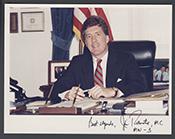
Historical · U.S. House · Minnesota · District 3
Jim Ramstad
Former U.S. Representative · Minnesota District 3 · 1991–2009 · Republican
Jim Ramstad represented Minnesota's District 3 in the United States House of Representatives (1991–2009) for the Republican party. The page below collects sourced biographical facts, term history, committee roles, and provenance for Ramstad.
Bioguide ID: R000033
Key facts
- Full name
- Jim Ramstad
- State
- Minnesota
- District
- District 3
- Party
- Republican
- House service
- 1991–2009
- First House term
- 1991
- Status
- Left office
- Current term ends
- —
- Born
- 1946
- Bioguide ID
- R000033
- Committee assignments
- —
- Dataset version
- 1.20260605
Biographical narrative
949 words · sourced from the Wikipedia REST extract
James Marvin Ramstad was an American politician and lawyer who served as a U.S. Representative for Minnesota's 3rd congressional district from 1991 until 2009. A member of the Republican Party, he was known for his moderate political stance and his advocacy for mental health and addiction recovery. Ramstad's legislative career was marked by his commitment to bipartisan cooperation, particularly in addressing issues related to mental health and addiction. He was also a recovering alcoholic, which informed his advocacy work and personal mission to support those struggling with addiction.
Early life and career
Jim Ramstad was born on May 6, 1946, in Jamestown, North Dakota. He pursued higher education at the University of Minnesota and later attended the George Washington University Law School, where he earned his law degree. Following his education, Ramstad served as an officer in the United States Army Reserve from 1968 to 1974. After his military service, he began his professional career as a private practice attorney and also worked as a legislative aide in the Minnesota House of Representatives.
In the late 1970s, Ramstad became involved in local governance and community service. He served on the Wayzata-Plymouth Chemical Health Commission, the Plymouth Human Rights Commission, and the Minnesota State Human Rights Advisory Committee from 1979 to 1980. His early political career began in 1981 when he was elected to the Minnesota State Senate, where he served until 1990. During his time in the state senate, he was reelected multiple times, establishing a reputation as a dedicated public servant.
In 1990, Ramstad transitioned to national politics by winning election to the U.S. House of Representatives, representing Minnesota's 3rd congressional district. His victory came after defeating former Minneapolis city councilman Lou DeMars in the election. Ramstad's congressional career would span nearly two decades, during which he would serve in nine consecutive terms.
House tenure
Jim Ramstad's tenure in the U.S. House of Representatives began on January 3, 1991, and continued until January 3, 2009. Throughout his time in office, he represented Minnesota's 3rd congressional district, which encompasses suburban areas around the Twin Cities. Ramstad was known for his ability to win reelection by significant margins, reflecting his strong support within his district. He was recognized as a moderate Republican, often working across party lines to achieve legislative goals.
In September 2007, Ramstad announced that he would not seek reelection in 2008, a decision he reiterated in December of that year. His decision to retire marked the end of a significant chapter in his political career, and he was succeeded by Republican State Representative Erik Paulsen.
During his time in Congress, Ramstad was particularly focused on issues related to mental health and addiction recovery. He viewed the elimination of discrimination against individuals suffering from mental health and addiction problems as a key aspect of his legislative legacy. He played a crucial role in advocating for the Mental Health Parity Bill, which aimed to ensure that mental health services were covered by insurance in a manner comparable to physical health services. This legislation was eventually passed and signed into law in December 2008, shortly after Ramstad's announcement of his retirement.
In addition to his legislative work, Ramstad was mentioned as a potential candidate for Director of the Office of National Drug Control Policy in the Obama administration, although the position ultimately went to another individual. He also considered a run for Governor of Minnesota in the 2010 election but decided against it.
Legislative focus and committees
Throughout his congressional career, Jim Ramstad served on several important committees that shaped his legislative focus. He was a member of the Ways and Means Committee, which is one of the most influential committees in the House, responsible for taxation and revenue-related legislation. Within this committee, he held the position of Ranking Member on the Subcommittee on Oversight and was also a member of the Subcommittee on Health.
Ramstad's commitment to addiction recovery was evident in his role as co-chair of the Addiction Treatment and Recovery Caucus, where he worked to promote policies that support individuals struggling with substance use disorders. He also co-chaired the Disabilities Caucus and the Law Enforcement Caucus, reflecting his interest in a wide range of issues affecting his constituents and the nation.
In addition to these roles, Ramstad was involved with the Medical Technology Caucus, advocating for advancements in medical technology that could improve healthcare outcomes. His work on these committees allowed him to influence a variety of legislative initiatives, particularly those related to health care and social services.
Ramstad's political positions included a mix of traditional Republican values and more progressive stances on certain social issues. He was pro-choice and supported embryonic stem cell research, while also opposing gay marriage. His voting record indicated a moderate approach, as he was recognized as the most moderate Republican member of the Minnesota delegation during the 109th Congress, scoring relatively low on conservative measures while also receiving some acknowledgment from progressive groups.
In his personal life, Ramstad was a recovering alcoholic and a long-time advocate for addiction treatment and recovery services. He had been sober for 39 years at the time of his death. His advocacy work extended beyond his congressional career, as he became involved with organizations focused on addiction recovery and served as a sponsor for individuals in recovery, including notable figures in politics.
Jim Ramstad passed away on November 5, 2020, at the age of 74, due to complications from Parkinson's disease. In 2022, to honor his legacy, his widow established the Jim Ramstad Institute for Civility and Youth Leadership, aimed at fostering leadership skills among young people and promoting the ideals of bipartisanship, ethics, and civic engagement that Ramstad championed throughout his life.
Notable legislation
Sponsored and co-sponsored legislation for Jim Ramstad is pending operator curation. The biographical narrative above carries the same provenance trail until per-bill rows are written.
Sources
- [1]https://en.wikipedia.org/wiki/Jim_RamstadWikipedia · retrieved 2026-06-05
Notable quotes
Sourced quotes for Jim Ramstad are pending operator curation. Narrative-scope provenance remains attached below.
Sources
- [1]https://en.wikipedia.org/wiki/Jim_RamstadWikipedia · retrieved 2026-06-05
Key positions
Curated policy positions for Jim Ramstad are pending operator review. The biographical narrative above carries the same provenance trail until per-topic positions are written.
Sources
- [1]https://en.wikipedia.org/wiki/Jim_RamstadWikipedia · retrieved 2026-06-05
Terms served
- 1991–1993U.S. House · Term 1 · Republican
- 1993–1995U.S. House · Term 2 · Republican
- 1995–1997U.S. House · Term 3 · Republican
- 1997–1999U.S. House · Term 4 · Republican
- 1999–2001U.S. House · Term 5 · Republican
- 2001–2003U.S. House · Term 6 · Republican
- 2003–2005U.S. House · Term 7 · Republican
- 2005–2007U.S. House · Term 8 · Republican
- 2007–2009U.S. House · Term 9 · Republican
Sources & provenance
Every attributable claim above carries a per-section [N] marker that resolves to the corresponding URL below. Each entry records the upstream provider, the canonical URL, and the timestamp at which the source was retrieved by the ingest pipeline.
Key facts
- https://bioguide.congress.gov/search/bio/R000033bioguide · retrieved 2026-06-05
- http://www.house.gov/ramstadhouse.gov · retrieved 2026-06-05
Biographical narrative
- https://en.wikipedia.org/wiki/Jim_Ramstadwikipedia · retrieved 2026-06-05
Find your representative
Every U.S. state elects representatives by district. Browse Minnesota’s delegation, the full former-representative roster, or explore the role and term length.
Related on The Candidate
- Preceded by William FrenzelEarlier holder of the Minnesota District 3 House seat · Republican.Open
- Succeeded by Erik PaulsenLater holder of the Minnesota District 3 House seat · Republican.Open
- Albert QuieFormer U.S. Representative · Minnesota District 1 · RepublicanOpen
- Allen FurlowFormer U.S. Representative · Minnesota District 1 · RepublicanOpen
- Arlen ErdahlFormer U.S. Representative · Minnesota District 1 · RepublicanOpen
- August AndresenFormer U.S. Representative · Minnesota District 1 · RepublicanOpen