
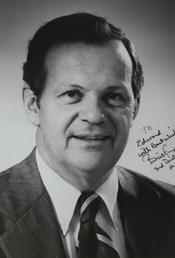
Historical · U.S. House · Minnesota · District 3
William Frenzel
Former U.S. Representative · Minnesota District 3 · 1971–1991 · Republican
William Frenzel represented Minnesota's District 3 in the United States House of Representatives (1971–1991) for the Republican party. The page below collects sourced biographical facts, term history, committee roles, and provenance for Frenzel.
Bioguide ID: F000380
Key facts
- Full name
- William Frenzel
- State
- Minnesota
- District
- District 3
- Party
- Republican
- House service
- 1971–1991
- First House term
- 1971
- Status
- Left office
- Current term ends
- —
- Born
- 1928
- Bioguide ID
- F000380
- Committee assignments
- —
- Dataset version
- 1.20260605
Biographical narrative
987 words · sourced from the Wikipedia REST extract
William Eldridge Frenzel was an American politician and businessman who served as a U.S. Representative for Minnesota's 3rd congressional district from 1971 until 1991. A member of the Republican Party, Frenzel's political career spanned two decades in the U.S. Congress, where he became known for his expertise in budget and fiscal policy, trade, and congressional procedures. He also held various leadership roles, including ranking Republican on the House Budget Committee and membership on the influential Ways and Means Committee. Prior to his tenure in the U.S. House, Frenzel served in the Minnesota House of Representatives and held several positions in the private sector.
Early life and career
Bill Frenzel was born on July 31, 1928, in Minnesota. He received his early education at the Saint Paul Academy in Saint Paul, Minnesota. Following high school, he attended Dartmouth College, where he earned a Bachelor of Arts degree in 1950 and a Master of Business Administration in 1951. After completing his education, Frenzel served as a lieutenant in the United States Naval Reserve during the Korean War from 1951 to 1954, a period that shaped his understanding of national service and governance.
Frenzel's political career began at the state level when he was elected to the Minnesota House of Representatives, where he served from 1963 until 1971. During his time in the Minnesota legislature, he gained valuable experience in public policy and governance, which laid the groundwork for his future role in Congress. In addition to his legislative work, Frenzel held leadership positions in the private sector, including serving as president of the No. Waterway Terminals Corporation from 1965 to 1970 and the Minneapolis Terminal Warehouse Company from 1966 to 1970. He was also a member of the executive committee for Hennepin County, Minnesota, from 1966 to 1967, further expanding his experience in public administration.
House tenure
Frenzel was elected to the U.S. House of Representatives as a Republican in 1970 and began his first term on January 3, 1971. Over the course of his congressional career, he was re-elected multiple times, serving a total of ten terms until his departure from Congress on January 3, 1991. During his time in the House, Frenzel became a prominent figure in budgetary matters, serving as the ranking Republican on the House Budget Committee. His role on this committee allowed him to influence fiscal policy and budgetary decisions at a national level.
In addition to his work on the Budget Committee, Frenzel was a member of the Ways and Means Committee, one of the most powerful committees in Congress, which oversees taxation and revenue-related legislation. His expertise in trade and fiscal policy was further recognized through his appointment as a Congressional Representative to the General Agreement on Tariffs and Trade (GATT) in Geneva, where he served for 15 years. Frenzel's involvement in GATT underscored his commitment to international trade and economic relations.
Frenzel was also known for his participation in significant legislative negotiations, including his role as a negotiator during the 1990 budget summit. His approach to economic policy was characterized by a focus on maintaining strong trade relationships, even in the context of controversial international events. For instance, during the Iran–Iraq War in the 1980s, he advocated for economic ties with Iraq and opposed congressional efforts to condemn the Iraqi regime's actions, arguing that such measures could hinder future trade opportunities.
Throughout his congressional career, Frenzel held various leadership positions, including serving as vice chairman of the Committee on House Administration and vice chairman of the Commission on Congressional Mailing Standards. His legislative focus and expertise earned him recognition as a key moderate within the Republican Party, particularly during a time of significant political change.
Frenzel chose not to seek re-election in 1990, concluding his two-decade-long service in the U.S. House of Representatives. His departure marked the end of a significant chapter in his political career, during which he had established himself as a knowledgeable and influential member of Congress.
Legislative focus and committees
Throughout his tenure in the U.S. House of Representatives, Bill Frenzel's legislative focus encompassed a variety of critical issues, particularly in the realms of budget and fiscal policy, trade, and election law. His expertise in these areas positioned him as a key player in shaping legislation that impacted both domestic and international economic policies.
Frenzel's role on the House Budget Committee allowed him to engage deeply with fiscal matters, advocating for responsible budgeting practices and fiscal discipline. His understanding of budgetary processes was complemented by his membership on the Ways and Means Committee, where he contributed to discussions on taxation and revenue generation. His involvement in these committees reflected his commitment to ensuring sound economic governance.
In addition to his work on budgetary issues, Frenzel was recognized for his contributions to trade policy. His long-standing role as a Congressional Representative to GATT demonstrated his dedication to promoting international trade agreements and fostering economic relationships with other nations. His advocacy for trade was often intertwined with his views on economic growth and development, as he believed that strong trade ties were essential for the prosperity of the United States.
Frenzel's legislative activities also included a focus on election law and congressional procedures, where he sought to improve the integrity and efficiency of the electoral process. His insights into these areas were informed by his experiences in both state and federal government, allowing him to approach legislative challenges with a comprehensive understanding of the political landscape.
In summary, Bill Frenzel's career in the U.S. House of Representatives was marked by a commitment to fiscal responsibility, trade advocacy, and legislative integrity. His contributions to key committees and his role in significant negotiations underscored his influence in shaping policies that affected both his constituents in Minnesota and the broader national landscape. Following his departure from Congress, Frenzel continued to engage in public policy discussions and served in various capacities, reflecting his enduring interest in governance and public service.
Notable legislation
Sponsored and co-sponsored legislation for William Frenzel is pending operator curation. The biographical narrative above carries the same provenance trail until per-bill rows are written.
Sources
- [1]https://en.wikipedia.org/wiki/Bill_FrenzelWikipedia · retrieved 2026-06-05
Notable quotes
Sourced quotes for William Frenzel are pending operator curation. Narrative-scope provenance remains attached below.
Sources
- [1]https://en.wikipedia.org/wiki/Bill_FrenzelWikipedia · retrieved 2026-06-05
Key positions
Curated policy positions for William Frenzel are pending operator review. The biographical narrative above carries the same provenance trail until per-topic positions are written.
Sources
- [1]https://en.wikipedia.org/wiki/Bill_FrenzelWikipedia · retrieved 2026-06-05
Terms served
- 1971–1973U.S. House · Term 1 · Republican
- 1973–1975U.S. House · Term 2 · Republican
- 1975–1977U.S. House · Term 3 · Republican
- 1977–1979U.S. House · Term 4 · Republican
- 1979–1981U.S. House · Term 5 · Republican
- 1981–1983U.S. House · Term 6 · Republican
- 1983–1985U.S. House · Term 7 · Republican
- 1985–1987U.S. House · Term 8 · Republican
- 1987–1989U.S. House · Term 9 · Republican
- 1989–1991U.S. House · Term 10 · Republican
Sources & provenance
Every attributable claim above carries a per-section [N] marker that resolves to the corresponding URL below. Each entry records the upstream provider, the canonical URL, and the timestamp at which the source was retrieved by the ingest pipeline.
Key facts
- https://bioguide.congress.gov/search/bio/F000380bioguide · retrieved 2026-06-05
- https://www.govtrack.us/congress/members/404325govtrack · retrieved 2026-06-05
Biographical narrative
- https://en.wikipedia.org/wiki/Bill_Frenzelwikipedia · retrieved 2026-06-05
Find your representative
Every U.S. state elects representatives by district. Browse Minnesota’s delegation, the full former-representative roster, or explore the role and term length.
Related on The Candidate
- Preceded by Clark MacGregorEarlier holder of the Minnesota District 3 House seat · Republican.Open
- Succeeded by Jim RamstadLater holder of the Minnesota District 3 House seat · Republican.Open
- Albert QuieFormer U.S. Representative · Minnesota District 1 · RepublicanOpen
- Allen FurlowFormer U.S. Representative · Minnesota District 1 · RepublicanOpen
- Arlen ErdahlFormer U.S. Representative · Minnesota District 1 · RepublicanOpen
- August AndresenFormer U.S. Representative · Minnesota District 1 · RepublicanOpen