
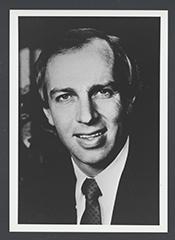
Historical · U.S. House · Minnesota · District 6
William Luther
Former U.S. Representative · Minnesota District 6 · 1995–2003 · Democratic
William Luther represented Minnesota's District 6 in the United States House of Representatives (1995–2003) for the Democratic party. The page below collects sourced biographical facts, term history, committee roles, and provenance for Luther.
Bioguide ID: L000521
Key facts
- Full name
- William Luther
- State
- Minnesota
- District
- District 6
- Party
- Democratic
- House service
- 1995–2003
- First House term
- 1995
- Status
- Left office
- Current term ends
- —
- Born
- 1945
- Bioguide ID
- L000521
- Committee assignments
- —
- Dataset version
- 1.20260605
Biographical narrative
845 words · sourced from the Wikipedia REST extract
William Paul Luther, born on June 27, 1945, is a former American politician and lawyer who served as a Democratic member of the United States House of Representatives, representing Minnesota's 6th congressional district from January 3, 1995, until January 3, 2003. Over the course of his political career, Luther was known for his moderate stance within the Democratic-Farmer-Labor Party (DFL) and was involved in various legislative roles both at the state and federal levels. His tenure in Congress included four consecutive terms, during which he focused on issues pertinent to his constituents in the northern suburbs of the Twin Cities.
Early life and career
Luther was born in Fergus Falls, Minnesota, where he spent his formative years. He pursued higher education at the University of Minnesota, where he earned a Bachelor of Science degree in 1967. Following his undergraduate studies, he continued his education at the University of Minnesota Law School, obtaining his Juris Doctor in 1970. This legal background would later inform his approach to public policy and governance.
Luther's political career began in earnest in the mid-1970s. He served on the Minnesota Governor's Council on Consumer Affairs from 1974 to 1975, a role that allowed him to engage with consumer protection issues at the state level. His legislative career continued as he was elected to the Minnesota House of Representatives, where he served from 1975 to 1976. Subsequently, he moved to the Minnesota Senate, where he represented his constituents from 1977 until 1994. During his time in the state legislature, Luther developed a reputation as a moderate Democrat, often seeking bipartisan solutions to the challenges facing Minnesota.
His experience in state politics laid the groundwork for his later congressional career. Luther's legislative work at the state level involved various issues, including education, healthcare, and economic development, which would continue to be central themes in his later work in Congress.
House tenure
Luther's entry into the U.S. House of Representatives came after he won election to represent Minnesota's 6th congressional district in 1994. His first term began on January 3, 1995, and he was re-elected three additional times, serving through the 107th Congress. During his tenure, Luther participated in significant legislative debates and initiatives, contributing to the development of policies that affected his district and the nation.
Throughout his congressional career, Luther served in a political environment that was marked by increasing partisanship. He was a member of the Democratic Party, which often found itself in opposition to the Republican majority in Congress during the late 1990s and early 2000s. Luther's moderate approach allowed him to navigate this landscape, often seeking common ground with colleagues across the aisle.
However, the political landscape shifted significantly following the 2000 census, which resulted in a redistricting process that altered the boundaries of Minnesota's congressional districts. Luther's 6th District was reconfigured, becoming more Republican-leaning, which posed challenges for his re-election efforts. Despite these changes, he initially sought to adapt by running in the newly created 2nd District, which included a portion of his former constituency.
In the 2002 election, Luther faced a rematch against Republican John Kline, who had previously challenged him in the 1998 and 2000 elections. The campaign was contentious, and Luther's team faced difficulties, particularly when a supporter engaged in a controversial tactic that drew negative attention. Ultimately, Luther lost the election, receiving 42 percent of the vote compared to Kline's 53 percent, marking the end of his congressional career.
Legislative focus and committees
During his time in the House of Representatives, Luther was involved in various legislative initiatives and served on several committees that aligned with his interests and expertise. His work often reflected a commitment to issues such as consumer protection, education, and healthcare, which were significant to his constituents in Minnesota.
Luther's moderate stance allowed him to engage with a range of policy issues, and he often sought to promote legislation that would benefit his district while also appealing to a broader audience. His ability to work across party lines was a hallmark of his approach, and he aimed to foster collaboration in a time of increasing political division.
After leaving Congress, Luther continued to be active in public service. In 2006, he entered the DFL Party primary for the office of Minnesota Attorney General after the previously endorsed candidate withdrew from the race. However, he did not secure the nomination, finishing third in the primary election.
In 2021, Luther was appointed to the Office of Congressional Ethics, a nonpartisan committee responsible for overseeing ethics complaints against members of Congress. His appointment to this role reflects his continued engagement in public service and commitment to maintaining ethical standards in government. As of 2025, he serves as co-chair of the office's board, further contributing to the oversight of congressional conduct.
Luther's political career, spanning decades at both the state and federal levels, showcases his dedication to public service and his efforts to address the needs of his constituents. His experience as a legislator and his moderate approach to governance have left a lasting impact on the political landscape in Minnesota.
Notable legislation
Sponsored and co-sponsored legislation for William Luther is pending operator curation. The biographical narrative above carries the same provenance trail until per-bill rows are written.
Sources
- [1]https://en.wikipedia.org/wiki/Bill_LutherWikipedia · retrieved 2026-06-05
Notable quotes
Sourced quotes for William Luther are pending operator curation. Narrative-scope provenance remains attached below.
Sources
- [1]https://en.wikipedia.org/wiki/Bill_LutherWikipedia · retrieved 2026-06-05
Key positions
Curated policy positions for William Luther are pending operator review. The biographical narrative above carries the same provenance trail until per-topic positions are written.
Sources
- [1]https://en.wikipedia.org/wiki/Bill_LutherWikipedia · retrieved 2026-06-05
Terms served
- 1995–1997U.S. House · Term 1 · Democratic
- 1997–1999U.S. House · Term 2 · Democratic
- 1999–2001U.S. House · Term 3 · Democratic
- 2001–2003U.S. House · Term 4 · Democratic
Sources & provenance
Every attributable claim above carries a per-section [N] marker that resolves to the corresponding URL below. Each entry records the upstream provider, the canonical URL, and the timestamp at which the source was retrieved by the ingest pipeline.
Key facts
- https://bioguide.congress.gov/search/bio/L000521bioguide · retrieved 2026-06-05
- https://www.govtrack.us/congress/members/400529govtrack · retrieved 2026-06-05
Biographical narrative
- https://en.wikipedia.org/wiki/Bill_Lutherwikipedia · retrieved 2026-06-05
Find your representative
Every U.S. state elects representatives by district. Browse Minnesota’s delegation, the full former-representative roster, or explore the role and term length.
Related on The Candidate
- Preceded by Gerald SikorskiEarlier holder of the Minnesota District 6 House seat · Democratic.Open
- Succeeded by Michele BachmannLater holder of the Minnesota District 6 House seat · Republican.Open
- Albert QuieFormer U.S. Representative · Minnesota District 1 · RepublicanOpen
- Allen FurlowFormer U.S. Representative · Minnesota District 1 · RepublicanOpen
- Arlen ErdahlFormer U.S. Representative · Minnesota District 1 · RepublicanOpen
- August AndresenFormer U.S. Representative · Minnesota District 1 · RepublicanOpen