
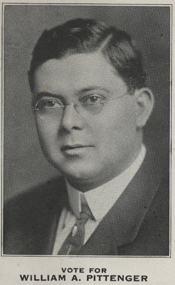
Historical · U.S. House · Minnesota · District 8
William Pittenger
Former U.S. Representative · Minnesota District 8 · 1929–1947 · Republican
William Pittenger represented Minnesota's District 8 in the United States House of Representatives (1929–1947) for the Republican party. The page below collects sourced biographical facts, term history, committee roles, and provenance for Pittenger.
Bioguide ID: P000371
Key facts
- Full name
- William Pittenger
- State
- Minnesota
- District
- District 8
- Party
- Republican
- House service
- 1929–1947
- First House term
- 1929
- Status
- Left office
- Current term ends
- —
- Born
- 1885
- Bioguide ID
- P000371
- Committee assignments
- —
- Dataset version
- 1.20260605
Biographical narrative
889 words · sourced from the Wikipedia REST extract
William Pittenger was a notable figure in American politics, serving as a U.S. Representative for Minnesota's 8th congressional district. A member of the Republican Party, Pittenger's congressional career spanned several terms from the late 1920s to the mid-1940s. His legal background and experience in state politics contributed to his legislative work at the national level. Pittenger's tenure in the House of Representatives was marked by multiple elections and re-elections, reflecting both the challenges and opportunities of political life during a transformative period in American history.
Early life and career
William Alvin Pittenger was born on December 29, 1885, on a farm situated near Crawfordsville in Montgomery County, Indiana. His upbringing in a rural setting provided him with a foundational understanding of the agricultural and economic issues that would later influence his political career. Pittenger attended local rural schools, where he likely developed an early interest in education and civic engagement.
In pursuit of higher education, Pittenger enrolled at Wabash College in Crawfordsville, Indiana, where he completed his undergraduate studies and graduated in 1909. His academic journey continued at Harvard Law School, where he earned his law degree in 1912. Upon his graduation, Pittenger was admitted to the bar and established a law practice in Duluth, Minnesota. This move marked the beginning of his professional life in Minnesota, a state that would become central to his political career.
Pittenger's involvement in politics began at the state level when he served as a member of the Minnesota House of Representatives from 1917 to 1920. His time in the state assembly allowed him to gain valuable experience in legislative processes and to understand the needs of his constituents. This period also helped him build a network of political allies and establish his reputation as a dedicated public servant.
House tenure
William Pittenger's congressional career commenced when he was elected as a Republican to the 71st Congress, which convened on March 4, 1929. He represented Minnesota's 8th congressional district, a position he held until March 3, 1933. During his initial term, Pittenger faced the challenges of the Great Depression, which had significant implications for his constituents and the nation as a whole. However, following his first term, he ran for re-election in 1932 but was unsuccessful. This defeat led him to return to his law practice in Duluth, where he continued to serve his community in a different capacity.
Pittenger's political career did not end with his initial defeat. He made a comeback by winning election to the 74th Congress, serving from January 3, 1935, until January 3, 1937. Despite his efforts, he was unable to secure re-election to the 75th Congress in 1936. His persistence in politics was evident as he returned to the House of Representatives for the 76th, 77th, 78th, and 79th Congresses, serving from January 3, 1939, until January 3, 1947. Throughout these terms, Pittenger was involved in various legislative discussions and decisions that shaped the nation during a time of significant change, including World War II and its aftermath.
In 1946, Pittenger faced another electoral challenge and lost his bid for re-election to the 80th Congress. Despite this setback, he made one more attempt in 1950 to reclaim his former House seat but was defeated in the election by a significant margin. His political career, marked by both victories and defeats, reflects the dynamic nature of American politics during the first half of the 20th century.
Legislative focus and committees
During his time in Congress, William Pittenger's legislative focus encompassed a range of issues pertinent to his constituents and the broader national landscape. While specific details regarding the bills he sponsored or supported are not provided, it can be inferred that his background in law and experience in state politics would have informed his approach to various legislative matters. As a member of the Republican Party, he likely aligned with the party's platform on economic and social issues, particularly during the challenging years of the Great Depression and World War II.
Pittenger's involvement in congressional committees would have further shaped his legislative priorities and allowed him to influence policy decisions. Committees play a crucial role in the legislative process, as they are responsible for reviewing proposed legislation, conducting hearings, and making recommendations to the full House. While the specific committees on which Pittenger served are not detailed in the available information, it is common for members of Congress to participate in committees that align with their interests and expertise.
In addition to his legislative work, Pittenger's legal background would have provided him with a unique perspective on issues related to law and governance. His experience as a practicing attorney in Duluth likely informed his understanding of the legal implications of proposed legislation and the importance of upholding the rule of law in public policy.
After his retirement from politics in 1947, Pittenger returned to his law practice in Duluth, where he continued to contribute to his community until his death on November 26, 1951. He is buried in Forest Hill Cemetery, marking the end of a life dedicated to public service and the law. Pittenger's career reflects the complexities of American political life during a significant era, characterized by economic challenges, social change, and global conflict. His contributions to the legislative process and his commitment to his constituents remain a part of Minnesota's political history.
Notable legislation
Sponsored and co-sponsored legislation for William Pittenger is pending operator curation. The biographical narrative above carries the same provenance trail until per-bill rows are written.
Sources
- [1]https://en.wikipedia.org/wiki/William_Alvin_PittengerWikipedia · retrieved 2026-06-05
Notable quotes
Sourced quotes for William Pittenger are pending operator curation. Narrative-scope provenance remains attached below.
Sources
- [1]https://en.wikipedia.org/wiki/William_Alvin_PittengerWikipedia · retrieved 2026-06-05
Key positions
Curated policy positions for William Pittenger are pending operator review. The biographical narrative above carries the same provenance trail until per-topic positions are written.
Sources
- [1]https://en.wikipedia.org/wiki/William_Alvin_PittengerWikipedia · retrieved 2026-06-05
Terms served
- 1929–1931U.S. House · Term 1 · Republican
- 1931–1933U.S. House · Term 2 · Republican
- 1935–1937U.S. House · Term 3 · Republican
- 1939–1941U.S. House · Term 4 · Republican
- 1941–1943U.S. House · Term 5 · Republican
- 1943–1945U.S. House · Term 6 · Republican
- 1945–1947U.S. House · Term 7 · Republican
Sources & provenance
Every attributable claim above carries a per-section [N] marker that resolves to the corresponding URL below. Each entry records the upstream provider, the canonical URL, and the timestamp at which the source was retrieved by the ingest pipeline.
Key facts
- https://bioguide.congress.gov/search/bio/P000371bioguide · retrieved 2026-06-05
- https://www.govtrack.us/congress/members/408766govtrack · retrieved 2026-06-05
Biographical narrative
- https://en.wikipedia.org/wiki/William_Alvin_Pittengerwikipedia · retrieved 2026-06-05
Find your representative
Every U.S. state elects representatives by district. Browse Minnesota’s delegation, the full former-representative roster, or explore the role and term length.
Related on The Candidate
- Preceded by William CarssEarlier holder of the Minnesota District 8 House seat · Farmer-Labor.Open
- Succeeded by John BlatnikLater holder of the Minnesota District 8 House seat · Democratic.Open
- Albert QuieFormer U.S. Representative · Minnesota District 1 · RepublicanOpen
- Allen FurlowFormer U.S. Representative · Minnesota District 1 · RepublicanOpen
- Arlen ErdahlFormer U.S. Representative · Minnesota District 1 · RepublicanOpen
- August AndresenFormer U.S. Representative · Minnesota District 1 · RepublicanOpen