
Historical · U.S. House · Missouri · District 3
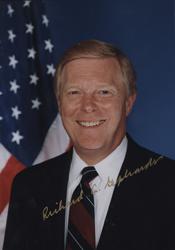
Dick Gephardt
Former U.S. Representative · Missouri District 3 · 1977–2005 · Democratic
Dick Gephardt represented Missouri's District 3 in the United States House of Representatives (1977–2005) for the Democratic party. The page below collects sourced biographical facts, term history, committee roles, and provenance for Gephardt.
Bioguide ID: G000132
Key facts
- Full name
- Dick Gephardt
- State
- Missouri
- District
- District 3
- Party
- Democratic
- House service
- 1977–2005
- First House term
- 1977
- Status
- Left office
- Current term ends
- —
- Born
- 1941
- Bioguide ID
- G000132
- Committee assignments
- —
- Dataset version
- 1.20260605
Biographical narrative
1,003 words · sourced from the Wikipedia REST extract
Richard A. Gephardt is a former American politician and attorney who served as a U.S. Representative for Missouri's 3rd congressional district from 1977 until 2005. A member of the Democratic Party, Gephardt held significant leadership roles during his tenure, including serving as House majority leader from 1989 to 1995 and as minority leader from 1995 to 2003. He was also a candidate for the Democratic presidential nomination in both 1988 and 2004. Following his congressional career, Gephardt transitioned into lobbying and public affairs, founding several firms and engaging in various consulting roles.
Early life and career
Richard Andrew Gephardt was born on January 31, 1941, in St. Louis, Missouri. He is the son of Loreen Estelle (née Cassell) and Louis Andrew Gephardt, who worked as a Teamster milkman. Gephardt's ancestry includes German roots. He completed his secondary education at Southwest High School in St. Louis, graduating in 1958. During his youth, he was active in the Boy Scouts of America, achieving the rank of Eagle Scout and later receiving the Distinguished Eagle Scout Award.
Gephardt pursued higher education at Northwestern University, where he earned a Bachelor of Science degree in 1962. While at Northwestern, he demonstrated leadership capabilities by serving as president of the Beta Theta Pi fraternity, the student senate, and his freshman class. He continued his education at the University of Michigan Law School, obtaining his Juris Doctor degree in 1965. After being admitted to the Missouri Bar in the same year, Gephardt joined the Missouri Air National Guard, where he served until 1971.
In addition to his military service, Gephardt was politically active in his community. He served as a Democratic committeeman for the 14th ward in St. Louis from 1968 to 1971. His early political career included a position as an alderman on the St. Louis Board of Aldermen from 1971 to 1976, where he was part of a group of progressive young leaders known informally as "The Young Turks."
House tenure
Gephardt's congressional career began when he was elected to represent Missouri's 3rd congressional district in 1976, succeeding long-serving incumbent Leonor Sullivan. He was re-elected 13 times, serving a total of 14 terms in the House of Representatives. Throughout his tenure, Gephardt was known for his close working relationship with his National Political Director, Joyce Aboussie, a political consultant based in St. Louis.
During his early years in Congress, Gephardt participated in significant legislative actions, including voting in favor of the bill that established Martin Luther King Jr. Day as a federal holiday in 1983. However, he did not cast a vote on the Civil Rights Restoration Act of 1987 or on the subsequent vote to override President Reagan's veto in 1988.
In 1988, Gephardt sought the Democratic nomination for President of the United States. He was one of the first candidates to announce his candidacy for the election cycle, gaining traction in early primary states, particularly Iowa, where he won the caucuses. Despite these early successes, his campaign struggled to maintain momentum and ultimately fell short in subsequent primaries, leading to his withdrawal from the race.
Following his presidential bid, Gephardt's prominence in the House increased, and he was elected as the House majority leader in June 1989, a position he held until January 1995. As majority leader, he was the second-ranking Democrat in the House, working closely with Speaker Tom Foley. After the Republican Party gained a majority in the 1994 elections, Gephardt transitioned to the role of minority leader, where he faced off against Republican leaders including Newt Gingrich and Dennis Hastert.
Throughout his leadership, Gephardt was instrumental in fundraising efforts for Democratic candidates across the country, assembling a team of top fundraising staff to support numerous local and federal campaigns. He played a significant role in the Democratic Party's efforts during the 1996, 1998, and 2000 elections, contributing to gains in the House, although the Democrats did not regain the majority until 2006, after Gephardt had left Congress.
Gephardt's tenure was marked by his strong advocacy for labor issues, although he faced challenges in aligning with President Bill Clinton on certain trade policies. Notably, Gephardt and his union supporters opposed the North American Free Trade Agreement (NAFTA) and other free trade initiatives, leading to a reliance on bipartisan support for their passage. During the impeachment proceedings against President Clinton, Gephardt led a walkout in the House when a censure motion was deemed irrelevant to the impeachment debate.
Legislative focus and committees
Throughout his time in Congress, Gephardt's legislative focus included a strong emphasis on labor rights, economic issues, and social justice. His background as a union supporter and advocate for workers' rights shaped his approach to policy-making and legislative priorities. He was known for his commitment to issues affecting the working class and often aligned himself with labor unions in his advocacy efforts.
Gephardt served on various committees during his congressional career, which allowed him to influence legislation in key areas. His leadership roles and committee assignments provided him with a platform to address the concerns of his constituents and the broader Democratic agenda. His ability to navigate complex legislative landscapes contributed to his reputation as a skilled negotiator and strategist within the House.
After retiring from Congress in 2005, Gephardt transitioned into the private sector, becoming a lobbyist and founding several firms, including Gephardt Government Affairs and the Gephardt Group, which focuses on labor consultancy. He also engaged in consulting work for prominent organizations and firms, including DLA Piper, FTI Consulting, and Goldman Sachs. Gephardt remains active in public affairs and civic engagement, participating in initiatives such as the ReFormers Caucus of Issue One and co-chairing the Council for Responsible Social Media alongside former Massachusetts lieutenant governor Kerry Healey.
Richard A. Gephardt's lengthy career in public service and his subsequent work in lobbying and consulting reflect his ongoing commitment to political engagement and advocacy for various causes. His legacy in the U.S. House of Representatives is characterized by his leadership roles, legislative achievements, and dedication to the Democratic Party's principles.
Notable legislation
Sponsored and co-sponsored legislation for Dick Gephardt is pending operator curation. The biographical narrative above carries the same provenance trail until per-bill rows are written.
Sources
- [1]https://en.wikipedia.org/wiki/Dick_GephardtWikipedia · retrieved 2026-06-05
Notable quotes
Sourced quotes for Dick Gephardt are pending operator curation. Narrative-scope provenance remains attached below.
Sources
- [1]https://en.wikipedia.org/wiki/Dick_GephardtWikipedia · retrieved 2026-06-05
Key positions
Curated policy positions for Dick Gephardt are pending operator review. The biographical narrative above carries the same provenance trail until per-topic positions are written.
Sources
- [1]https://en.wikipedia.org/wiki/Dick_GephardtWikipedia · retrieved 2026-06-05
Terms served
- 1977–1979U.S. House · Term 1 · Democratic
- 1979–1981U.S. House · Term 2 · Democratic
- 1981–1983U.S. House · Term 3 · Democratic
- 1983–1985U.S. House · Term 4 · Democratic
- 1985–1987U.S. House · Term 5 · Democratic
- 1987–1989U.S. House · Term 6 · Democratic
- 1989–1991U.S. House · Term 7 · Democratic
- 1991–1993U.S. House · Term 8 · Democratic
- 1993–1995U.S. House · Term 9 · Democratic
- 1995–1997U.S. House · Term 10 · Democratic
- 1997–1999U.S. House · Term 11 · Democratic
- 1999–2001U.S. House · Term 12 · Democratic
- 2001–2003U.S. House · Term 13 · Democratic
- 2003–2005U.S. House · Term 14 · Democratic
Sources & provenance
Every attributable claim above carries a per-section [N] marker that resolves to the corresponding URL below. Each entry records the upstream provider, the canonical URL, and the timestamp at which the source was retrieved by the ingest pipeline.
Key facts
- https://bioguide.congress.gov/search/bio/G000132bioguide · retrieved 2026-06-05
- http://dickgephardt.house.govhouse.gov · retrieved 2026-06-05
Biographical narrative
- https://en.wikipedia.org/wiki/Dick_Gephardtwikipedia · retrieved 2026-06-05
Find your representative
Every U.S. state elects representatives by district. Browse Missouri’s delegation, the full former-representative roster, or explore the role and term length.
Related on The Candidate
- Preceded by Leonor SullivanEarlier holder of the Missouri District 3 House seat · Democratic.Open
- Succeeded by Russ CarnahanLater holder of the Missouri District 3 House seat · Democratic.Open
- Anthony IttnerFormer U.S. Representative · Missouri District 1 · RepublicanOpen
- Bill Clay Sr.Former U.S. Representative · Missouri District 1 · DemocraticOpen
- Charles ClarkFormer U.S. Representative · Missouri District 1 · RepublicanOpen
- Clare MageeFormer U.S. Representative · Missouri District 1 · DemocraticOpen