
Historical · U.S. House · Missouri · District 9
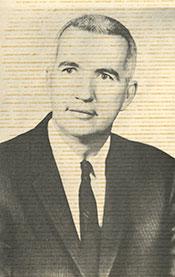
William Hungate
Former U.S. Representative · Missouri District 9 · 1963–1977 · Democratic
William Hungate represented Missouri's District 9 in the United States House of Representatives (1963–1977) for the Democratic party. The page below collects sourced biographical facts, term history, committee roles, and provenance for Hungate.
Bioguide ID: H000965
Key facts
- Full name
- William Hungate
- State
- Missouri
- District
- District 9
- Party
- Democratic
- House service
- 1963–1977
- First House term
- 1963
- Status
- Left office
- Current term ends
- —
- Born
- 1922
- Bioguide ID
- H000965
- Committee assignments
- —
- Dataset version
- 1.20260605
Biographical narrative
910 words · sourced from the Wikipedia REST extract
William L. Hungate was a prominent American politician and jurist who served as a United States Representative from Missouri's Ninth Congressional District from 1964 until 1977. A member of the Democratic Party, Hungate's tenure in the House of Representatives was marked by significant involvement in legislative matters, particularly during a tumultuous period in American politics. Following his congressional career, he was appointed as a United States District Judge for the Eastern District of Missouri, a position he held until his retirement in 1992. His contributions to both legislative and judicial branches of government reflect a commitment to public service that spanned several decades.
Early life and career
William Leonard Hungate was born on December 14, 1922, in Benton, Illinois. He completed his secondary education at Bowling Green High School in Bowling Green, Missouri, graduating in 1940. Following high school, Hungate began his higher education at the University of Michigan but later transferred to the University of Missouri in Columbia, where he earned an Artium Baccalaureus degree in 1943. He continued his education at Harvard Law School, obtaining his Bachelor of Laws in 1948 and later a Doctor of Jurisprudence degree in 1969.
Hungate's early career was significantly shaped by his military service during World War II. He enlisted in the United States Army in 1943 and served until 1946, participating in operations in England, France, and Germany. His service was recognized with several honors, including the Combat Infantryman Badge, three Battle Stars, and a Bronze Star. After returning from military service, Hungate was admitted to the Missouri Bar in 1948 and the Illinois Bar in 1949, marking the beginning of his legal career. He practiced law in Troy, Missouri, from 1948 until 1968 and held the position of prosecuting attorney for Lincoln County, Missouri, from 1951 to 1956. Additionally, he served as a Missouri Special Assistant Attorney General from 1958 to 1964, which further established his legal credentials and experience in public service.
House tenure
Hungate's political career in the U.S. House of Representatives began with a special election on November 3, 1964, to fill the vacancy left by the death of Congressman Clarence Cannon. He was elected as a Democrat to serve in the 88th Congress and was subsequently re-elected to the 89th Congress. Over the course of his political career, Hungate served a total of seven terms in the House, concluding his tenure on January 3, 1977.
During his time in Congress, Hungate was known for his active participation in legislative matters. He was a member of the House Judiciary Committee, which played a crucial role in various significant legislative actions, including the impeachment process against President Richard Nixon in 1974. Hungate sponsored the second article of impeachment against Nixon, which charged him with abuse of power. This involvement placed him at the center of one of the most consequential political events in American history. Later in 1974, he chaired the Judiciary Committee's subcommittee on criminal justice, overseeing the congressional review of President Gerald Ford's pardon of Nixon.
Hungate's legislative record included votes on key civil rights legislation. He supported the Voting Rights Act of 1965 but opposed the Civil Rights Act of 1968. His decisions reflected the complex political landscape of the time and the evolving views on civil rights within the Democratic Party and the broader American society.
Despite his active engagement in Congress, Hungate chose not to seek re-election for the 95th Congress in 1976. He expressed concerns about the changing nature of politics, reflecting on a shift from what he described as the "age of Camelot" to the "age of Watergate," which he felt had altered the public's perception of political integrity and trust.
Legislative focus and committees
Throughout his congressional career, Hungate's legislative focus encompassed a range of issues, particularly those related to civil rights, judicial matters, and government oversight. His role on the House Judiciary Committee was particularly significant, as it positioned him to influence critical legislative actions during a period of national upheaval. His participation in the impeachment proceedings against President Nixon underscored his commitment to upholding the rule of law and accountability in government.
In addition to his work on impeachment, Hungate was involved in various legislative initiatives aimed at reforming the criminal justice system. As chairman of the subcommittee on criminal justice, he played a pivotal role in examining the implications of presidential pardons and their impact on public trust in government. His leadership in these areas reflected a broader concern for maintaining the integrity of the judicial process and ensuring that justice was served fairly and equitably.
After leaving Congress, Hungate continued to contribute to public service through his appointment as a United States District Judge for the Eastern District of Missouri in 1979, a position he held until his retirement in 1992. His judicial career included overseeing significant cases, such as the St. Louis public school desegregation case, where he was instrumental in developing a voluntary desegregation plan for the local school districts.
Hungate's legacy extends beyond his time in Congress and the judiciary. He authored several works reflecting on his experiences, including a collection of anecdotes and photographs from his life, which provides insight into his perspectives on politics and public service. He passed away on June 22, 2007, leaving behind a legacy of dedication to the law and public service, as well as a family that includes his son, David Hungate, a musician known for his work with the rock band Toto.
Notable legislation
Sponsored and co-sponsored legislation for William Hungate is pending operator curation. The biographical narrative above carries the same provenance trail until per-bill rows are written.
Sources
- [1]https://en.wikipedia.org/wiki/William_L._HungateWikipedia · retrieved 2026-06-05
Notable quotes
Sourced quotes for William Hungate are pending operator curation. Narrative-scope provenance remains attached below.
Sources
- [1]https://en.wikipedia.org/wiki/William_L._HungateWikipedia · retrieved 2026-06-05
Key positions
Curated policy positions for William Hungate are pending operator review. The biographical narrative above carries the same provenance trail until per-topic positions are written.
Sources
- [1]https://en.wikipedia.org/wiki/William_L._HungateWikipedia · retrieved 2026-06-05
Terms served
- 1963–1965U.S. House · Term 1 · Democratic
- 1965–1967U.S. House · Term 2 · Democratic
- 1967–1969U.S. House · Term 3 · Democratic
- 1969–1971U.S. House · Term 4 · Democratic
- 1971–1973U.S. House · Term 5 · Democratic
- 1973–1975U.S. House · Term 6 · Democratic
- 1975–1977U.S. House · Term 7 · Democratic
Sources & provenance
Every attributable claim above carries a per-section [N] marker that resolves to the corresponding URL below. Each entry records the upstream provider, the canonical URL, and the timestamp at which the source was retrieved by the ingest pipeline.
Key facts
- https://bioguide.congress.gov/search/bio/H000965bioguide · retrieved 2026-06-05
- https://www.govtrack.us/congress/members/405809govtrack · retrieved 2026-06-05
Biographical narrative
- https://en.wikipedia.org/wiki/William_L._Hungatewikipedia · retrieved 2026-06-05
Find your representative
Every U.S. state elects representatives by district. Browse Missouri’s delegation, the full former-representative roster, or explore the role and term length.
Related on The Candidate
- Preceded by Theodore HukriedeEarlier holder of the Missouri District 9 House seat · Republican.Open
- Succeeded by Harold VolkmerLater holder of the Missouri District 9 House seat · Democratic.Open
- Anthony IttnerFormer U.S. Representative · Missouri District 1 · RepublicanOpen
- Bill Clay Sr.Former U.S. Representative · Missouri District 1 · DemocraticOpen
- Charles ClarkFormer U.S. Representative · Missouri District 1 · RepublicanOpen
- Clare MageeFormer U.S. Representative · Missouri District 1 · DemocraticOpen