
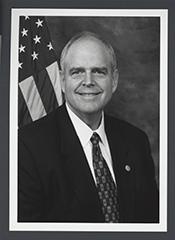
Historical · U.S. House · North Carolina · District 8
Robin Hayes
Former U.S. Representative · North Carolina District 8 · 1999–2009 · Republican
Robin Hayes represented North Carolina's District 8 in the United States House of Representatives (1999–2009) for the Republican party. The page below collects sourced biographical facts, term history, committee roles, and provenance for Hayes.
Bioguide ID: H001029
Key facts
- Full name
- Robin Hayes
- State
- North Carolina
- District
- District 8
- Party
- Republican
- House service
- 1999–2009
- First House term
- 1999
- Status
- Left office
- Current term ends
- —
- Born
- 1945
- Bioguide ID
- H001029
- Committee assignments
- —
- Dataset version
- 1.20260605
Biographical narrative
953 words · sourced from the Wikipedia REST extract
Robert Cannon "Robin" Hayes is a former American politician and businessman who served as a U.S. Representative for North Carolina's 8th congressional district from 1999 until 2009. A member of the Republican Party, Hayes's political career includes a notable run for the governorship of North Carolina in 1996, as well as leadership roles within the state Republican Party. His tenure in Congress was marked by significant electoral battles, legislative initiatives, and controversies that shaped his political legacy.
Early life and career
Robin Hayes was born on August 14, 1945, in Concord, North Carolina, to Mariam Winslow and Robert Griffith Hayes Jr. He comes from a family with deep roots in North Carolina's textile industry; his great-grandfather, James William Cannon, founded the Cannon Mills Corporation, a prominent textile company in Kannapolis. This legacy continued with his grandfather, Charles Albert Cannon, who managed the corporation. Hayes is also a descendant of Abraham Owen, a military officer who lost his life at the Battle of Tippecanoe.
Hayes pursued higher education at Duke University, where he graduated before embarking on a career in business. He became the owner of a hosiery mill located in Mount Pleasant, North Carolina, which contributed to his understanding of the local economy and the challenges faced by the textile industry. His political career began at the local level when he was elected to the Concord city council in 1978. This experience laid the groundwork for his subsequent election to the North Carolina House of Representatives in 1992, where he served two terms.
In 1996, Hayes was the Republican nominee for governor of North Carolina. However, he faced a significant defeat against the incumbent Democratic governor, Jim Hunt. Despite this setback, Hayes continued to build his political career, which ultimately led to his election to the U.S. House of Representatives.
House tenure
Hayes entered the U.S. House of Representatives in 1999, succeeding 12-term incumbent Democrat Bill Hefner, who announced his retirement. In a closely contested election, Hayes narrowly defeated Democrat Mike Taylor, securing 51% of the vote compared to Taylor's 48%. Following this initial victory, Hayes faced Taylor again in a rematch in 2000, where he won with a more comfortable margin of 55% to 44%.
The political landscape of North Carolina's 8th congressional district shifted significantly after the 2000 Census, as the Democratic-controlled state legislature redrew district lines, making the district more Democratic-leaning. Despite these changes, Hayes managed to secure victories in subsequent elections. In 2002, he defeated Democrat Chris Kouri with 54% of the vote, and in 2004, he won against Democrat Beth Troutman with 56% of the vote.
However, the 2006 election proved to be a challenging one for Hayes. He faced Democrat Larry Kissell, a social studies teacher and former textile worker, in a highly competitive race. The election was one of the closest in the country, with both candidates receiving approximately equal support from voters. Ultimately, Hayes won by a narrow margin of just 329 votes after a recount, despite only winning three of the district's nine counties.
In 2008, Hayes faced Kissell again in a rematch. The race was characterized as a toss-up by various political analysts, reflecting the competitive nature of the district. During the campaign, Hayes faced scrutiny for comments made at a rally for John McCain, which led to controversy and media attention. Ultimately, Hayes lost the election to Kissell, receiving 45% of the vote compared to Kissell's 55%.
Legislative focus and committees
Throughout his time in Congress, Hayes was known for his advocacy on issues related to the textile industry and trade. He was a staunch opponent of online gambling and co-sponsored legislation aimed at prohibiting internet poker. His legislative actions were often influenced by the interests of his constituents and the economic realities of the textile sector in North Carolina.
One of the most notable moments in Hayes's legislative career occurred during the debate over the Central American Free Trade Agreement (CAFTA) in 2005. Initially, he expressed strong opposition to the agreement, citing concerns about job losses in the textile industry. However, after significant lobbying from Republican leadership and textile executives, he changed his vote to support the agreement, which ultimately passed by a narrow margin. Hayes's decision to switch his vote was pivotal, as it contributed to the final tally.
Hayes also played a crucial role in the passage of the Trade Act of 2002, which shifted some trade agreement authority from Congress to the President. His initial resistance to the legislation was overcome by intense lobbying from the White House and congressional leaders, leading him to support the measure at the last moment.
In addition to his legislative work, Hayes was involved in various committees during his tenure in the House. His focus on trade and economic issues reflected the interests of his constituents, particularly those in the textile industry. He was known for his efforts to advocate for policies that would benefit local businesses and protect jobs in North Carolina.
After leaving Congress in 2009, Hayes continued to be active in North Carolina politics. He served as chairman of the North Carolina Republican Party from 2011 to 2013 and again from 2016 to 2019. However, his later years were marred by legal troubles; in 2019, he was accused in a bribery scheme and pleaded guilty to lying to the FBI. In January 2021, he received a pardon from President Donald Trump, which marked a significant chapter in his post-congressional life.
Robin Hayes's political career reflects the complexities of representing a diverse constituency in a changing political landscape. His experiences in business and local government informed his approach to legislation, while his electoral battles highlighted the competitive nature of North Carolina politics during his time in office.
Notable legislation
Sponsored and co-sponsored legislation for Robin Hayes is pending operator curation. The biographical narrative above carries the same provenance trail until per-bill rows are written.
Sources
- [1]https://en.wikipedia.org/wiki/Robin_HayesWikipedia · retrieved 2026-06-05
Notable quotes
Sourced quotes for Robin Hayes are pending operator curation. Narrative-scope provenance remains attached below.
Sources
- [1]https://en.wikipedia.org/wiki/Robin_HayesWikipedia · retrieved 2026-06-05
Key positions
Curated policy positions for Robin Hayes are pending operator review. The biographical narrative above carries the same provenance trail until per-topic positions are written.
Sources
- [1]https://en.wikipedia.org/wiki/Robin_HayesWikipedia · retrieved 2026-06-05
Terms served
- 1999–2001U.S. House · Term 1 · Republican
- 2001–2003U.S. House · Term 2 · Republican
- 2003–2005U.S. House · Term 3 · Republican
- 2005–2007U.S. House · Term 4 · Republican
- 2007–2009U.S. House · Term 5 · Republican
Sources & provenance
Every attributable claim above carries a per-section [N] marker that resolves to the corresponding URL below. Each entry records the upstream provider, the canonical URL, and the timestamp at which the source was retrieved by the ingest pipeline.
Key facts
- https://bioguide.congress.gov/search/bio/H001029bioguide · retrieved 2026-06-05
- http://hayes.house.govhouse.gov · retrieved 2026-06-05
Biographical narrative
- https://en.wikipedia.org/wiki/Robin_Hayeswikipedia · retrieved 2026-06-05
Find your representative
Every U.S. state elects representatives by district. Browse North Carolina’s delegation, the full former-representative roster, or explore the role and term length.
Related on The Candidate
- Preceded by Bill HefnerEarlier holder of the North Carolina District 8 House seat · Democratic.Open
- Succeeded by Larry KissellLater holder of the North Carolina District 8 House seat · Democratic.Open
- Alfred GatlinFormer U.S. Representative · North Carolina District 1 · Crawford RepublicanOpen
- Clinton CobbFormer U.S. Representative · North Carolina District 1 · RepublicanOpen
- Eva ClaytonFormer U.S. Representative · North Carolina District 1 · DemocraticOpen
- Frank Ballance Jr.Former U.S. Representative · North Carolina District 1 · DemocraticOpen