
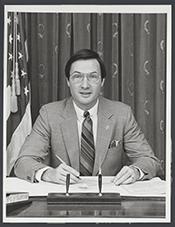
Historical · U.S. House · Nebraska · District 2
Hal Daub
Former U.S. Representative · Nebraska District 2 · 1981–1989 · Republican
Hal Daub represented Nebraska's District 2 in the United States House of Representatives (1981–1989) for the Republican party. The page below collects sourced biographical facts, term history, committee roles, and provenance for Daub.
Bioguide ID: D000065
Key facts
- Full name
- Hal Daub
- State
- Nebraska
- District
- District 2
- Party
- Republican
- House service
- 1981–1989
- First House term
- 1981
- Status
- Left office
- Current term ends
- —
- Born
- 1941
- Bioguide ID
- D000065
- Committee assignments
- —
- Dataset version
- 1.20260605
Biographical narrative
875 words · sourced from the Wikipedia REST extract
Harold John Daub Jr., commonly known as Hal Daub, is a former American politician and attorney who served as a U.S. Representative for Nebraska's 2nd congressional district. A member of the Republican Party, Daub held office in the House of Representatives from 1981 until 1989, completing four terms. In addition to his congressional career, he has held various political positions, including serving as the 48th mayor of Omaha, Nebraska. After his time in Congress, Daub continued to engage in public service and political activities, including a role on the Board of Regents of the University of Nebraska system.
Early life and career
Hal Daub was born on April 23, 1941, at Fort Bragg, North Carolina, where his father was stationed as a member of the military. His early years were spent in North Omaha, Nebraska, where he completed his secondary education at Benson High School. Following high school, Daub pursued higher education, earning a Bachelor of Science degree from Washington University in St. Louis in 1963. He then attended the University of Nebraska College of Law in Lincoln, where he received his Juris Doctor degree in 1966.
Daub's professional career began in the legal field, as he entered private practice as an attorney after completing his law degree. His commitment to public service was evident early on when he served as an infantry captain in the United States Army from 1966 to 1968, with a deployment to Korea. His military service contributed to his leadership skills and community involvement, and he is recognized as a Distinguished Eagle Scout, reflecting his long-standing commitment to youth and community service.
After establishing himself in Omaha, Daub became actively involved in the Republican Party, which laid the groundwork for his future political endeavors. His initial foray into electoral politics occurred in 1978 when he ran for the U.S. House of Representatives in Nebraska's 2nd congressional district. Although he was unsuccessful in this first attempt, losing to the incumbent Democrat John J. Cavanaugh III, he remained engaged in political activities.
House tenure
Daub's persistence paid off when he ran for the same congressional seat again in 1980 after Cavanaugh opted not to seek re-election. In this election, Daub successfully defeated Democrat Richard Fellman, marking the beginning of his tenure in the U.S. House of Representatives. He was subsequently re-elected three times, serving from 1981 until the end of his last term in January 1989. During his time in Congress, Daub participated in various legislative activities and contributed to discussions on a range of issues pertinent to his constituents and the nation.
In March 1987, following the death of Nebraska's senior U.S. Senator Edward Zorinsky, Daub entered the race for the Senate seat. He contested the Republican primary against David Karnes but was unsuccessful, losing by a margin of nine points. Karnes went on to lose the general election to Bob Kerrey, a former Democratic governor. In 1990, Daub again sought a Senate seat, this time challenging Democratic Senator J. James Exon. He secured the Republican nomination but ultimately lost the general election by a significant margin.
Throughout his congressional career, Daub was known for his involvement in various political and legislative initiatives. His experiences in the House of Representatives provided him with insights into the workings of federal governance and the legislative process, which he would later apply in other roles within public service.
Legislative focus and committees
During his tenure in the House, Daub was involved in a variety of legislative matters that reflected the interests and concerns of his constituents in Nebraska. His work encompassed issues related to local economic development, agriculture, and various social policies. While specific committee assignments during his time in Congress are not detailed, members of Congress typically serve on committees that align with their interests and the needs of their districts, allowing them to influence legislation and advocate for their constituents effectively.
After leaving Congress, Daub continued to engage in public service and political activities. He won a special election in 1995 to become the Mayor of Omaha, a position he held until 2001. His mayoral tenure included efforts to address urban development and community issues in Omaha. Following his time as mayor, he served on the Social Security Advisory Board from 2002 to 2006 and joined a law firm in Missouri, furthering his career in legal and public policy.
In 2012, Daub was elected to the Board of Regents of the University of Nebraska system, where he continued to influence educational policy and governance. His tenure on the board included addressing issues related to university administration and student welfare. However, his time on the board was not without controversy; he made headlines for his comments regarding student-athletes and protests, which sparked public debate.
Daub's political career has also included various lobbying positions, reflecting his continued engagement in the political landscape. He has been associated with organizations such as Blackwell Sanders LLP and Deloitte, where he utilized his legal and political expertise.
In summary, Hal Daub's career has spanned various roles in public service, including significant contributions as a U.S. Representative and Mayor of Omaha. His involvement in politics and law has shaped his approach to governance and public policy, leaving a lasting impact on the communities he has served.
Notable legislation
Sponsored and co-sponsored legislation for Hal Daub is pending operator curation. The biographical narrative above carries the same provenance trail until per-bill rows are written.
Sources
- [1]https://en.wikipedia.org/wiki/Hal_DaubWikipedia · retrieved 2026-06-05
Notable quotes
Sourced quotes for Hal Daub are pending operator curation. Narrative-scope provenance remains attached below.
Sources
- [1]https://en.wikipedia.org/wiki/Hal_DaubWikipedia · retrieved 2026-06-05
Key positions
Curated policy positions for Hal Daub are pending operator review. The biographical narrative above carries the same provenance trail until per-topic positions are written.
Sources
- [1]https://en.wikipedia.org/wiki/Hal_DaubWikipedia · retrieved 2026-06-05
Terms served
- 1981–1983U.S. House · Term 1 · Republican
- 1983–1985U.S. House · Term 2 · Republican
- 1985–1987U.S. House · Term 3 · Republican
- 1987–1989U.S. House · Term 4 · Republican
Sources & provenance
Every attributable claim above carries a per-section [N] marker that resolves to the corresponding URL below. Each entry records the upstream provider, the canonical URL, and the timestamp at which the source was retrieved by the ingest pipeline.
Key facts
- https://bioguide.congress.gov/search/bio/D000065bioguide · retrieved 2026-06-05
- https://www.govtrack.us/congress/members/403203govtrack · retrieved 2026-06-05
Biographical narrative
- https://en.wikipedia.org/wiki/Hal_Daubwikipedia · retrieved 2026-06-05
Find your representative
Every U.S. state elects representatives by district. Browse Nebraska’s delegation, the full former-representative roster, or explore the role and term length.
Related on The Candidate
- Preceded by John CavanaughEarlier holder of the Nebraska District 2 House seat · Democratic.Open
- Succeeded by Peter HoaglandLater holder of the Nebraska District 2 House seat · Democratic.Open
- Archibald WeaverFormer U.S. Representative · Nebraska District 1 · RepublicanOpen
- Charles ReavisFormer U.S. Representative · Nebraska District 1 · RepublicanOpen
- Charles ThoneFormer U.S. Representative · Nebraska District 1 · RepublicanOpen
- Clair CallanFormer U.S. Representative · Nebraska District 1 · DemocraticOpen