
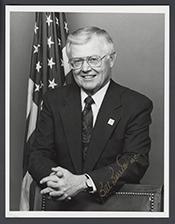
Historical · U.S. House · Nebraska · District 3
Bill Barrett
Former U.S. Representative · Nebraska District 3 · 1991–2001 · Republican
Bill Barrett represented Nebraska's District 3 in the United States House of Representatives (1991–2001) for the Republican party. The page below collects sourced biographical facts, term history, committee roles, and provenance for Barrett.
Bioguide ID: B000179
Key facts
- Full name
- Bill Barrett
- State
- Nebraska
- District
- District 3
- Party
- Republican
- House service
- 1991–2001
- First House term
- 1991
- Status
- Left office
- Current term ends
- —
- Born
- 1929
- Bioguide ID
- B000179
- Committee assignments
- —
- Dataset version
- 1.20260605
Biographical narrative
992 words · sourced from the Wikipedia REST extract
William Emery Barrett was an American politician who served as a Republican member of the United States House of Representatives from Nebraska's third congressional district. His tenure in Congress spanned from 1991 until 2001, during which he was elected to five consecutive terms. Known for his low-key approach, Barrett focused on agricultural and educational issues while supporting the broader priorities of his party.
Early life and career
Bill Barrett was born on February 9, 1929, in Lexington, Nebraska. He pursued higher education at Hastings College, where he laid the groundwork for his future career. After completing his studies, Barrett earned a license to work as a real estate broker, which would become a significant part of his professional life. His early career also included service in the United States Navy, where he gained valuable experience that would inform his later public service.
Before entering the political arena, Barrett was an active member of the Republican Party and engaged in various roles that showcased his commitment to public service. He served as an administrator at Hastings College, contributing to the educational sector. In the 1960s, he became a member of the Nebraska Republican State Executive Committee, where he played a role in shaping party strategy and policy. His political involvement deepened when he chaired the Nebraska campaign for President Gerald Ford during the 1976 election, further solidifying his position within the party.
In 1978, Barrett's political career took a significant turn when he was elected to the unicameral Nebraska Legislature. His tenure in the state legislature lasted until he was elected to Congress in 1990. During his time in the Nebraska Legislature, Barrett ascended to the role of speaker from 1987 to 1991. His leadership during this period was marked by intense negotiations over the state budget, which generated some controversy but also demonstrated his ability to navigate complex political landscapes.
House tenure
Barrett's journey to the U.S. House of Representatives began in 1990 when he decided to run for the Republican nomination in Nebraska's third congressional district. This decision came after the retirement announcement of eight-term incumbent Virginia D. Smith. Barrett entered a competitive primary field that included several candidates, and despite being a prominent figure, he won the primary by a narrow margin of 2,000 votes. This close victory set the stage for a challenging general election.
In the general election, Barrett faced fellow state senator Sandra K. Scofield. Initially considered a strong favorite in the heavily Republican district, Barrett encountered a surprisingly close race. Ultimately, he secured victory by a margin of just 4,400 votes, marking the closest contest a Democrat had faced in the district since Smith's first election in 1974. Following this initial challenge, Barrett's subsequent re-elections were considerably more decisive, as he consistently garnered over 70 percent of the vote in later elections. Notably, in 1998, the Democratic Party did not field a challenger against him, reflecting his established position in the district.
During his five terms in the House, Barrett was characterized as a low-key member who generally aligned with the priorities of Republican leadership. His legislative focus included significant involvement in agricultural policy, which was particularly relevant to his constituents in Nebraska. He served on the House Agriculture Committee, where he played a role in crafting the Freedom to Farm Act of 1996. His expertise and contributions eventually led him to the position of vice chairman of the committee, where he continued to influence agricultural legislation.
In addition to his work on the Agriculture Committee, Barrett was also a member of the Education and the Workforce Committee. His involvement in these committees allowed him to address issues pertinent to both agriculture and education, two critical areas for his district and the state of Nebraska. Throughout his tenure, Barrett maintained a reputation for supporting the broader goals of the Republican Party while focusing on the needs of his constituents.
Barrett chose not to seek re-election in 2000, concluding his congressional career with his last term ending on January 3, 2001. After retiring from public office, he returned to Lexington, Nebraska, where he continued to reside until his passing on September 20, 2016, at the age of 87. His life and career were marked by a commitment to public service and a dedication to the constituents of Nebraska's third congressional district.
Legislative focus and committees
Throughout his time in the U.S. House of Representatives, Bill Barrett's legislative focus primarily revolved around issues related to agriculture and education, reflecting the interests and needs of his constituents in Nebraska. As a member of the House Agriculture Committee, Barrett was involved in significant legislative efforts aimed at reforming agricultural policies. One of his notable contributions was to the Freedom to Farm Act of 1996, which aimed to transition U.S. agriculture towards a more market-oriented system. His role in this legislation underscored his commitment to supporting farmers and agricultural producers in his district.
In addition to his work on agricultural issues, Barrett's membership on the Education and the Workforce Committee allowed him to address a range of educational concerns. This involvement was particularly relevant in a state where education plays a crucial role in community development and workforce readiness. Barrett's legislative efforts in this area were aimed at improving educational opportunities and outcomes for students in Nebraska.
Barrett's approach to legislation was generally characterized by a collaborative spirit, as he sought to work within the framework of the Republican Party's priorities while also addressing the specific needs of his constituents. His low-key demeanor in Congress did not diminish his effectiveness; rather, it allowed him to build relationships and navigate the complexities of legislative processes.
Overall, Barrett's tenure in the House of Representatives was marked by a focus on agricultural and educational issues, reflecting his background and the priorities of the constituents he represented. His contributions to significant legislation and his role on key committees demonstrated his commitment to public service and the well-being of the people of Nebraska.
Notable legislation
Sponsored and co-sponsored legislation for Bill Barrett is pending operator curation. The biographical narrative above carries the same provenance trail until per-bill rows are written.
Sources
- [1]https://en.wikipedia.org/wiki/Bill_BarrettWikipedia · retrieved 2026-06-05
Notable quotes
Sourced quotes for Bill Barrett are pending operator curation. Narrative-scope provenance remains attached below.
Sources
- [1]https://en.wikipedia.org/wiki/Bill_BarrettWikipedia · retrieved 2026-06-05
Key positions
Curated policy positions for Bill Barrett are pending operator review. The biographical narrative above carries the same provenance trail until per-topic positions are written.
Sources
- [1]https://en.wikipedia.org/wiki/Bill_BarrettWikipedia · retrieved 2026-06-05
Terms served
- 1991–1993U.S. House · Term 1 · Republican
- 1993–1995U.S. House · Term 2 · Republican
- 1995–1997U.S. House · Term 3 · Republican
- 1997–1999U.S. House · Term 4 · Republican
- 1999–2001U.S. House · Term 5 · Republican
Sources & provenance
Every attributable claim above carries a per-section [N] marker that resolves to the corresponding URL below. Each entry records the upstream provider, the canonical URL, and the timestamp at which the source was retrieved by the ingest pipeline.
Key facts
- https://bioguide.congress.gov/search/bio/B000179bioguide · retrieved 2026-06-05
- https://www.govtrack.us/congress/members/400568govtrack · retrieved 2026-06-05
Biographical narrative
- https://en.wikipedia.org/wiki/Bill_Barrettwikipedia · retrieved 2026-06-05
Find your representative
Every U.S. state elects representatives by district. Browse Nebraska’s delegation, the full former-representative roster, or explore the role and term length.
Related on The Candidate
- Preceded by Virginia SmithEarlier holder of the Nebraska District 3 House seat · Republican.Open
- Succeeded by Tom OsborneLater holder of the Nebraska District 3 House seat · Republican.Open
- Archibald WeaverFormer U.S. Representative · Nebraska District 1 · RepublicanOpen
- Charles ReavisFormer U.S. Representative · Nebraska District 1 · RepublicanOpen
- Charles ThoneFormer U.S. Representative · Nebraska District 1 · RepublicanOpen
- Clair CallanFormer U.S. Representative · Nebraska District 1 · DemocraticOpen