
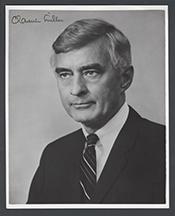
Historical · U.S. House · Ohio · District 10
Clarence Miller
Former U.S. Representative · Ohio District 10 · 1967–1993 · Republican
Clarence Miller represented Ohio's District 10 in the United States House of Representatives (1967–1993) for the Republican party. The page below collects sourced biographical facts, term history, committee roles, and provenance for Miller.
Bioguide ID: M000718
Key facts
- Full name
- Clarence Miller
- State
- Ohio
- District
- District 10
- Party
- Republican
- House service
- 1967–1993
- First House term
- 1967
- Status
- Left office
- Current term ends
- —
- Born
- 1917
- Bioguide ID
- M000718
- Committee assignments
- —
- Dataset version
- 1.20260605
Biographical narrative
806 words · sourced from the Wikipedia REST extract
Clarence E. Miller was a Republican politician who served as a U.S. Representative for Ohio's 10th congressional district from January 3, 1967, until January 3, 1993. Throughout his 13 terms in office, Miller was known for his fiscal conservatism and his commitment to reducing government spending. He was a prominent figure in southeastern Ohio, where he had previously served as mayor of Lancaster. His engineering background informed his approach to politics, emphasizing a methodical and detail-oriented style.
Early life and career
Clarence Ellsworth Miller, Jr. was born on November 1, 1917, in Lancaster, Ohio. He was one of six children in his family, raised in a household where his father worked as an electrician. After completing high school, Miller pursued further education through correspondence courses, ultimately becoming a certified electrical engineer. His professional career began with Columbia Gas, where he applied his engineering skills and contributed to the field by holding patents related to gas pumping technology.
Miller's technical expertise and innovative mindset were evident in his work, which included two notable U.S. patents. The first patent, issued in 1963, was for a remote control and alarm system designed for compressor stations and their engines. The second patent, granted in 1965, involved a magneto with an auxiliary pole piece. These inventions reflected his engineering acumen and commitment to improving operational efficiency in the energy sector.
Before entering Congress, Miller was actively involved in local politics. He served as the mayor of Lancaster, Ohio, where he gained valuable experience in governance and public service. His tenure as mayor likely shaped his understanding of the needs and concerns of his constituents, which he would later carry into his congressional career.
House tenure
Miller was elected to the U.S. House of Representatives in 1966, defeating the incumbent Democrat Walter H. Moeller. His election marked the beginning of a long and notable congressional career, during which he was re-elected to twelve successive terms. Miller's reputation as a fiscal conservative earned him the nickname "Five Percent Clarence," reflecting his goal of reducing spending bills by five percent. He was known for his dedication to his legislative duties, maintaining a near-perfect attendance record for votes, regardless of their significance.
Throughout his time in Congress, Miller focused on issues related to government spending and fiscal responsibility. His approach to politics was characterized by a preference for substance over publicity, as he often avoided the spotlight and media attention that many of his colleagues sought. This led to him being recognized by some as one of the more obscure members of Congress, a designation that was meant to highlight his commitment to legislative work over self-promotion.
Miller's electoral success was notable; he won twelve of his thirteen elections by significant margins, often exceeding 25 percent. His ability to connect with voters in southeastern Ohio contributed to his longevity in office. However, his political career faced challenges, particularly during the 1992 primary elections. Following a redistricting process that eliminated his district, Miller chose to run in a new district against fellow Republican Bob McEwen. The primary campaign became contentious, reflecting the competitive nature of Ohio politics.
Legislative focus and committees
During his tenure in the House, Clarence Miller served on the House Appropriations Committee, where he played a crucial role in shaping federal spending policies. His engineering background influenced his legislative priorities, as he approached fiscal matters with a precise and orderly mindset. Miller was particularly focused on reducing government expenditures, often introducing bills aimed at cutting spending measures. While many of these initiatives were not successful, he did achieve a significant victory in 1977 when he successfully persuaded his colleagues to reduce foreign aid by five percent.
Miller's legislative efforts were characterized by a commitment to conservative principles, including opposition to high taxes and government programs that he deemed excessive. He was known for his meticulous attention to detail, which was a hallmark of his engineering training. This analytical approach allowed him to scrutinize proposed legislation and advocate for fiscal restraint effectively.
Despite his focus on fiscal issues, Miller's legislative career was not without its challenges. The 1992 primary election against McEwen was marked by a heated rivalry, with both candidates exchanging sharp criticisms. Miller's decision to remain in the race, despite facing personal challenges, demonstrated his determination to continue serving his constituents. Ultimately, he lost the primary election, marking the end of his congressional career.
Clarence E. Miller's legacy is defined by his long service in the U.S. House of Representatives and his steadfast commitment to fiscal conservatism. His engineering background and methodical approach to politics set him apart from many of his contemporaries, allowing him to focus on substantive legislative work. After leaving Congress, Miller's contributions to public service and his impact on Ohio politics remained significant, reflecting a career dedicated to the principles he championed throughout his life.
Notable legislation
Sponsored and co-sponsored legislation for Clarence Miller is pending operator curation. The biographical narrative above carries the same provenance trail until per-bill rows are written.
Sources
- [1]https://en.wikipedia.org/wiki/Clarence_E._MillerWikipedia · retrieved 2026-06-05
Notable quotes
Sourced quotes for Clarence Miller are pending operator curation. Narrative-scope provenance remains attached below.
Sources
- [1]https://en.wikipedia.org/wiki/Clarence_E._MillerWikipedia · retrieved 2026-06-05
Key positions
Curated policy positions for Clarence Miller are pending operator review. The biographical narrative above carries the same provenance trail until per-topic positions are written.
Sources
- [1]https://en.wikipedia.org/wiki/Clarence_E._MillerWikipedia · retrieved 2026-06-05
Terms served
- 1967–1969U.S. House · Term 1 · Republican
- 1969–1971U.S. House · Term 2 · Republican
- 1971–1973U.S. House · Term 3 · Republican
- 1973–1975U.S. House · Term 4 · Republican
- 1975–1977U.S. House · Term 5 · Republican
- 1977–1979U.S. House · Term 6 · Republican
- 1979–1981U.S. House · Term 7 · Republican
- 1981–1983U.S. House · Term 8 · Republican
- 1983–1985U.S. House · Term 9 · Republican
- 1985–1987U.S. House · Term 10 · Republican
- 1987–1989U.S. House · Term 11 · Republican
- 1989–1991U.S. House · Term 12 · Republican
- 1991–1993U.S. House · Term 13 · Republican
Sources & provenance
Every attributable claim above carries a per-section [N] marker that resolves to the corresponding URL below. Each entry records the upstream provider, the canonical URL, and the timestamp at which the source was retrieved by the ingest pipeline.
Key facts
- https://bioguide.congress.gov/search/bio/M000718bioguide · retrieved 2026-06-05
- https://www.govtrack.us/congress/members/407700govtrack · retrieved 2026-06-05
Biographical narrative
- https://en.wikipedia.org/wiki/Clarence_E._Millerwikipedia · retrieved 2026-06-05
Find your representative
Every U.S. state elects representatives by district. Browse Ohio’s delegation, the full former-representative roster, or explore the role and term length.
Related on The Candidate
- Preceded by Walter MoellerEarlier holder of the Ohio District 10 House seat · Democratic.Open
- Succeeded by Martin HokeLater holder of the Ohio District 10 House seat · Republican.Open
- Aaron PerryFormer U.S. Representative · Ohio District 1 · RepublicanOpen
- Alexander DuncanFormer U.S. Representative · Ohio District 1 · DemocraticOpen
- Bellamy StorerFormer U.S. Representative · Ohio District 1 · WhigOpen
- Bellamy StorerFormer U.S. Representative · Ohio District 1 · RepublicanOpen