
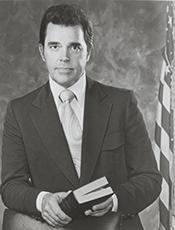
Historical · U.S. House · Ohio · District 18
Douglas Applegate
Former U.S. Representative · Ohio District 18 · 1977–1995 · Democratic
Douglas Applegate represented Ohio's District 18 in the United States House of Representatives (1977–1995) for the Democratic party. The page below collects sourced biographical facts, term history, committee roles, and provenance for Applegate.
Bioguide ID: A000214
Key facts
- Full name
- Douglas Applegate
- State
- Ohio
- District
- District 18
- Party
- Democratic
- House service
- 1977–1995
- First House term
- 1977
- Status
- Left office
- Current term ends
- —
- Born
- 1928
- Bioguide ID
- A000214
- Committee assignments
- —
- Dataset version
- 1.20260605
Biographical narrative
909 words · sourced from the Wikipedia REST extract
Douglas Applegate was an American politician who served as a U.S. Representative for Ohio's 18th congressional district from 1977 until 1995. A member of the Democratic Party, Applegate's political career spanned several decades, during which he held various positions in both state and federal government. His legislative efforts and political activities were marked by a mix of liberal and conservative ideologies, reflecting the diverse views of his constituents.
Early life and career
Douglas Earl Applegate was born on March 27, 1928, in Steubenville, Ohio. He was the son of Earl Applegate, who had a notable career in public service, serving as both the mayor of Steubenville and a member of the Ohio House of Representatives. Growing up in a politically active family, Applegate was influenced by his father's commitment to public service. He completed his education at Steubenville High School, graduating in 1947. Following high school, he pursued a career in real estate, becoming a licensed broker in 1956.
Applegate's political career began in the early 1960s when he was elected to the Ohio House of Representatives in the 1960 election. He ran alongside Michael Blischak in a multi-member district, successfully defeating the Republican nominees Ed Griffith and William G. Powell. In 1962, after the multi-member district was eliminated, Applegate faced Blischak in the Democratic primary and won, subsequently defeating Republican nominee Edward V. Miller in the general election. He continued to serve in the Ohio House until 1968, winning reelection in 1964 and 1966.
In 1968, Applegate sought a seat in the Ohio Senate, where he faced a competitive primary. He emerged victorious against several candidates, including former Senator Danny D. Johnson and former Representatives Joseph Loha and Stuart Henderson. In the general election, he defeated incumbent Republican Senator John Longsworth, marking a significant achievement as he was the only candidate in Ohio to unseat an incumbent state senator that year. Following a reapportionment of districts in 1972, Applegate's district was redrawn, and he successfully defeated Republican Senator Kenneth F. Berry in the general election.
During his time in the Ohio legislature, Applegate was actively involved in various committees and held leadership roles. He served on the House Democratic Policy Committee and was appointed to several committees, including those focused on Elections and Federal Relations, Health, and Reference in the House, and Commerce, Finance, Labor, and Ways and Means in the Senate. He was also appointed as the chair of the newly established Energy and Environment Committee in 1974.
House tenure
Applegate's tenure in the U.S. House of Representatives began in 1977 after he was selected to replace Wayne Hays as the Democratic nominee for Ohio's 18th congressional district. Hays had resigned, and Applegate was chosen to run in the special election. He served in the House until his retirement in 1995, completing a total of nine terms in office.
Throughout his congressional career, Applegate was a member of several important committees, including the Transportation, Public Works, and Veterans' Affairs committees. His involvement in these committees allowed him to influence legislation related to infrastructure, transportation, and veteran services, which were significant issues for his constituents.
In 1988, Applegate sought the Democratic presidential nomination as a favorite son candidate, aiming to secure delegates from his district. He won one delegate and cast his vote for Michael Dukakis at the Democratic National Convention. Additionally, he supported Senator John Glenn for the vice-presidential nomination, although this effort was ultimately unsuccessful.
Applegate's voting record reflected a blend of liberal and conservative positions, as evidenced by his ratings from various political organizations. The Americans for Democratic Action assigned him scores ranging from 5% to 80%, while the American Conservative Union rated him between 12.5% and 64.86%. This range illustrates his ability to navigate the complex political landscape of his district, which included a diverse electorate with varying priorities and beliefs.
Legislative focus and committees
During his time in the House of Representatives, Applegate focused on a range of legislative issues, particularly those that affected transportation, public works, and veterans' affairs. His work on the Transportation Committee allowed him to advocate for infrastructure improvements, which were essential for the development and maintenance of Ohio's transportation systems. He was involved in discussions and initiatives aimed at enhancing public transportation options and ensuring the safety and efficiency of roadways.
In addition to his work on transportation, Applegate was dedicated to addressing the needs of veterans. His role on the Veterans' Affairs Committee enabled him to support legislation that aimed to improve services and benefits for veterans, a demographic that often faces unique challenges after returning from military service. His commitment to these issues was reflective of his understanding of the importance of supporting those who have served the country.
Throughout his congressional career, Applegate maintained a focus on constituent services, ensuring that the needs and concerns of the residents of Ohio's 18th district were addressed. His ability to connect with constituents and understand their priorities contributed to his long tenure in office.
Douglas Applegate's political career came to an end when he chose not to seek reelection in 1994, with his final term concluding on January 3, 1995. After leaving Congress, he remained engaged in public life until his passing on August 7, 2021. His legacy includes a significant period of service in both the Ohio legislature and the U.S. House of Representatives, during which he navigated the complexities of American politics and contributed to the legislative process on behalf of his constituents.
Notable legislation
Sponsored and co-sponsored legislation for Douglas Applegate is pending operator curation. The biographical narrative above carries the same provenance trail until per-bill rows are written.
Sources
- [1]https://en.wikipedia.org/wiki/Douglas_ApplegateWikipedia · retrieved 2026-06-05
Notable quotes
Sourced quotes for Douglas Applegate are pending operator curation. Narrative-scope provenance remains attached below.
Sources
- [1]https://en.wikipedia.org/wiki/Douglas_ApplegateWikipedia · retrieved 2026-06-05
Key positions
Curated policy positions for Douglas Applegate are pending operator review. The biographical narrative above carries the same provenance trail until per-topic positions are written.
Sources
- [1]https://en.wikipedia.org/wiki/Douglas_ApplegateWikipedia · retrieved 2026-06-05
Terms served
- 1977–1979U.S. House · Term 1 · Democratic
- 1979–1981U.S. House · Term 2 · Democratic
- 1981–1983U.S. House · Term 3 · Democratic
- 1983–1985U.S. House · Term 4 · Democratic
- 1985–1987U.S. House · Term 5 · Democratic
- 1987–1989U.S. House · Term 6 · Democratic
- 1989–1991U.S. House · Term 7 · Democratic
- 1991–1993U.S. House · Term 8 · Democratic
- 1993–1995U.S. House · Term 9 · Democratic
Sources & provenance
Every attributable claim above carries a per-section [N] marker that resolves to the corresponding URL below. Each entry records the upstream provider, the canonical URL, and the timestamp at which the source was retrieved by the ingest pipeline.
Key facts
- https://bioguide.congress.gov/search/bio/A000214bioguide · retrieved 2026-06-05
- https://www.govtrack.us/congress/members/400906govtrack · retrieved 2026-06-05
Biographical narrative
- https://en.wikipedia.org/wiki/Douglas_Applegatewikipedia · retrieved 2026-06-05
Find your representative
Every U.S. state elects representatives by district. Browse Ohio’s delegation, the full former-representative roster, or explore the role and term length.
Related on The Candidate
- Preceded by Wayne HaysEarlier holder of the Ohio District 18 House seat · Democratic.Open
- Succeeded by Bob NeyLater holder of the Ohio District 18 House seat · Republican.Open
- Aaron PerryFormer U.S. Representative · Ohio District 1 · RepublicanOpen
- Alexander DuncanFormer U.S. Representative · Ohio District 1 · DemocraticOpen
- Bellamy StorerFormer U.S. Representative · Ohio District 1 · WhigOpen
- Bellamy StorerFormer U.S. Representative · Ohio District 1 · RepublicanOpen