
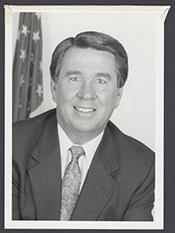
Historical · U.S. House · Oklahoma · District 3
Wes Watkins
Former U.S. Representative · Oklahoma District 3 · 1977–2003 · Republican
Wes Watkins represented Oklahoma's District 3 in the United States House of Representatives (1977–2003) for the Republican party. The page below collects sourced biographical facts, term history, committee roles, and provenance for Watkins.
Bioguide ID: W000194
Key facts
- Full name
- Wes Watkins
- State
- Oklahoma
- District
- District 3
- Party
- Republican
- House service
- 1977–2003
- First House term
- 1977
- Status
- Left office
- Current term ends
- —
- Born
- 1938
- Bioguide ID
- W000194
- Committee assignments
- —
- Dataset version
- 1.20260605
Biographical narrative
911 words · sourced from the Wikipedia REST extract
Wes Watkins was an American politician who served as a U.S. Representative for Oklahoma's 3rd congressional district. His political career spanned over three decades, during which he held office as a member of both the Democratic and Republican parties. Watkins's tenure in the House of Representatives lasted from 1977 until 2003, during which he was known for his involvement in budgetary and appropriations matters. He was born on December 15, 1938, in De Queen, Arkansas, and spent much of his early life in Oklahoma, where he later pursued higher education and began his political career.
Early life and career
Wes Watkins was born in De Queen, Arkansas, and grew up in Bryan County, Oklahoma. He attended Oklahoma State University, where he earned his undergraduate degree in 1960, followed by a Master’s degree in 1961. During his time at the university, he was actively involved in student governance, serving as president of both the student body and the student senate. After completing his education, Watkins briefly worked for the United States Department of Agriculture before returning to Oklahoma State University as an administrator from 1963 to 1966. During this period, he also served as a faculty advisor for the Tau Kappa Epsilon fraternity, where he was honored as an honorary member.
In addition to his academic and administrative roles, Watkins served in the Oklahoma National Guard from 1960 to 1967. His early career laid a foundation for his future in public service, showcasing his leadership abilities and commitment to community engagement.
House tenure
Watkins entered the political arena in 1974 when he was elected to the Oklahoma State Senate. His tenure in the state legislature set the stage for his subsequent election to the U.S. House of Representatives. In 1976, following the announcement of U.S. House Speaker Carl Albert's retirement, Watkins ran for the Democratic nomination to represent Oklahoma's 3rd congressional district. This district, located in the southeastern part of the state, was known for its strong Democratic leanings.
Despite facing a strong challenge from Charles Ward, Albert's former chief of staff, Watkins's local connections and understanding of the district's needs helped him secure victory in the Democratic primary runoff. He subsequently won the general election with a significant majority. Over the next 14 years, Watkins was re-elected multiple times, consistently receiving around 80% of the vote in subsequent elections. Throughout his initial congressional tenure, he served on key committees, including the Budget and Appropriations Committees, which allowed him to influence fiscal policy and federal spending.
Watkins's political career took a notable turn in the early 1990s. In 1990, he chose not to seek re-election to the House, instead running for the Democratic nomination for governor of Oklahoma. Despite raising substantial campaign funds and initially leading in the primary, he ultimately lost to David Walters. Discontent with the Democratic Party's direction led him to run as an independent candidate for governor in 1994, where he garnered a significant share of the vote but did not win.
In 1996, following the retirement of Republican Congressman Frank Brewster, Watkins made a comeback, this time as a Republican. The party leadership encouraged his candidacy, promising him a position on the influential Ways and Means Committee if he won. Watkins's voting record shifted notably during his second tenure in Congress, aligning more closely with conservative principles, as he voted with the Republican majority a significant majority of the time.
Watkins initially planned to retire after undergoing back surgery in 1998 but was persuaded to run for re-election, which he did successfully. He faced no major-party opposition in his final term in 2000. However, following the 2000 census, Oklahoma lost a congressional seat, leading to the redistricting of Watkins's constituency. The changes in district boundaries ultimately influenced his decision to retire from Congress in 2003, as he sought to avoid a situation where Republican incumbents would have to compete against one another.
Legislative focus and committees
During his time in the House of Representatives, Wes Watkins was primarily involved in budgetary and appropriations matters, reflecting his background in fiscal policy. His early tenure as a Democrat was characterized by a moderate voting record, but this shifted significantly during his later years as a Republican, where he consistently received high ratings from conservative organizations. Watkins's legislative focus included issues related to economic development, trade, and fiscal responsibility, which aligned with the priorities of his constituents.
Watkins's committee assignments played a crucial role in shaping his legislative influence. Serving on the Budget and Appropriations Committees allowed him to engage directly with federal spending decisions and budgetary allocations, which were critical issues for his district and the state of Oklahoma. His work on these committees positioned him as a key player in discussions surrounding federal funding for various programs and initiatives.
After leaving Congress, Watkins continued to engage with public policy and community issues. He took on a role as a senior legislative analyst at a lobbying and public relations firm, where he applied his extensive experience in government to influence policy discussions. Additionally, he founded the Matthew 24.40 Foundation, a non-profit organization focused on addressing issues related to economic development and global hunger.
Wes Watkins passed away on March 26, 2025, in Stillwater, Oklahoma, at the age of 86. His legacy includes a long career in public service, marked by significant contributions to his constituents and the state of Oklahoma, as well as a notable transition between political parties during a dynamic period in American politics.
Notable legislation
Sponsored and co-sponsored legislation for Wes Watkins is pending operator curation. The biographical narrative above carries the same provenance trail until per-bill rows are written.
Sources
- [1]https://en.wikipedia.org/wiki/Wes_WatkinsWikipedia · retrieved 2026-06-05
Notable quotes
Sourced quotes for Wes Watkins are pending operator curation. Narrative-scope provenance remains attached below.
Sources
- [1]https://en.wikipedia.org/wiki/Wes_WatkinsWikipedia · retrieved 2026-06-05
Key positions
Curated policy positions for Wes Watkins are pending operator review. The biographical narrative above carries the same provenance trail until per-topic positions are written.
Sources
- [1]https://en.wikipedia.org/wiki/Wes_WatkinsWikipedia · retrieved 2026-06-05
Terms served
- 1977–1979U.S. House · Term 1 · Democratic
- 1979–1981U.S. House · Term 2 · Democratic
- 1981–1983U.S. House · Term 3 · Democratic
- 1983–1985U.S. House · Term 4 · Democratic
- 1985–1987U.S. House · Term 5 · Democratic
- 1987–1989U.S. House · Term 6 · Democratic
- 1989–1991U.S. House · Term 7 · Democratic
- 1997–1999U.S. House · Term 8 · Republican
- 1999–2001U.S. House · Term 9 · Republican
- 2001–2003U.S. House · Term 10 · Republican
Sources & provenance
Every attributable claim above carries a per-section [N] marker that resolves to the corresponding URL below. Each entry records the upstream provider, the canonical URL, and the timestamp at which the source was retrieved by the ingest pipeline.
Key facts
- https://bioguide.congress.gov/search/bio/W000194bioguide · retrieved 2026-06-05
- https://www.govtrack.us/congress/members/400540govtrack · retrieved 2026-06-05
Biographical narrative
- https://en.wikipedia.org/wiki/Wes_Watkinswikipedia · retrieved 2026-06-05
Find your representative
Every U.S. state elects representatives by district. Browse Oklahoma’s delegation, the full former-representative roster, or explore the role and term length.
Related on The Candidate
- Preceded by Carl AlbertEarlier holder of the Oklahoma District 3 House seat · Democratic.Open
- Bird McGuireFormer U.S. Representative · Oklahoma District 1 · RepublicanOpen
- Charles O’ConnorFormer U.S. Representative · Oklahoma District 1 · RepublicanOpen
- Dixie GilmerFormer U.S. Representative · Oklahoma District 1 · DemocraticOpen
- Everette HowardFormer U.S. Representative · Oklahoma District 1 · DemocraticOpen
- Republican PartyFederal candidates and office holders on the Republican line.Open