
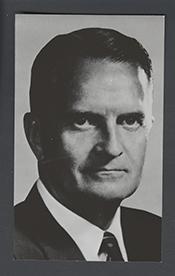
Historical · U.S. House · Oklahoma · District 5
John Jarman
Former U.S. Representative · Oklahoma District 5 · 1951–1977 · Republican
John Jarman represented Oklahoma's District 5 in the United States House of Representatives (1951–1977) for the Republican party. The page below collects sourced biographical facts, term history, committee roles, and provenance for Jarman.
Bioguide ID: J000057
Key facts
- Full name
- John Jarman
- State
- Oklahoma
- District
- District 5
- Party
- Republican
- House service
- 1951–1977
- First House term
- 1951
- Status
- Left office
- Current term ends
- —
- Born
- 1915
- Bioguide ID
- J000057
- Committee assignments
- —
- Dataset version
- 1.20260605
Biographical narrative
912 words · sourced from the Wikipedia REST extract
John Jarman was a prominent American politician who served as a U.S. Representative for Oklahoma's 5th congressional district from 1951 until 1977. A member of the Republican Party, Jarman's political career spanned 26 years, during which he was involved in significant legislative developments and witnessed the evolving political landscape of Oklahoma and the nation. His tenure in Congress was marked by a notable party switch and a commitment to various civil rights initiatives.
Early life and career
John Jarman was born on July 17, 1915, in Sallisaw, Oklahoma. He pursued higher education at Yale University, where he graduated in 1937. Following his undergraduate studies, he attended Harvard Law School, earning his law degree in 1941. Upon his admission to the bar that same year, Jarman began practicing law in Oklahoma City, establishing a foundation for his future political career.
In January 1942, shortly after the attack on Pearl Harbor, Jarman enlisted in the U.S. Army. He served in the Security Intelligence Corps during World War II, a role that involved gathering and analyzing intelligence to support military operations. His military service concluded in December 1945, after which he returned to Oklahoma City to continue his law practice.
Jarman's political career began at the state level, where he was elected to the Oklahoma House of Representatives. He later served in the Oklahoma State Senate, gaining valuable experience in legislative processes and governance. His transition to national politics occurred in 1950 when he was elected to the U.S. House of Representatives as a member of the Democratic Party. His election marked the beginning of a long and influential career in Congress.
House tenure
John Jarman's first term in the U.S. House of Representatives began in 1951, and he would go on to serve a total of 13 terms in office. Throughout his congressional career, Jarman was known for his ability to navigate the complexities of legislative politics. He was re-elected 11 times, often without facing significant opposition, despite the shifting political dynamics in Oklahoma City and the surrounding areas.
During the early years of his tenure, Jarman participated in various legislative initiatives, including those related to civil rights. He notably voted for the Civil Rights Act of 1960, the 24th Amendment to the U.S. Constitution, and the Voting Rights Act of 1965. His voting record indicated a commitment to civil rights, although he did not support several other significant civil rights measures, including the Civil Rights Acts of 1957, 1964, and 1968.
As the political landscape in Oklahoma began to shift in the 1970s, Jarman faced increased competition from Republican candidates. The local political environment had historically leaned Democratic, but by this time, Republicans were gaining ground. In 1974, Jarman faced a close challenge from Republican newcomer Mickey Edwards, who would later succeed him in Congress. This election was particularly notable as it occurred during a period when the Republican Party was experiencing backlash due to the Watergate scandal.
In a significant political move, Jarman switched parties on January 24, 1975, becoming a Republican. His decision was influenced by his discontent with the Democratic Caucus, which he believed had changed over the years. Jarman expressed concerns about the party's direction, particularly regarding the treatment of members who did not align with the more liberal elements within the caucus. He cited the removal of several committee chairmen as a catalyst for his party switch, indicating a desire to align himself with a party that he felt better represented his views.
Despite his party switch, Jarman did not seek re-election in 1976. His decision to retire marked the end of an era for his congressional career, and he left office on January 3, 1977. Following his departure from Congress, the 5th district seat was won by Mickey Edwards, who would maintain Republican control of the district for many years.
Legislative focus and committees
Throughout his time in the House of Representatives, John Jarman was involved in a variety of legislative issues and served on several committees. His early focus included civil rights, where he played a role in voting for key legislation aimed at advancing equality and protecting the voting rights of marginalized groups. His support for the Civil Rights Act of 1960 and the Voting Rights Act of 1965 demonstrated his engagement with the civil rights movement, even as he refrained from endorsing some of the more contentious civil rights measures of the 1960s.
In addition to civil rights, Jarman's legislative interests likely encompassed a range of issues pertinent to his constituents in Oklahoma. As a member of Congress, he would have had the opportunity to address local concerns, including economic development, education, and infrastructure. His legal background may have informed his approach to various legislative matters, allowing him to contribute effectively to discussions and decisions within the House.
Jarman's tenure in Congress coincided with significant national events and transformations, including the civil rights movement, the Vietnam War, and changing political affiliations among voters. His ability to adapt to these changes was evident in his party switch, reflecting a broader trend of realignment within American politics during the 1970s.
After leaving Congress, Jarman returned to his law practice in Oklahoma City, where he continued to engage with the community until his passing on January 15, 1982. His long career in public service and law left a lasting impact on the political landscape of Oklahoma, and his experiences reflected the complexities of American political life during a transformative period in the nation's history.
Notable legislation
Sponsored and co-sponsored legislation for John Jarman is pending operator curation. The biographical narrative above carries the same provenance trail until per-bill rows are written.
Sources
- [1]https://en.wikipedia.org/wiki/John_JarmanWikipedia · retrieved 2026-06-05
Notable quotes
Sourced quotes for John Jarman are pending operator curation. Narrative-scope provenance remains attached below.
Sources
- [1]https://en.wikipedia.org/wiki/John_JarmanWikipedia · retrieved 2026-06-05
Key positions
Curated policy positions for John Jarman are pending operator review. The biographical narrative above carries the same provenance trail until per-topic positions are written.
Sources
- [1]https://en.wikipedia.org/wiki/John_JarmanWikipedia · retrieved 2026-06-05
Terms served
- 1951–1953U.S. House · Term 1 · Democratic
- 1953–1955U.S. House · Term 2 · Democratic
- 1955–1957U.S. House · Term 3 · Democratic
- 1957–1959U.S. House · Term 4 · Democratic
- 1959–1961U.S. House · Term 5 · Democratic
- 1961–1963U.S. House · Term 6 · Democratic
- 1963–1965U.S. House · Term 7 · Democratic
- 1965–1967U.S. House · Term 8 · Democratic
- 1967–1969U.S. House · Term 9 · Democratic
- 1969–1971U.S. House · Term 10 · Democratic
- 1971–1973U.S. House · Term 11 · Democratic
- 1973–1975U.S. House · Term 12 · Democratic
- 1975–1977U.S. House · Term 13 · Republican
Sources & provenance
Every attributable claim above carries a per-section [N] marker that resolves to the corresponding URL below. Each entry records the upstream provider, the canonical URL, and the timestamp at which the source was retrieved by the ingest pipeline.
Key facts
- https://bioguide.congress.gov/search/bio/J000057bioguide · retrieved 2026-06-05
- https://www.govtrack.us/congress/members/405962govtrack · retrieved 2026-06-05
Biographical narrative
- https://en.wikipedia.org/wiki/John_Jarmanwikipedia · retrieved 2026-06-05
Find your representative
Every U.S. state elects representatives by district. Browse Oklahoma’s delegation, the full former-representative roster, or explore the role and term length.
Related on The Candidate
- Preceded by Gomer SmithEarlier holder of the Oklahoma District 5 House seat · Democratic.Open
- Succeeded by Mickey EdwardsLater holder of the Oklahoma District 5 House seat · Republican.Open
- Bird McGuireFormer U.S. Representative · Oklahoma District 1 · RepublicanOpen
- Charles O’ConnorFormer U.S. Representative · Oklahoma District 1 · RepublicanOpen
- Dixie GilmerFormer U.S. Representative · Oklahoma District 1 · DemocraticOpen
- Everette HowardFormer U.S. Representative · Oklahoma District 1 · DemocraticOpen