
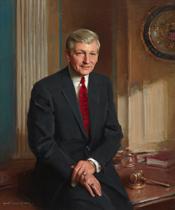
Historical · U.S. House · Pennsylvania · District 9
Bud Shuster
Former U.S. Representative · Pennsylvania District 9 · 1973–2001 · Republican
Bud Shuster represented Pennsylvania's District 9 in the United States House of Representatives (1973–2001) for the Republican party. The page below collects sourced biographical facts, term history, committee roles, and provenance for Shuster.
Bioguide ID: S000394
Key facts
- Full name
- Bud Shuster
- State
- Pennsylvania
- District
- District 9
- Party
- Republican
- House service
- 1973–2001
- First House term
- 1973
- Status
- Left office
- Current term ends
- —
- Born
- 1932
- Bioguide ID
- S000394
- Committee assignments
- —
- Dataset version
- 1.20260605
Biographical narrative
887 words · sourced from the Wikipedia REST extract
Elmer Greinert "Bud" Shuster was an American politician who served as a U.S. Representative for Pennsylvania's 9th congressional district from 1973 until 2001. A member of the Republican Party, Shuster was known for his significant contributions to transportation policy and infrastructure projects, including his advocacy for Interstate 99. Over his lengthy congressional career, he held various leadership positions and was involved in numerous legislative initiatives that shaped transportation funding and related issues.
Early life and career
Bud Shuster was born on January 23, 1932, in Glassport, Pennsylvania, a suburb of Pittsburgh. He was the son of Grace (née Greinert) and Prather Leroy Shuster. Shuster pursued higher education at the University of Pittsburgh, where he earned a Bachelor of Arts degree in 1954. During his time at the university, he became a member of the Sigma Chi fraternity. He continued his education at Duquesne University, obtaining a Master of Business Administration in 1960, followed by a Doctorate in Philosophy from American University in 1967.
Shuster's early career included service in the United States Army from 1954 to 1956. After his military service, he transitioned into the business sector, where he initially worked as a vice president at RCA. He later founded his own computer business, achieving considerable financial success. This business acumen and experience in the private sector would later inform his political career.
In 1972, Shuster made the decision to enter politics, motivated by a desire to represent his community. He ran in the Republican primary for Pennsylvania's 9th Congressional District, a seat previously held by five-term Republican J. Irving Whalley, who was retiring. Shuster won the primary against popular state senator D. Elmer Hawbaker, a significant achievement in a district that had historically leaned Republican. His victory in the general election was aided by the political climate of the time, as he was elected during President Nixon's re-election campaign.
House tenure
Shuster's congressional career began with his election to the House of Representatives in 1973. He quickly established himself as a loyal supporter of President Nixon, particularly during the Watergate scandal. Despite the growing controversy surrounding Nixon, Shuster remained steadfast in his support, even introducing a resolution to investigate the special prosecutor Archibald Cox, which ultimately did not advance in Congress.
Throughout his tenure, Shuster faced relatively little electoral opposition. His second term marked the only instance in which he received less than 60 percent of the vote. Notably, his most formidable challenger came in 1984 when actress Nancy Kulp, known for her role on "The Beverly Hillbillies," ran against him. Despite her celebrity status and support from Hollywood, Shuster won re-election decisively.
Shuster's congressional career spanned 15 terms, during which he was involved in various legislative initiatives and held significant leadership roles. He served as the chair of the U.S. House Committee on Transportation and Infrastructure from 1995 until the end of his tenure in 2001. In this capacity, he played a crucial role in shaping transportation policy and funding, advocating for the allocation of motor fuel and air travel taxes to their intended federal trust funds, despite opposition from both party leadership and the Clinton administration.
His leadership in transportation issues led to the funding of numerous infrastructure projects, including the establishment of Interstate 99, which was notably named the "Bud Shuster Highway" by Pennsylvania's Governor Robert Casey. Shuster's influence in Congress was characterized by his ability to navigate complex political landscapes, often taking on both party leaders and the executive branch to secure funding for critical transportation initiatives.
Legislative focus and committees
During his time in Congress, Bud Shuster's legislative focus primarily revolved around transportation and infrastructure. As chair of the Transportation and Infrastructure Committee, he was instrumental in advocating for federal funding for various transportation projects, ensuring that taxes collected from motor fuels and air travel were used for their intended purposes. His efforts in this area were significant, particularly during the 1990s when he successfully resisted attempts by party leaders and the Clinton administration to divert these funds for other uses.
Shuster's tenure was marked by his commitment to improving the nation's transportation infrastructure. He was known for his ability to secure funding for projects that benefited his constituents and the broader public. His work on the transportation authorization bill, often humorously referred to by colleagues as the "Bud E. Shuster Transportation for All Eternity Act," highlighted his influence in securing funding for numerous projects, which critics sometimes labeled as "pork barrel" spending.
In addition to his role as chair of the Transportation and Infrastructure Committee, Shuster served as the Ranking Member of the House Intelligence Committee, where he contributed to discussions on national security and intelligence matters. His diverse committee assignments allowed him to engage with a wide range of issues, although transportation remained his primary focus throughout his career.
Shuster's legislative legacy is closely tied to his advocacy for infrastructure development and his efforts to ensure that federal funds were allocated appropriately. His work in Congress left a lasting impact on transportation policy, and his initiatives continue to influence discussions on infrastructure funding and development in the United States. After serving for nearly three decades, Shuster concluded his congressional career on February 5, 2001, leaving behind a complex legacy shaped by his dedication to transportation issues and his ability to navigate the intricacies of congressional politics.
Notable legislation
Sponsored and co-sponsored legislation for Bud Shuster is pending operator curation. The biographical narrative above carries the same provenance trail until per-bill rows are written.
Sources
- [1]https://en.wikipedia.org/wiki/Bud_ShusterWikipedia · retrieved 2026-06-05
Notable quotes
Sourced quotes for Bud Shuster are pending operator curation. Narrative-scope provenance remains attached below.
Sources
- [1]https://en.wikipedia.org/wiki/Bud_ShusterWikipedia · retrieved 2026-06-05
Key positions
Curated policy positions for Bud Shuster are pending operator review. The biographical narrative above carries the same provenance trail until per-topic positions are written.
Sources
- [1]https://en.wikipedia.org/wiki/Bud_ShusterWikipedia · retrieved 2026-06-05
Terms served
- 1973–1975U.S. House · Term 1 · Republican
- 1975–1977U.S. House · Term 2 · Republican
- 1977–1979U.S. House · Term 3 · Republican
- 1979–1981U.S. House · Term 4 · Republican
- 1981–1983U.S. House · Term 5 · Republican
- 1983–1985U.S. House · Term 6 · Republican
- 1985–1987U.S. House · Term 7 · Republican
- 1987–1989U.S. House · Term 8 · Republican
- 1989–1991U.S. House · Term 9 · Republican
- 1991–1993U.S. House · Term 10 · Republican
- 1993–1995U.S. House · Term 11 · Republican
- 1995–1997U.S. House · Term 12 · Republican
- 1997–1999U.S. House · Term 13 · Republican
- 1999–2001U.S. House · Term 14 · Republican
- 2001–2001U.S. House · Term 15 · Republican
Sources & provenance
Every attributable claim above carries a per-section [N] marker that resolves to the corresponding URL below. Each entry records the upstream provider, the canonical URL, and the timestamp at which the source was retrieved by the ingest pipeline.
Key facts
- https://bioguide.congress.gov/search/bio/S000394bioguide · retrieved 2026-06-05
- https://www.govtrack.us/congress/members/400374govtrack · retrieved 2026-06-05
Biographical narrative
- https://en.wikipedia.org/wiki/Bud_Shusterwikipedia · retrieved 2026-06-05
Find your representative
Every U.S. state elects representatives by district. Browse Pennsylvania’s delegation, the full former-representative roster, or explore the role and term length.
Related on The Candidate
- Preceded by George WatkinsEarlier holder of the Pennsylvania District 9 House seat · Republican.Open
- Succeeded by Bill ShusterLater holder of the Pennsylvania District 9 House seat · Republican.Open
- Adam SeybertFormer U.S. Representative · Pennsylvania District 1 · RepublicanOpen
- Benjamin SayFormer U.S. Representative · Pennsylvania District 1 · RepublicanOpen
- Chapman FreemanFormer U.S. Representative · Pennsylvania District 1 · RepublicanOpen
- Harry RansleyFormer U.S. Representative · Pennsylvania District 1 · RepublicanOpen